I experienced a performance, but it was more than a performance. It was a gentle slide into the echoes of a genocide.
I went to Hewa Rwanda: Letter to the absent, because I wanted to see something about the real world that wasn’t necessarily dance. A brief entry in BAM’s Next Wave Festival, Hewa Rwanda was created and performed by writer/actor/director Dorcy Rugamba, who had been away from home in Kigali on the first day of the Rwandan genocide. This was a supremely subtle performance, a steadily deepening monolog, delivered by Rugamba as he stood center stage at a lectern. He opened with this:
“My family disappeared in a single day. It only took three quarters of an hour. It was the 7th of April, 1994, at 10 in the morning.”
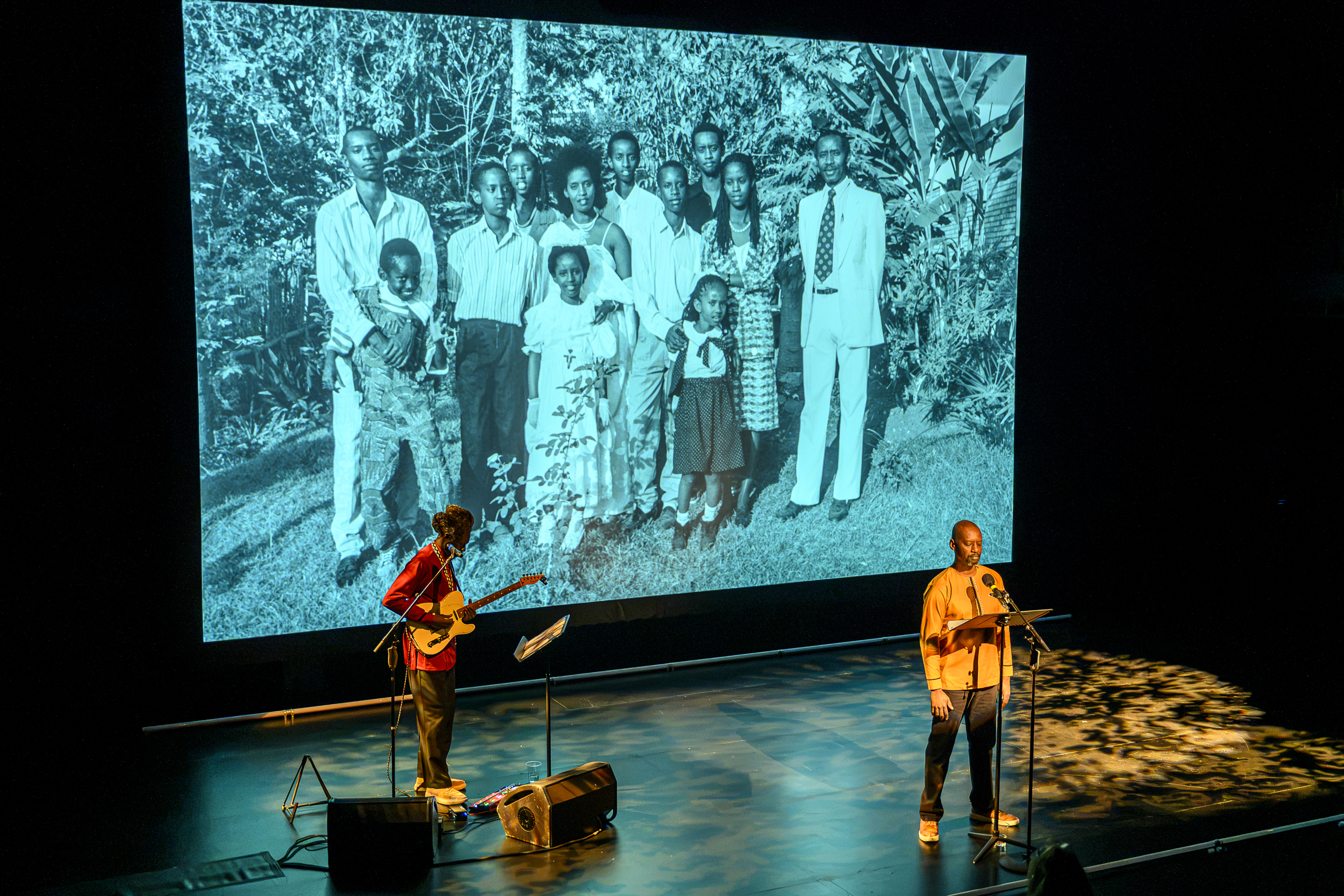
Dorcy Rugamba at right, Majnun at left. In projected photo: The Rugamba family in 1992. Dorcy is the tall man at left. All photos by Edwina Hay.
Projected behind him was a wall-sized, black-and-white photograph of his family, all dressed up for his sister Curdyna’s first communion, only two years before the calamity. To his right was the Senegalese musician Majnun with his guitar. As Rugamba writes in the program notes, “Telling a story with music is one of the oldest forms of theater, found in every culture.” Every ten or fifteen minutes, Rugamba paused and Majnun sang a beautiful song.
Rugamba’s delivery was straightforward, with a hint of sadness in his eyes, but not at all sentimental. While I hung on his words, I was also entranced by the almost ceremonial movement of his upper body. As he slowly placed each new page of the script before him, he used both hands, engaging his whole torso symmetrically. The only time he left center stage was to walk a few steps to his right and stand, back to audience, to look at his family. His focus drew our focus to the picture, gazing at each family member who had been shot to death in those forty-five minutes.
Rugamba was trained by his father, Cyprien Rugamba, a leading figure in arts and culture of Rwanda. The younger Rugamba founded the Rwanda Arts Initiative and the Kigali Triennal, where he first performed this work. The text is excerpted from his book of the same title, published in French in 2024.
In the script he describes a land of ripe fruit, colorful plants, birds chirping along the Nile—and a tradition of violence. It starts in the schools. As students, they tolerated getting beaten only by imagining the revenge of growing older and having their turn to beat younger children.
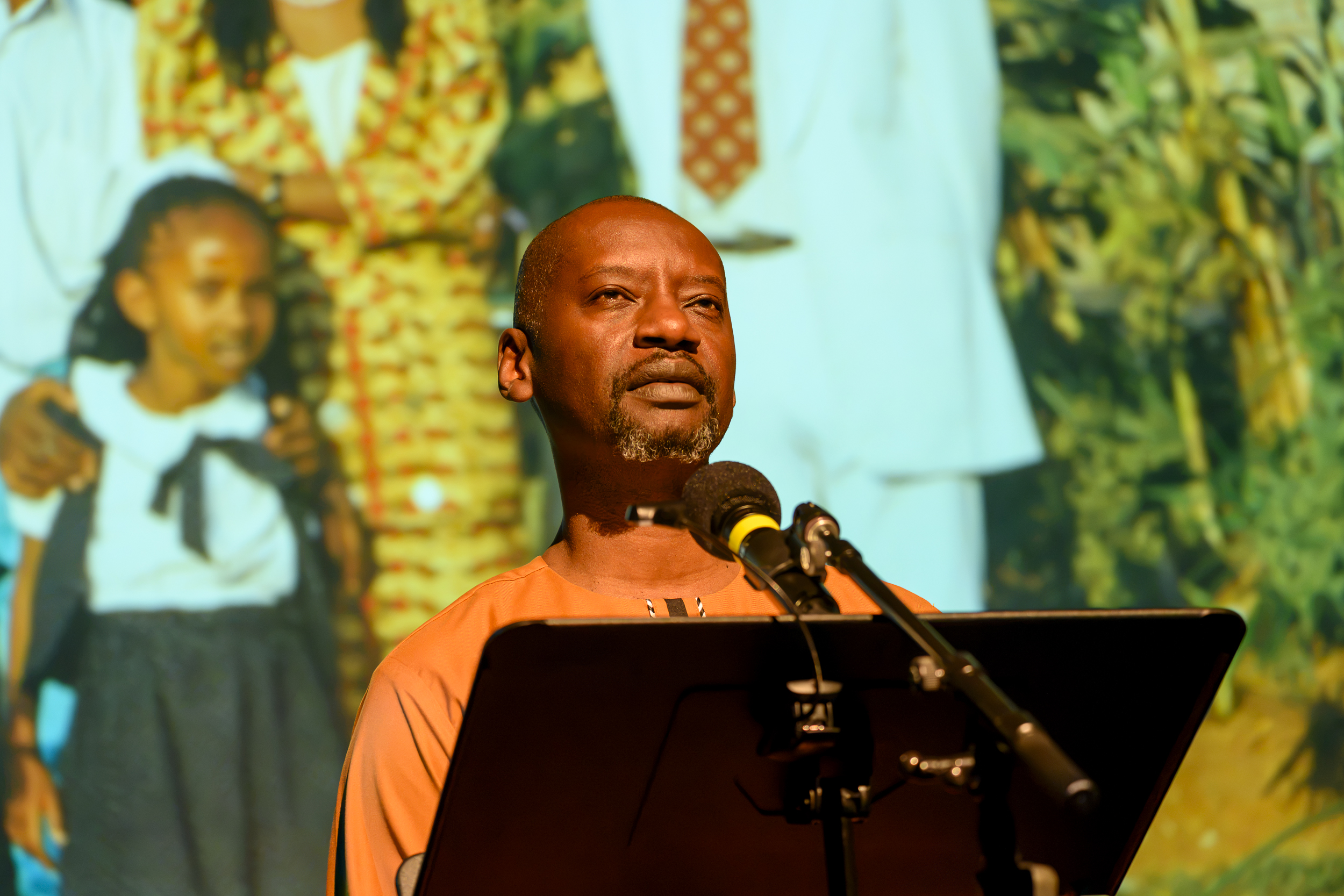
Mugamba
Rugamba’s admiration for his father and love for his mother knew no bounds. But he had gone out on his own, converting from Christianity to Islam, not realizing how this had cut to the quick of his mother’s soul. After talking with his father, he decided to renounce Islam to appease her, for it gave him great pain to cross her. And the next morning, before he could tell his parents his decision, the genocide wiped away everything he knew and loved. Knowing the massacres would spread, he fled the country.
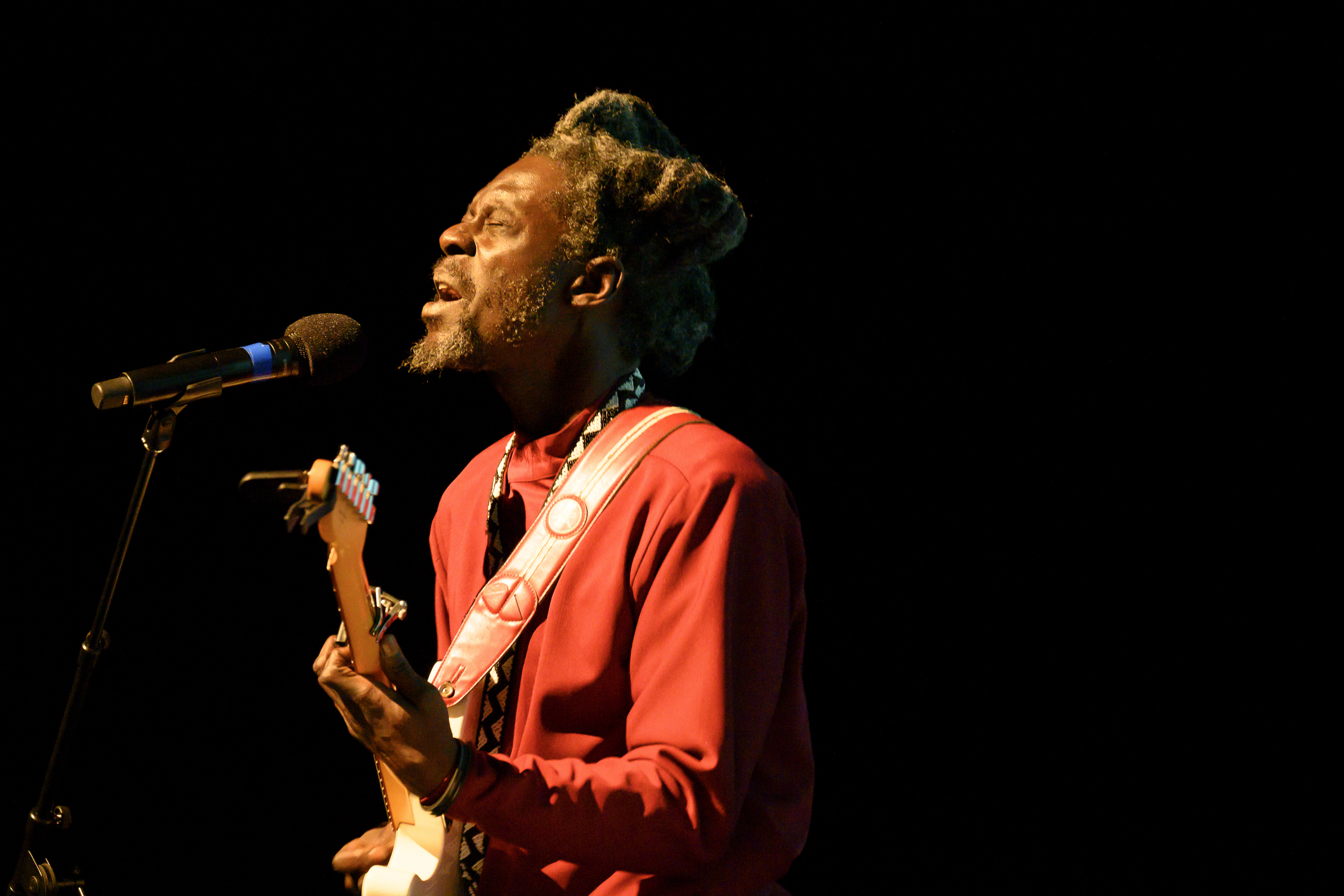
Majnun
Toward the end of the performance, he names all his relatives who were murdered, lingering on their long mellifluous names. He doesn’t shed a tear. There was no naming or blaming of those who perpetrated this massive violence, wherein almost a million people were killed within three months.[1] At first, he felt no sadness or suffering, only hatred—and a wish for vengeance. Where does all that rage go? Rugamba speaks of “Blows of such violence that they can…[open] a breach in you so large that all the misery of the world rushes in.”
Eventually Rugamba married and had two children. And then, in the dark month of April, a third child was born. As he glows about this child, he begins swaying and lilting to Majnun’s music. “He is the fruit of a passionate love, a love that banished sorrow from your home and made spring bloom again.” After the long dark days and years, there’s birth, rebirth, and he cannot contain his joy.
Needless to say, Hewa Rwanda was profoundly moving. What I had known only as a remote, incomprehensible news item in 1994 expanded into a monstrous cruelty, into which I was given a tiny glimpse. Through Rugamba, I could feel the beautiful landscape, the vividness of his family members, and the possibility for love and art to set a new path.
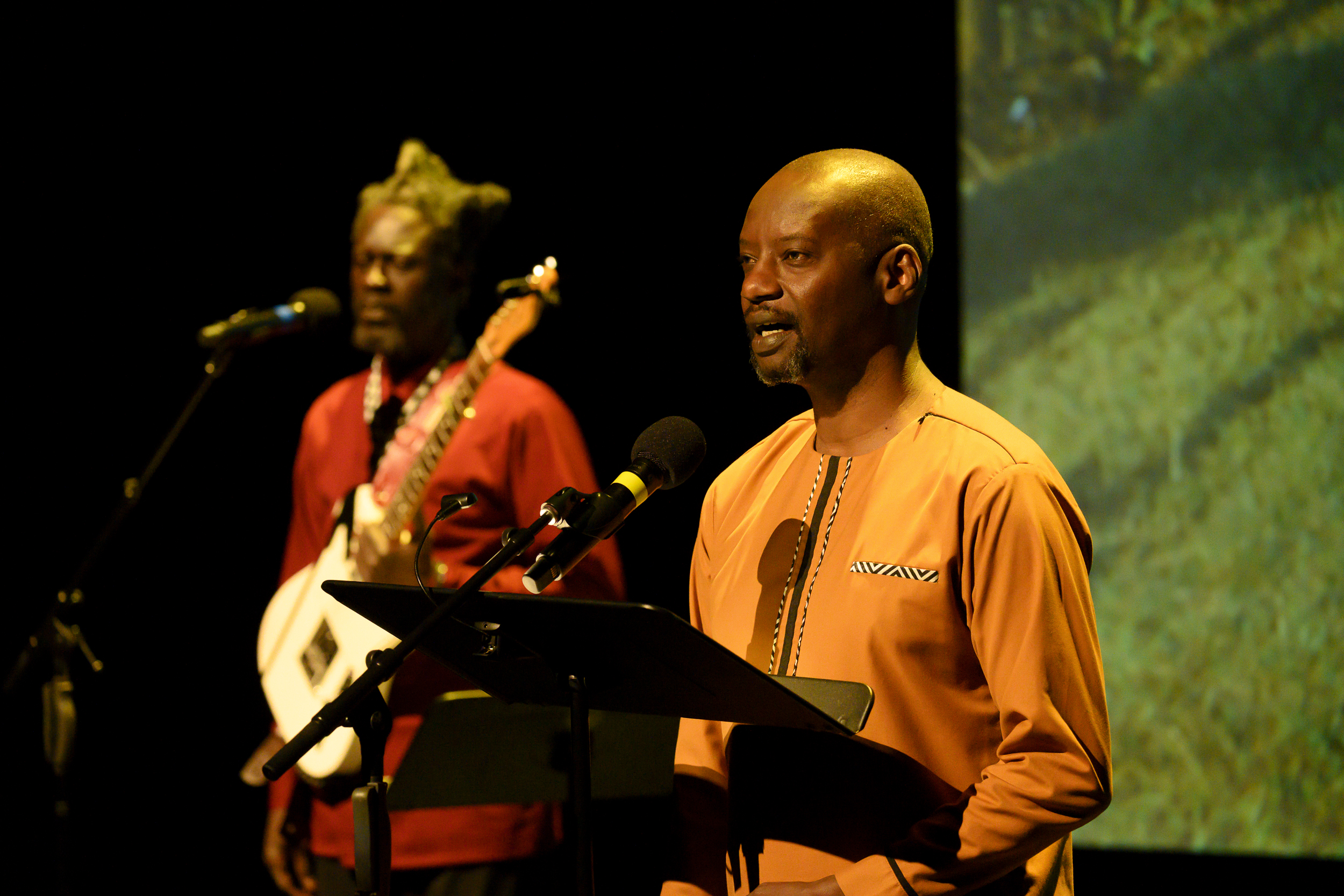
Majnun and Rugamba
Note: Because my hearing is less than 100 per cent, I missed a lot of the text during the performance. So I asked producer Ellen Dennis to see the script, and she referred me to Judy Dennis, who had worked with Rugamba on the English version. Reading it has been a revelation, and I look forward to the English translation of Rugamba’s book, Hewa Rwanda.
[1] According to The New York Times, the 1994 Rwandan genocide was perpetrated by Hutu-dominated government forces, extremist Hutu militias, and hundreds of thousands of Hutu civilians who targeted the ethnic Tutsi minority and moderate Hutus.
Featured Uncategorized Leave a comment
Leave a Reply