When Aaron Mattocks, producer of the Fisher Center at Bard College, asked me to write the program essay for Lucinda Childs at Bard this summer, I was delighted. I had seen some of the works but was especially intrigued with the Geranium redo. I wrote this for the SummerScape 2026, Fisher Center program brochure, which, alas, was published only digitally. I wanted to make it more visible because, even though the program, titled Momentary Reprise, is now in the past, I think my essay contributes to a greater understanding of Lucinda’s work over time.
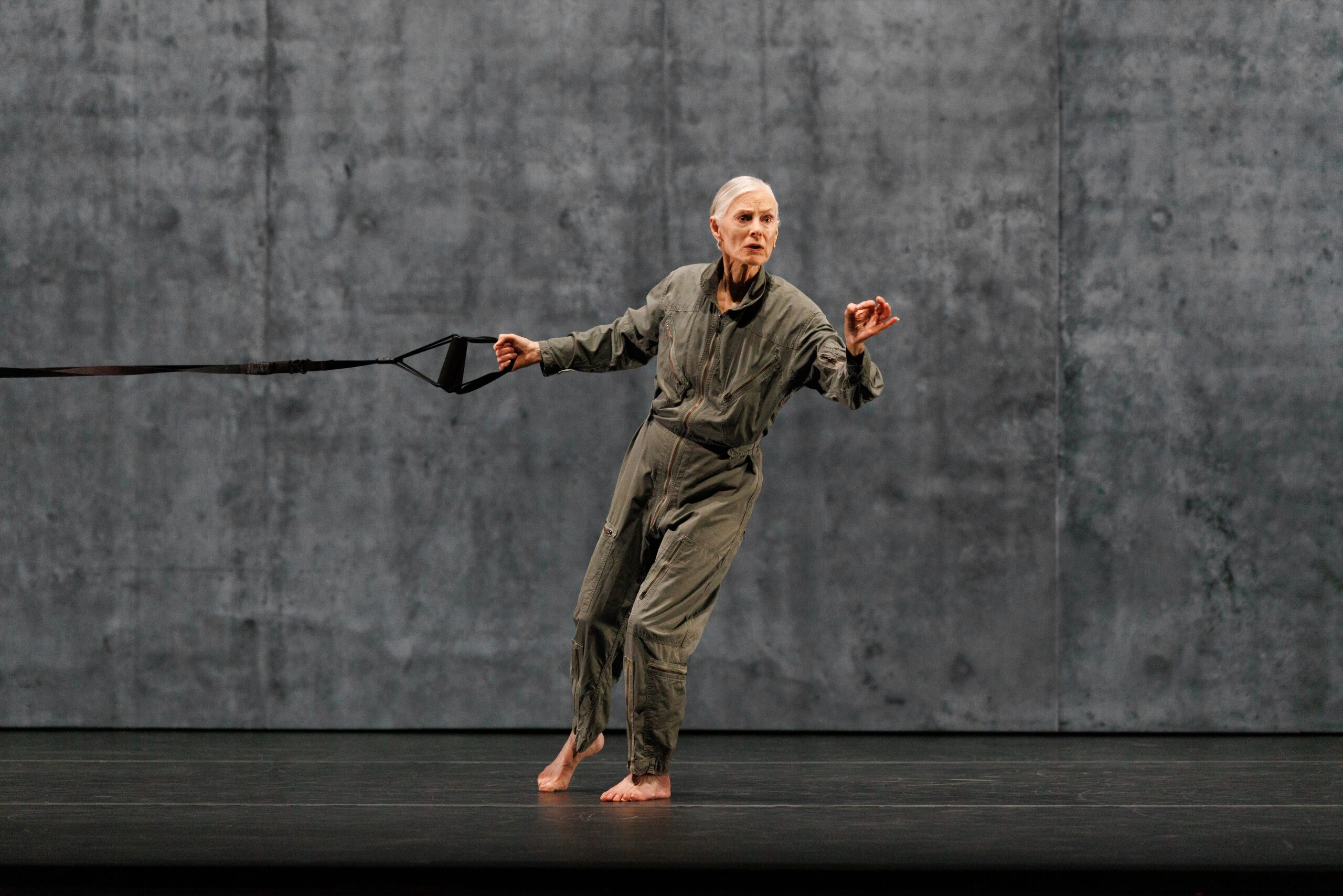
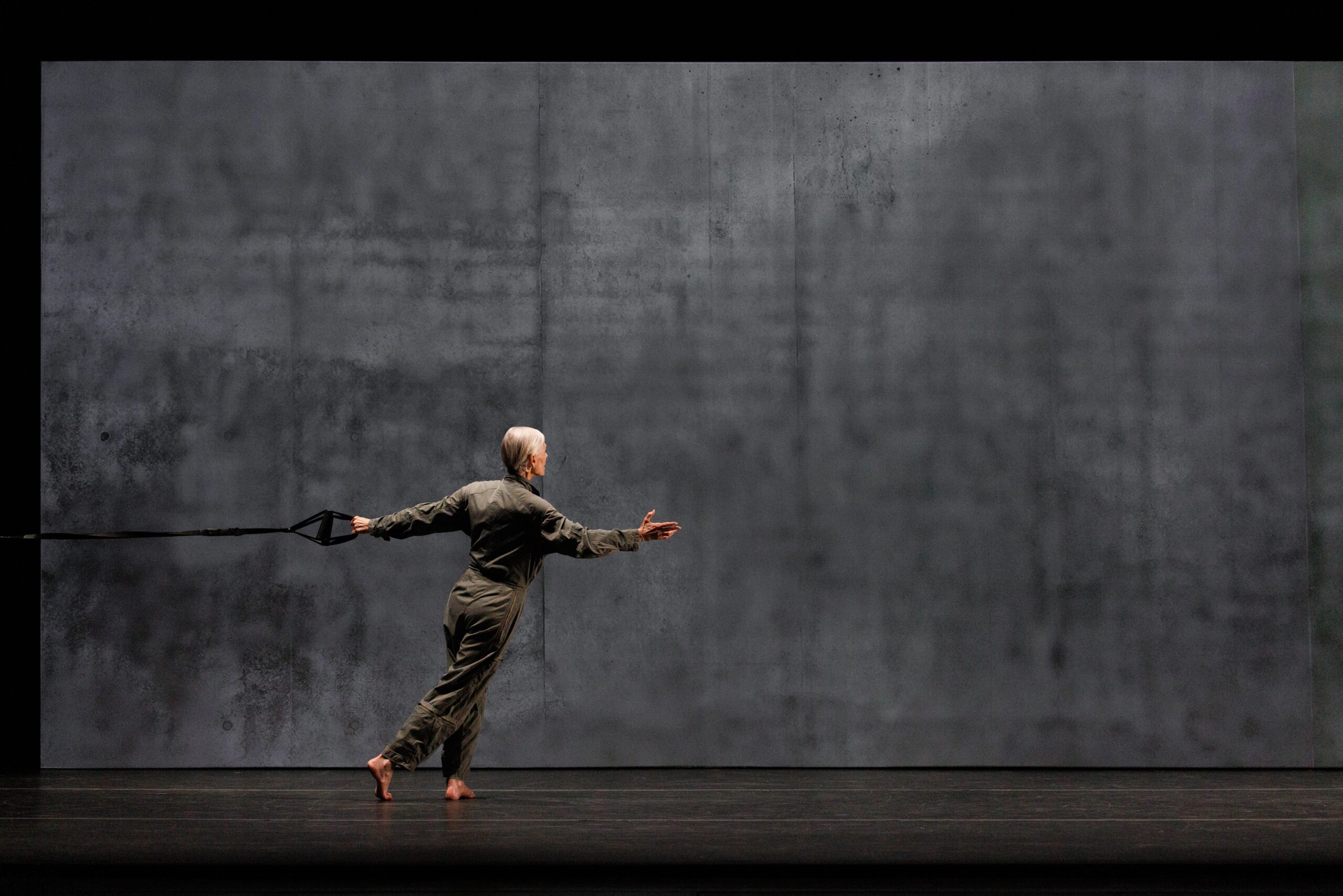
Lucinda Childs in Geranium ’64, photos by Maria Baranova
In Lucinda Childs’ re-envisioning of her 1965 solo Geranium, she is pulling on a rope in front of a wall whose textures and texts keep changing. As she makes her way across the stage, it’s like she’s floating through memories. The slate blue wall, designed by Albanian media artist Anri Sala, is as thick as concrete, but vapor seems to be drifting within it. Eventually, footage of football players emerges within the mist, and a broadcaster’s voice from the actual 1964 NFL Championship Game between the Baltimore Colts and the Cleveland Browns rises and falls with the cheers of the crowds.
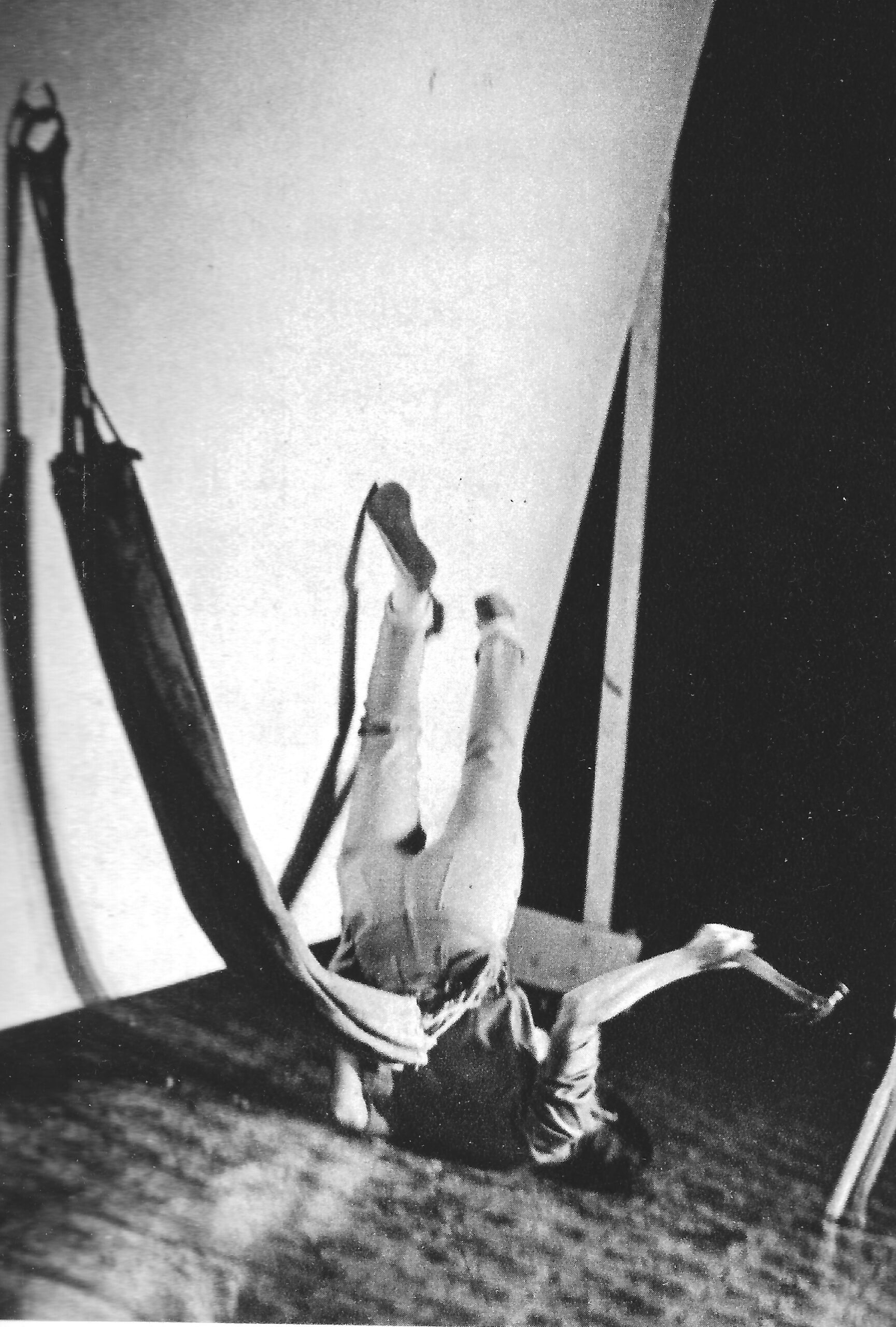
The original Geranlum (1965), photo Peter Moore
The only elements from her original wacky solo Geranium are the rope, the audio broadcast, and a wall. What attracted her to the recording in the first place, she said in a phone interview, was that it “had so many beautifully detailed comments about how the players fell, or banged, or toppled.” An embedded chance element (shades of John Cage’s influence) is that her voice triggers certain shapes on the wall.
In some way, this new solo, Geranium ’64, is a slow-mo echo of her famous solo in Einstein on the Beach (1976), where she slipped from one character to another with hallucinogenic speed, all while staying on a single diagonal path. At another point in Einstein, her voice is heard—clear, crisp diction with an ironic flair. This voice returns briefly in Geranium ’64; it’s the same voice that she used back in 1964 in her Street Dance, reprised recently in the SoHo studio where she used to live. Her recorded voice in the studio instructed the audience to go to the window and observe her actions in the street, where she pointed out various storefronts on the block. The gestures of her white-gloved hands three floors below, illustrating her vocal narrative in the studio, far below us, created a witty humor of displacement. In some sense, that dance, which came out of an assignment by Cage disciple Robert Dunn to make a six-minute dance, was the beginning of her explorations in scale and disorientation. Here, in Geranium ‘64, the disorientation morphs into a mesmerizing meditation on time and memory.
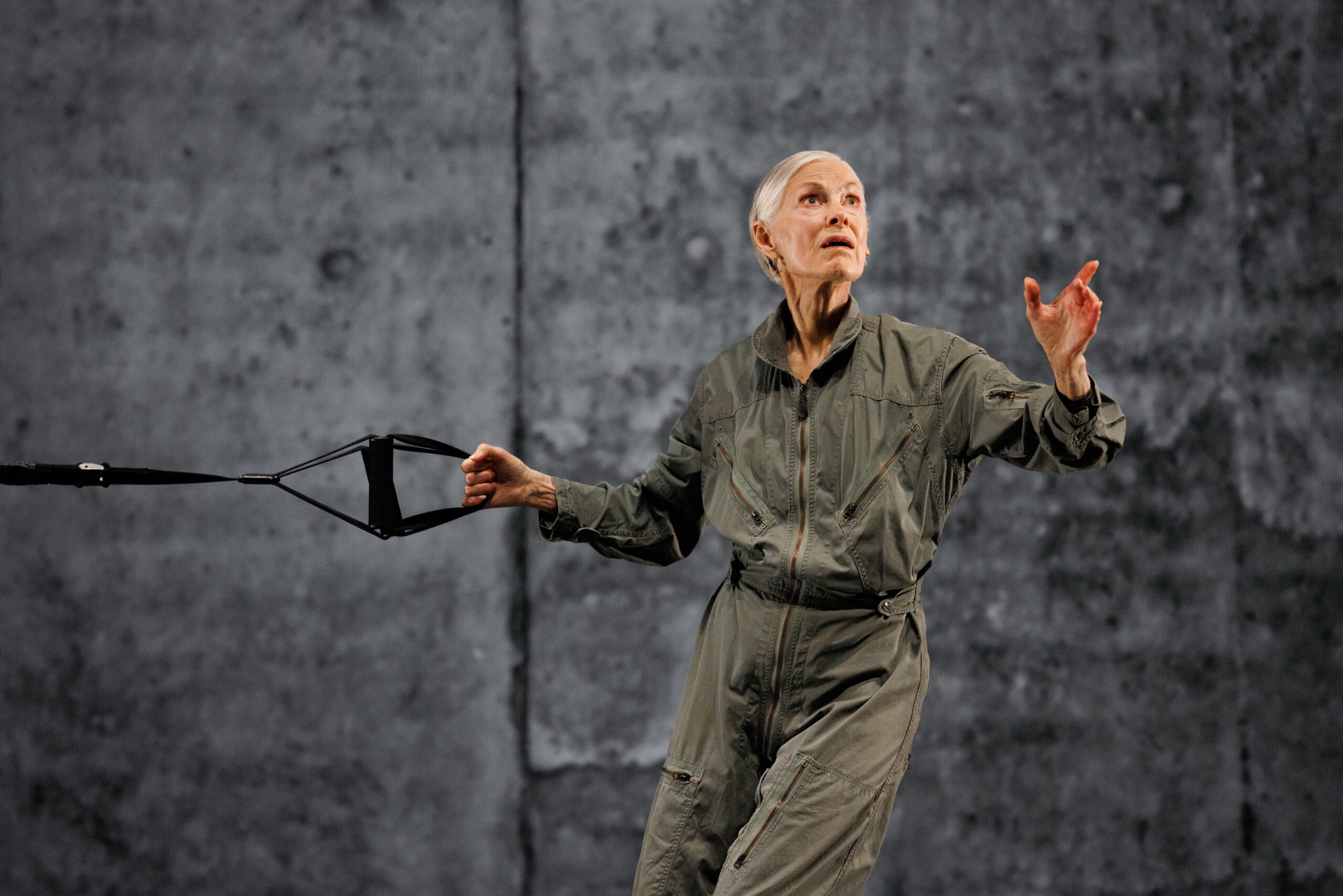
Geranium ’64
Also on the program will be four other works. The first, Actus, started as a solo for a member of Lyon Opera Ballet. It highlights the long lines of a ballet dancer, here performed by two from the Lucinda Childs Dance Company. The music is Bach; the spatial use is spare; the aura is simple and serene. This duet, which is accompanied by Russian pianist Anton Batagov playing live, sets the stage for the theme of doubling.
The eight-person Field Dance 2, from the 1984 revival of Einstein on the Beach, is a tribute to experimental theater director Robert Wilson, who died last year. Childs admired what she called, in an article in The Guardian, his “unique way of thinking.” When she first worked with Wilson, he relied on an improvisational process. What she came up with—the aforementioned diagonal—was a feat of shapeshifting of various characters. Her group dances, however, are pattern-based rather than exploratory.
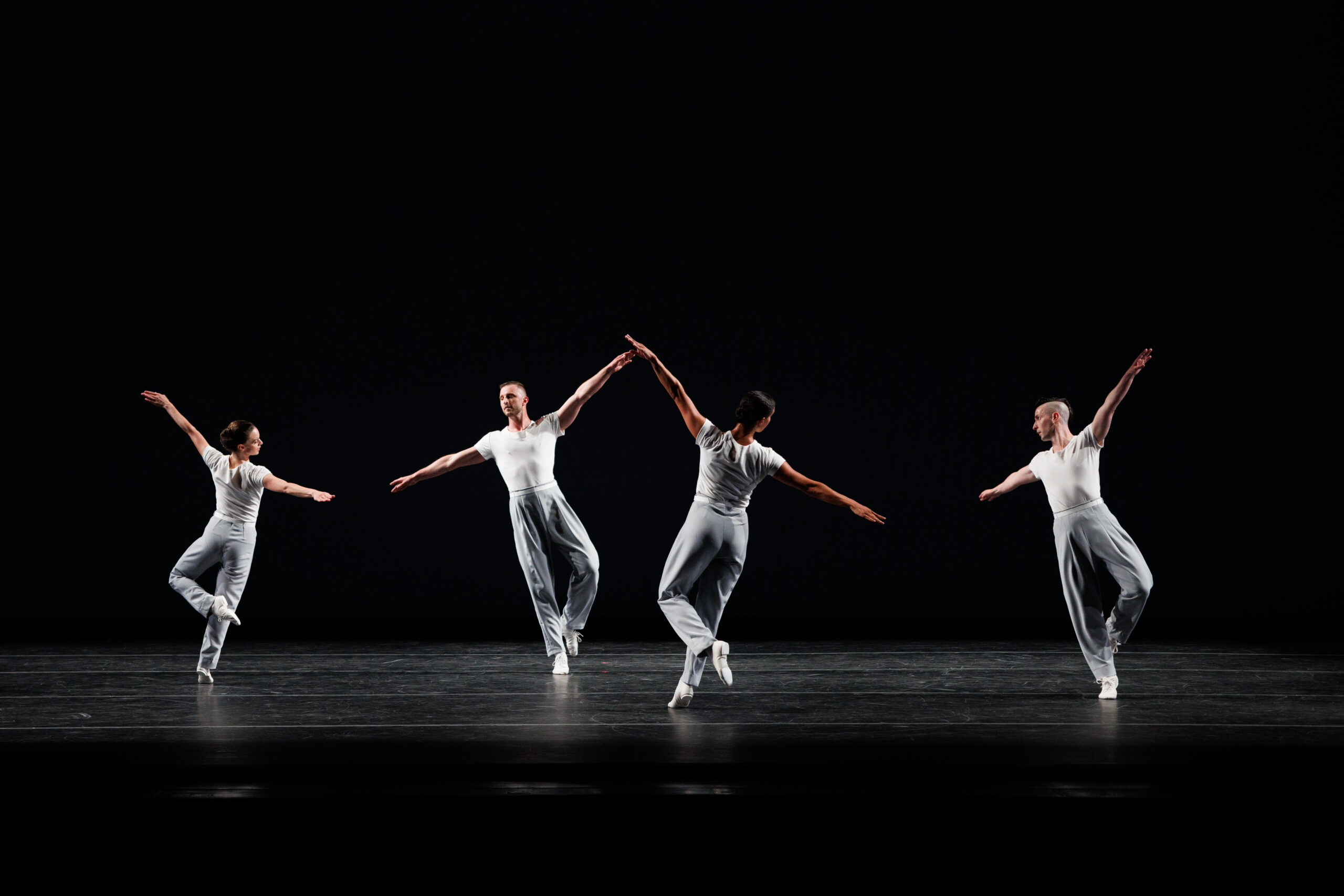
L–R: Sharon Milanese, Lonnie Poupard Jr., Sarah Hillmon, Robert Mark Burke in Field Dance 2.
Einstein was a precursor to Dance, the 1979 collaboration with Glass that had its own kind of doubling when their visual collaborator, Sol LeWitt, decided that instead of a backdrop, he would make a film of her dancers, so each performer’s actions were echoed on screen. Caitlin Scranton, who has danced with Childs for seventeen years, explained that the challenges of performing her work involve complex rhythms, quick changes of direction, an abundant amount of jumping, and a momentum that demands efficient transitions. “But the most difficult thing,” she said, “is just being present, being able to hold the patterns and the structure—not too tightly—as you adapt constantly to what goes on around you.”
The second section of Available Light, Childs’ 1983 collaboration with architect Frank Gehry, will be presented as a tribute to Gehry, who—of course—designed Bard’s remarkable Fisher Center. It was not possible to replicate the stunning two-tiered set, but it will be danced to the same music by John Adams. Meg Harper, who was in the original Available Light, remembers, “We were all connected to each other, and it felt like electricity moving between us as we kept changing directions. The stillness was totally vibrant.” The current edition, with ten dancers, retains the original color scheme of white, black, and red.
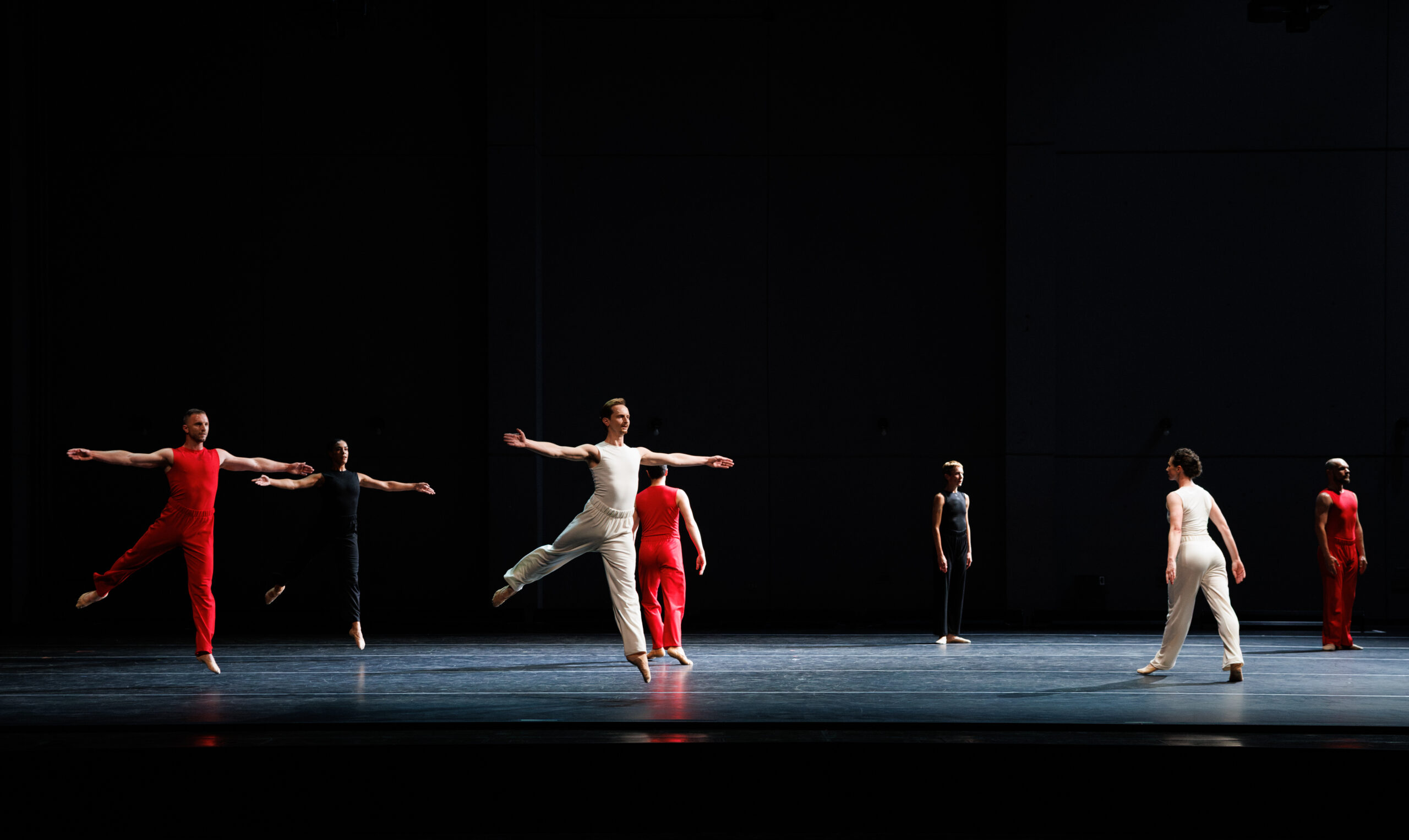
Childs’ Available Light (1983) photo Maria Baranova
The latest group piece, Distant Figure, also has music by Glass, played live by Batagov. Staying within her minimal palette, six dancers build gradually from slow to brisk in tempo, from gentle to forceful in manner, always shifting in congruences of twos and threes. The math alone demands intense focus for both dancers and watchers.
What all these works have in common is meticulous precision. Asked why that element is essential to her, Childs said, “The only way for it to hang together is to be clear about the dancers’ relationship to each other, to the space, and to the music.” The choreographer knows that the counts, reversals, and changes of direction can be diabolical for the dancers. “It’s very, very tricky, because if something goes wrong, the whole thing can fall apart.”
For longtime Lucinda watchers, there’s a striking difference between the delightful absurdism of her early works like Geranium, Carnation, and Street Dance—all from 1964—and the current works that rely on pattern, momentum, and precision. I asked Scranton what she sees as the connecting tissue. “I think there’s something about the simplicity and pedestrian quality of both of these things. It’s like using the most basic props for the most basic physical movement— walking, let’s say—and seeing all the possibilities. It’s like one small theme that she explodes into all these different opportunities. So it’s not just a sponge; you see what she does with the sponge. [In Carnation, she stuffed a pile of eight sponges into her mouth and fanned them out to be a spectacular rainbow duckbill.] It’s not just walking down the street; it’s an extremely intricate pattern. That one small rule or concept has so many different options and themes. I think that exploring that one simple thing to the Nth degree is what she’s interested in.”
During the ’60s and ’70s, Childs was often the target of negative reviews. Harper was in awe of her courage. “She kept going. She had an enormously strong vision of what she wanted to do. And she’s brilliant….Seeing her courage—it still knocks me out. When you have an artist who has such a strong vision and the unquenchable desire to get it out there, nothing can stop them.”
Returning to Bard has a special meaning for Childs and the dancers. Their engagement at Bard in 2009, when the transcendent Dance was remounted, sparked a flurry of interest in Childs’ work, triggering a busy period of international touring. As Scranton said, “That one opportunity, that remounting of Dance, completely changed the trajectory of our lives.”
In recent years, Childs has received much acclaim, including a Dance Magazine Award, the Golden Lion award from the Venice Biennale, and the Samuel H. Scripps Lifetime Achievement Award from the American Dance Festival. For Childs, this season at Bard is a way to look at where she’s been and where she’s going, to express her curiosity, and to pay tribute to artists she has collaborated with. For the rest of us, it’s a time to cherish one of our extraordinary postmodern mavericks.
Featured Leave a comment
Leave a Reply