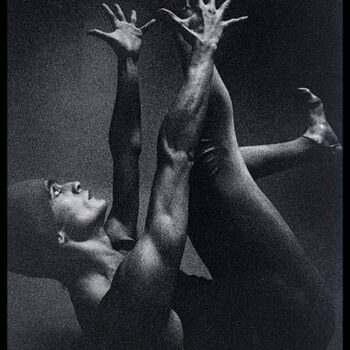
In the 1960s, Paul Sanasardo’s technique classes were the most rigorous modern dance classes in New York City. Many people in his advanced class became notable dance artists. The lead male dancer of Sanasardo’s company, Manuel Alum, was outstanding in that class. Graced with physical beauty as well as a strong sense discipline, he performed, whether in class or onstage, with a piercing intensity. When I saw a concert of his, I was blown away by his portrayal in The Cellar (1967): gripping, extreme, courageous. His authenticity and craft continued throughout his oeuvre of more than fifty works. Like many men in the dance community, tragically, he died of AIDS in the prime of life.
“I listen to Mozart always as more like being in a mountain…There’s a spirituality that a mountain has, the spiral ascending. I’ve always been attracted to that.” —Manuel Alum
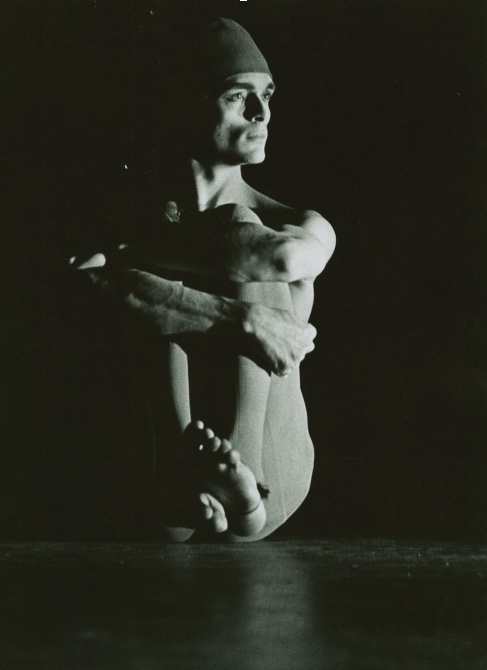
Cellar, ph Milton Oleaga, JErome Robbins Dance Division, NYPL
Manuel Alum was a dancer of uncommon gifts. Whether expanding into space with grandeur, or responding to an internal voice, he was a compelling figure onstage. Dance artist Margaret Beals recalled his “dark, soulful eyes and a body of liquid steel.”[1] Scholar and former Sanasardo dancer Mark Franko described him as a “riveting soloist whose intensity had a cool, almost schizoid detachment.”[2] New York critic Zita Allen wrote that “he pounces on movement with a falcon’s precision.”[3]
Alum was also a singular choreographer, creating mystical solos and swirling group pieces that mixed classical ballet and space-sculpting modern dance. He was not in the vanguard at the time, but he dug deep into the human psyche, and his rawness made for vivid dances. Chicago critic Linda Winer wrote of his mind/body integration that he was one of those “rare souls whose conceptual and technical wizardry are backed by a sympathetic kind of brain. Whatever he did, his mind did too.”[4] He explored rituals of other cultures, prompting Franko to write that “Alum initiated a form of choreographic multiculturalism.”[5] His dances had a spiritual component that was expressed in a variety of ways. Commissions came to him from companies across the modern/ballet divide, including Dance Theatre of Harlem, the Hartford Ballet Company, Ballet Rambert in London, Ballet Hispanico, Washington Ballet, and the Bat-Dor Company of Israel.
Born in Arecibo, Puerto Rico, Alum’s first encounter with dance came when the great Cuban ballerina, Alicia Alonso, rehearsed in a room in his father’s hotel. “I used to bring her towels,”[6] Manuel remembered. At the age of 12, he visited Chicago and decided to stay there with his grandmother. He studied painting, but a class with Jamaican modern dancer Neville Black opened a window into dance. Seeing his natural talent, Black offered him a year-long scholarship and a spot in his company. While in Chicago, Alum saw Sybil Shearer perform—and he found his calling. In her improvised solos, the extraordinary Shearer could keep a (small) audience spellbound while spinning a tapestry of quirky moves. Alum has said, “I felt she was doing with her body what I was doing with my abstract paintings.”[7] In 1961, Alum moved to New York, where he studied at the Martha Graham school on scholarship while supporting himself with restaurant jobs. But after two years at the Graham studio, he felt, “It was not the place for me to grow.”[8] He wanted to make dances, but her company members were expected to devote themselves solely to her choreography. A fellow student at the Graham School, Diane Germaine, brought him to the studio of Paul Sanasardo in Chelsea. Sanasardo, a commanding performer, had been in the original cast of Anna Sokolow’s masterpiece Rooms (1955), which depicts urban alienation in a searing, powerful way. In his own work, Sanasardo took Sokolow’s expressionism to tortured—and torturing—extremes.
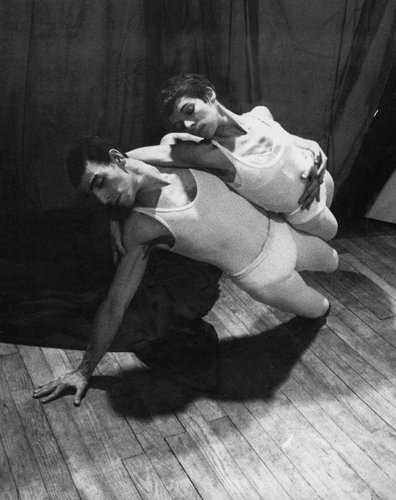
Donya Feuer and Paul Sanasardo, 1961 NY Times
Sanasardo and Donya Feuer, a Juilliard graduate, had started the Studio for Dance in 1958; it immediately grew into a vital hub of experimentation in a vein that could be categorized as dance theater. The m.o. was to delve into the human psyche with a dramatic edge, producing works that Franko characterized as “personal and poetic as well as provocative and disturbing.”[9]
In order to produce these collaborations, the Studio for Dance cultivated an environment that offered a sense of possibility. In a conversation quoted by Franko, Feuer waxed eloquent about her partnership with Sanasardo:
Being together made it possible to be what I would like to call “safe.” The world really could be just what this was, and nothing else. I think it was that that was so beautiful about the Studio for Dance, that it was filled with this kind of energy and belief, and way to work, and dedication. And it was also a kind of liquidity where courage was not a question: everything was possible, nothing was impossible. You could talk about beautiful things; you could talk about brutal things; all of it belonged to something bigger than that.[10]
Conceptually, philosophically, psychologically, as articulated by Franko, this approach sought to replace alienation with intensity.[11]
Feuer, however, departed for Sweden in 1963, at which point Sanasardo’s influence loomed larger. Because Alum arrived in late 1962, he did not have a chance to really work with Feuer. But he obviously was enthralled by Sanasardo’s intensity and experience. One of the positive aspects of Sanasardo’s influence was that he valued classical training, and he urged his dancers to study with Mia Slavenska, the Croatian former star of the Ballet Russe de Monte Carlo—which Alum did, along with classes from Maggie Black, former assistant to Antony Tudor, and Karel Shook, co-founder of Dance Theatre of Harlem. Within a couple of years, he attained a level of technical mastery that anchored his dancing. Almost immediately, he became a principal dancer as well as assistant to the director of the Paul Sanasardo Dance Company.
Sanasardo encouraged Manuel to choreograph, giving him space to rehearse, organizing shared concerts, and helping with design elements. The first opportunity for Alum to show his own work was in 1963, when Sanasardo engaged Judson Hall, a midtown space, for three of his top dancers to show their choreography: Judith Blackstone, who had performed with Sanasardo and Feuer since she was 10; Germaine, a strong, forceful dancer; and Alum. For Manuel’s first solo, Wings I Lack (sometimes called Of Wings I Lack), Sanasardo helped make the wooden wing that was essential to the piece. Alum appreciated the support during the ten years he was with the Sanasardo company, saying, “I was given the opportunity to make mistakes.”[12]
During the 1966-67 season, Sanasardo produced a series at the 92nd Street YM-YWHA, the bastion of modern dance in mid-century New York City. The series included his repertoire as well as pieces made by six of his dancers (Blackstone, Germaine, Franko, Alum, Cliff Keuter, and Elina Mooney). The critic Clive Barnes praised Sanasardo’s generosity in give this opportunity to young dancers. Barnes singled out Manuel’s choreography, noting that his solo Storm “produced oddly frozen posés set against a scene of tarlatan tundra, suggesting the bleakest desolation.” Also on the program were two other pieces by Alum: The Offering, a trio with religious overtones, and Nightbloom, a quartet with nature imagery.
The Cellar, shown the following year, was his breakout piece. A dark, compressed solo, it premiered on the Inside Modern Dance series at the New School for Social Research in 1967. It turned a limited vocabulary into a nightmare of claustrophobia, packing an emotional punch in a mere eight minutes. Both sound and sight were unnerving. A fast-ticking noise by Polish film composer Wojciech Kilar sometimes escalated into what critic Don McDonagh called “mechanical screeching.”[13] Alum crunched his body into a tight ball, signaling self-protection, a return to the womb, or sheer paranoia. Then he stretched up tall with big, precarious shapes. It was difficult for some audience members to sit through, but for some, the extreme imagery got burned into the memory.
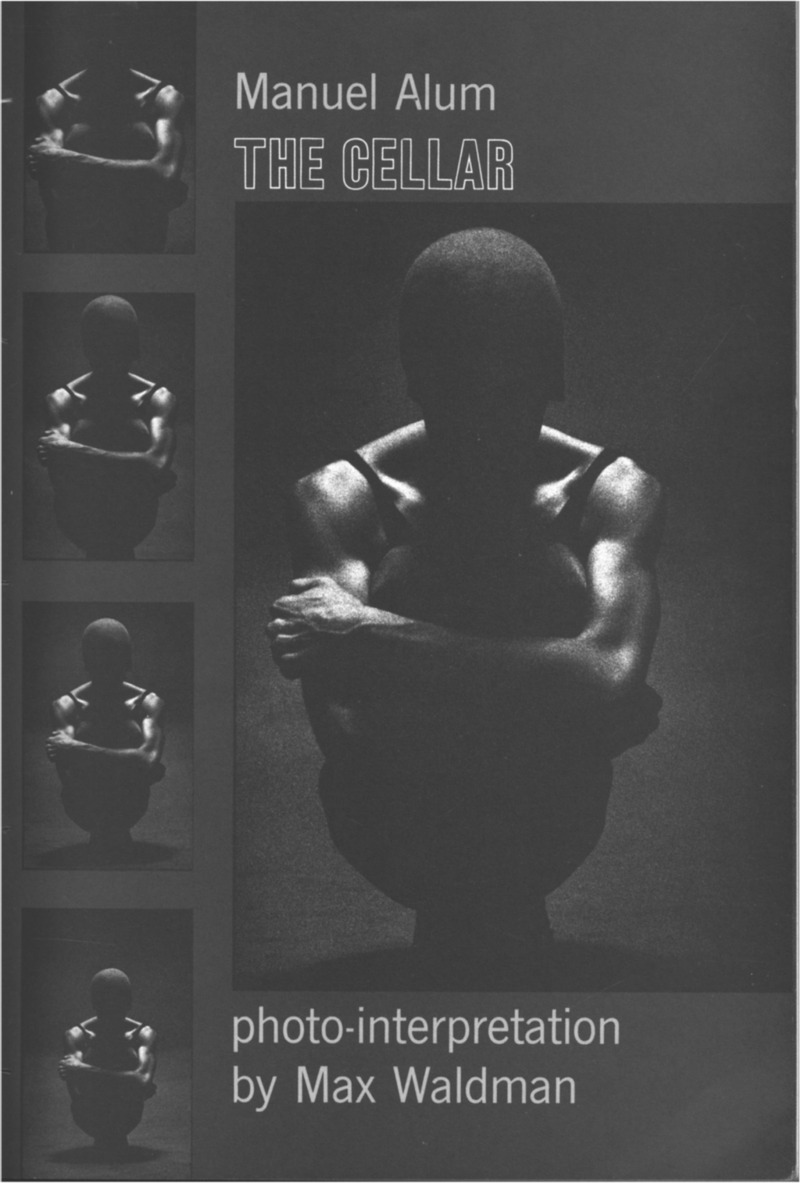
First page of series in TDR, Spring 1969
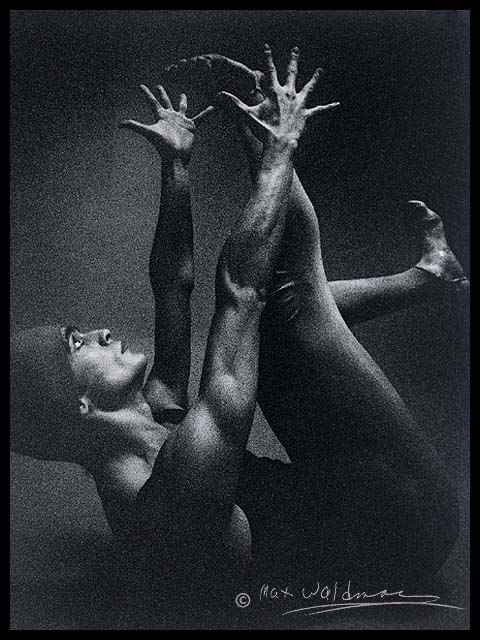
One image in the Photo Interpretation series © Max Waldman,
Clive Barnes saw the solo figure as a man “imprisoned by his own agony.”[14] Don McDonagh wrote that it had “a compelling, obsessive quality like a Poe short story.”[15] Tom Borek, commenting in Dance Magazine, said it “almost reaches the breaking point of madness;” he proclaimed it “an outstanding piece itself in the entire field of dance.”[16]
The Cellar was so visually stark that The Drama Review published an unprecedented twelve-page photo essay by the legendary Max Waldman. The images show, in Waldman’s famously black-and-white, grainy texture, Alum grasping himself in a fetal position. With fingers splayed open and feet turning inward, the images suggest extremes of fear, despair, and loneliness. This seems like a figure just after birth or just before death.
While Alum could always rely on his own electric performances for solos, choreography for ensemble works required a different skill set, which he developed quickly. He premiered Palomas (the Spanish word for doves), an anti-war piece for six women wearing pale grey, with the Northern Westchester Dance Company, where he’d been teaching. He later set it on Sanasardo’s company, and it also appeared on the first full evening of Manuel’s own work at the 92nd Street Y in 1970—the year he started his company.
Felicia Norton, a lead dancer in Alum’s company, remembers the ballet well. In her solo section, she said, it “felt like a plea for peace, and I remember at times opening my costume skirt fabric to allude to the wings of a dove or a prayer flag and hovering over the earth and opening to the sky.” She also remembered a particular fall that all six dancers did: “We opened out into a full body straddle, arcing back to one’s full extent, and then we fell [forward] flat to the ground…It was as if the whole body screamed and then descended with impact to the earth.”[17]
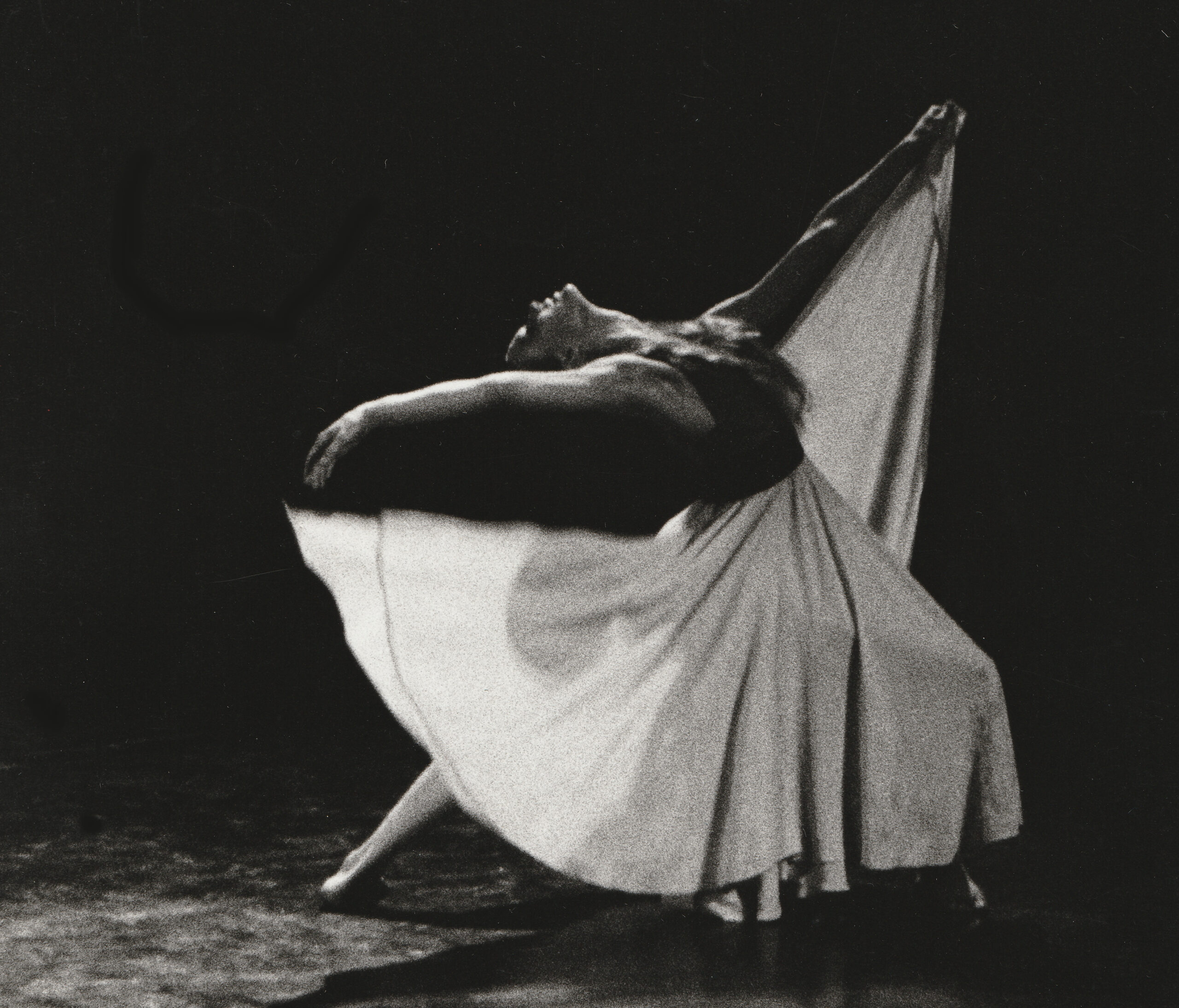
Felicia Norton in Palomas, 1974, Courtesy Felicia, ph unknown
When Clive Barnes saw Palomas at the Y, he called the dance “a true beauty.”[18] In fact, he was so impressed with the entire concert that he announced that it “marked the arrival of a potential major force in modern‐dance.”[19]
While Palomas pled for peace, Era (1970) gave a picture of rebellion. The ten dancers gradually became rambunctious, running around and bothering each other, either attacking or protecting someone else. With music by Penderecki contributing to a growing sense of anxiety, the group broke off into pairs of combatants. As Norton said, “It was the feeling of unrest in the world.” To give it a sense of spontaneity, Alum changed the order of the solos each time. According to Germaine, “You were out there pacing around and crisscrossing everybody, and Manuel…he’d run around and weave through and tag somebody. Then that person had to do their little improvised solo and tag somebody else. You never knew who he was going to tag and when.”[20]
For a while, the artistic relationship between Sanasardo and Alum was mutually beneficial. Doris Hering, premier Dance Magazine writer, effused about both of them as choreographers when she saw their concert at Brooklyn Academy of Music in 1971. After giving a poetic evocation of Sanasardo’s work as “a darkening pond,” she wrote, “What I like most in the choreography of both Sanasardo and Alum is the deep sense of responsibility. It extends them beyond themselves. More than that it affects their beautifully trained and obviously committed company. It also frees their choreography.”[21]
Just as Sanasardo was instrumental in Alum’s artistic growth, the younger dancer was instrumental in the older dancer’s choreographic career. Alum not only lent his gifts as a performer to many Sanasardo works, he ultimately contributed eight ballets to the company’s repertoire.
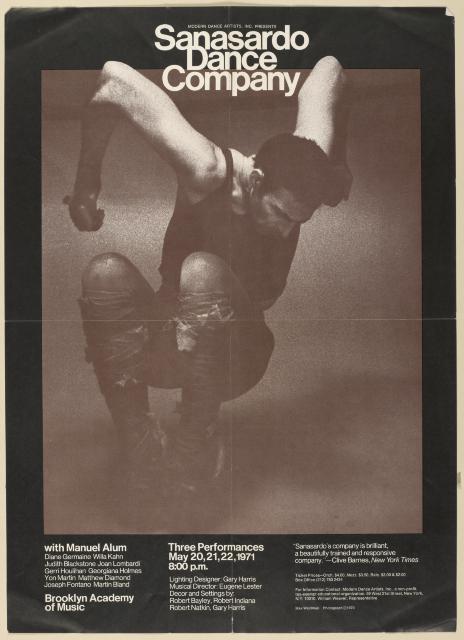
Sanasardo Dance Company brochure, with Alum’s name featured, BAM, 1971, photo of Sanasardo ©Max Waldman
As often happens in the dance world, mentor and disciple became lovers. Sanasardo was not by nature monogamous; relationships were messy. Blackstone described the situation: “There was a lot of drama, and Manuel was very sensitive and very vulnerable. He was a wounded person. So the tension with Paul didn’t help that at all. There was a lot of harshness and a lot, a lot of trauma. Drama-trauma.”[22]
All this was destabilizing for Alum. Germaine tells of a time when he went AWOL while working on his first solo. He was upset with Germaine for not readily coming to watch his rehearsal. But there was a larger issue. In his hand he held a small crucifix that was possibly a gift from Sanasardo. (More about religious symbols later.) With that crucifix, according to Germaine, he punched his fist into the window of the studio and ran downstairs and into the street. It took a while for Germaine and her fellow dancers to calm him down. Perhaps this was a case of vulnerability being strength, because that very woundedness ultimately contributed to his unique movement vocabulary.[23]
One of the more durable dances that Alum contributed to the Sanasardo rep was Nightbloom (1966), originally for Willa Kahn, Mark Franko, Joan Lombardi, and Alum. It opened with the four dancers on their backs, feet cycling in the air like budding stamens and pistils at warp speed to music by experimental Polish composer Kazimierz Serocki. Willa Kahn, a luscious mover, had a slow, deep bodied solo that added an element of pathos. While kneeling, she reached out and upward, stretching over to the side until she swooped into a fall, then dragged herself along the floor, as though in the trenches. At the end, all four reached up high as they sank to the floor. They all arched back as one, then folded forward as one, ending in a serene heap of blooming dominoes.
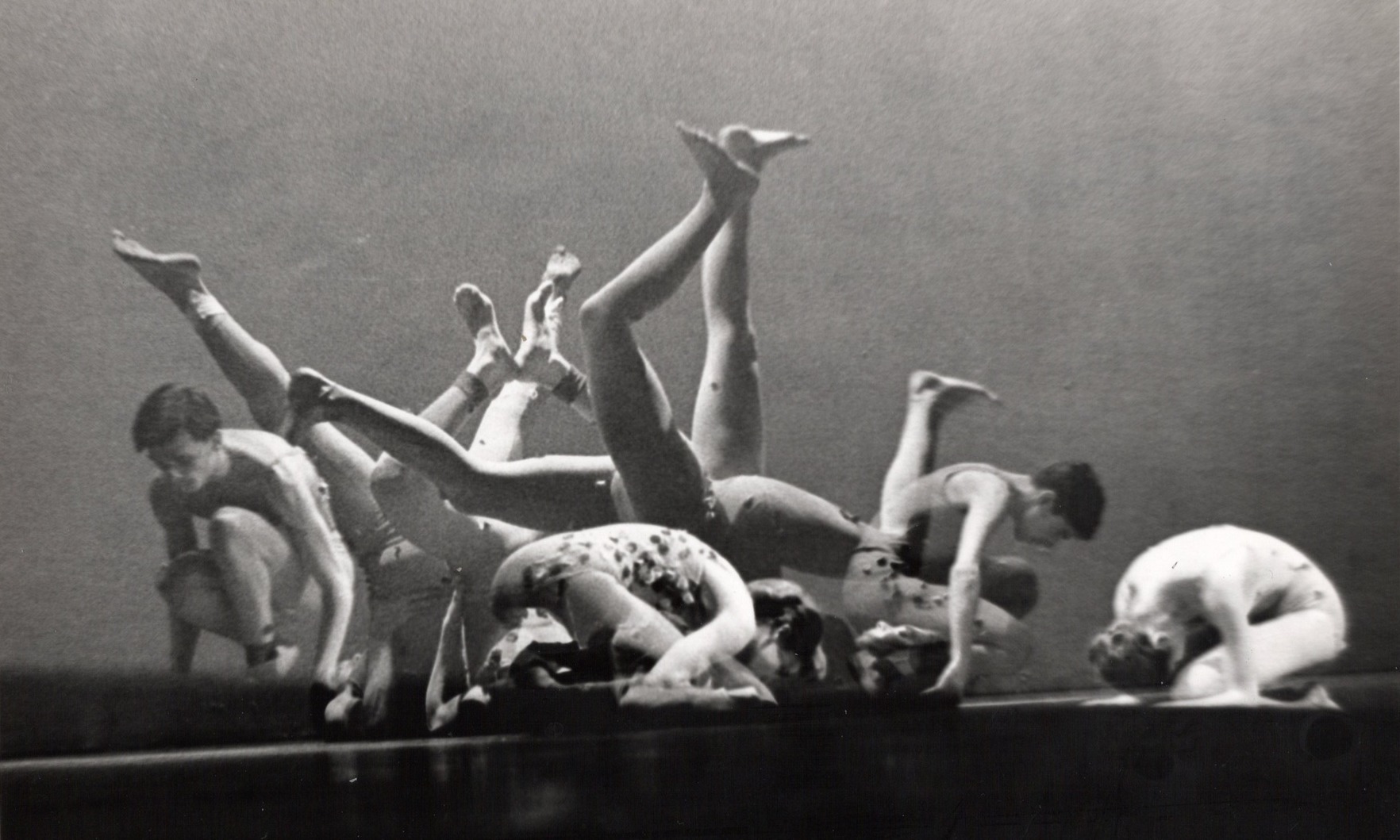
Nightbloom, by Alum, a later version, at Henry Street Settlement
Twenty-three years later, Alum made an expanded version for the apprentice company of Ballet Hispanico, calling it Nightbloom II (1989). He replaced the original music with a soundtrack that mixed birds chirping with classical music. One of the ten dancers from that version, Omonike Akinyei, gave a presentation at the Library for the Performing Arts at Lincoln Center in 2022, in which she looked back on her time with Alum in awe: “The Manuel Alum who had choreographed Nightbloom II was vibrant and mysterious. He entered the studio dressed in white, like a sort of Jedi knight, he seemed to be on a quest that was deep and secretive from the very start. His socks and dance shoes were laced to his feet as if to hold in the energy and keep it from bursting into the air.”[24] About the version he created for them, she recalled that “Our feet cackled like busy bats making noise until silenced by the wind. We were close to the ground and would fall and recover, not by listening for the counts in the music, but through a sense of timing based on the feeling of the people around us on stage.[25]
Judging from the video, this version was choreographically more cogent that the original quartet. Of course, it wasn’t danced as well because these teenagers were students, but the group patterns flowed more organically and it felt closer to nature.
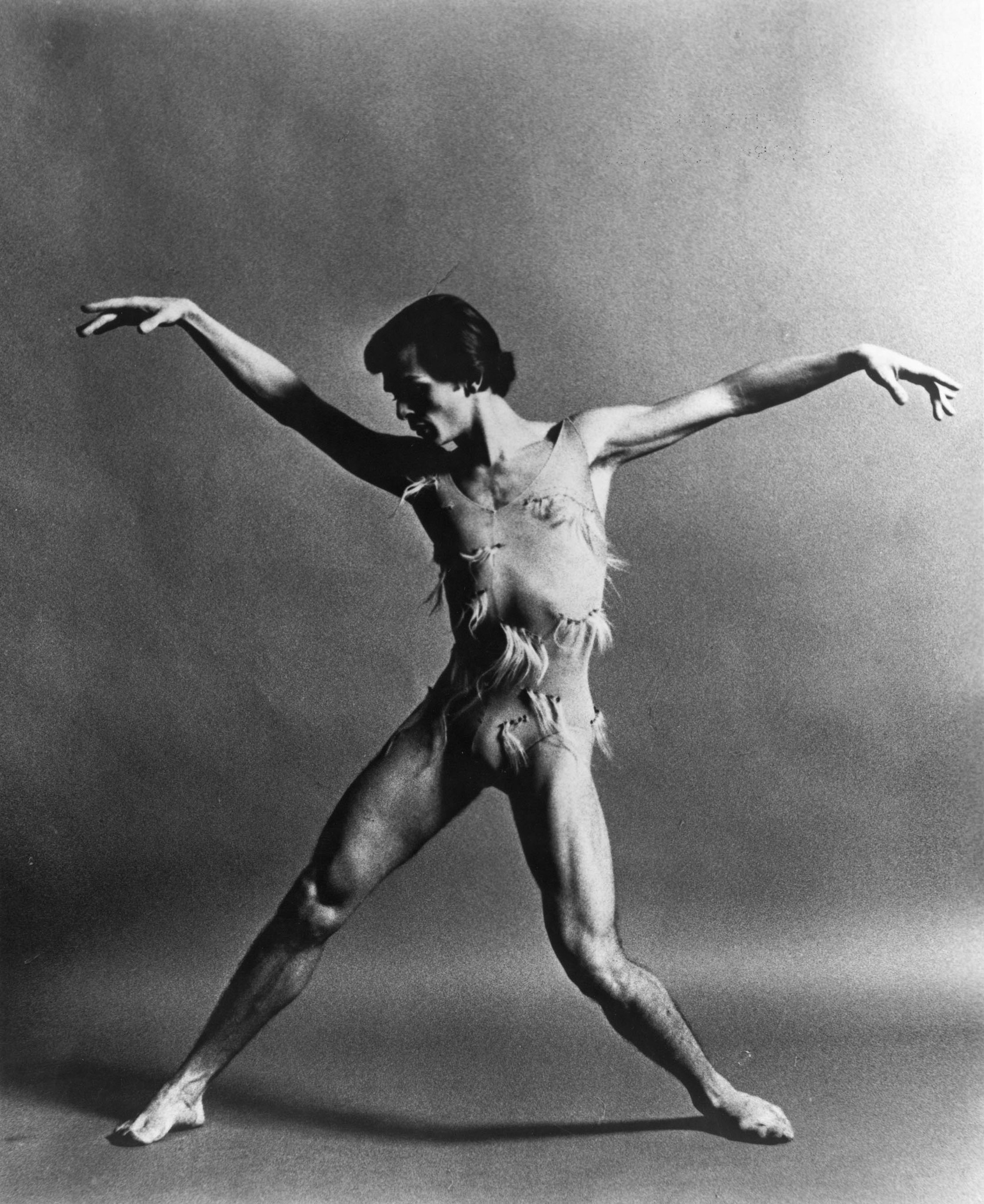
Alum in Feathers c. 1969, ph Zachary Freyman
One of Alum’s early teaching stints was at Ballet-Théâtre Contemporain, based in Amiens, France, in 1969. Among the dancers were Malou Airaudo and Dominique Mercy. For Airaudo, his teaching was a breath of fresh air. “Manuel was not like this kind of ballet kitsch,” she told me, referring to the kind of ballet she was seeing in Europe. “It was so simple, so pure, for me. I fell in love with the way he moved. The simplicity was incredibly beautiful.”[26] She arranged a leave of absence from her French company and followed him to New York. He had told her—and it was true in his mind—that he had a company. However, for European dancers, then and now, a “company” means a contract, a reasonable schedule of daytime rehearsals, and a paycheck. In downtown New York, a “company” may mean a casual arrangement of rehearsing at odd hours and getting paid only for performance. For Airaudo, there was no company.
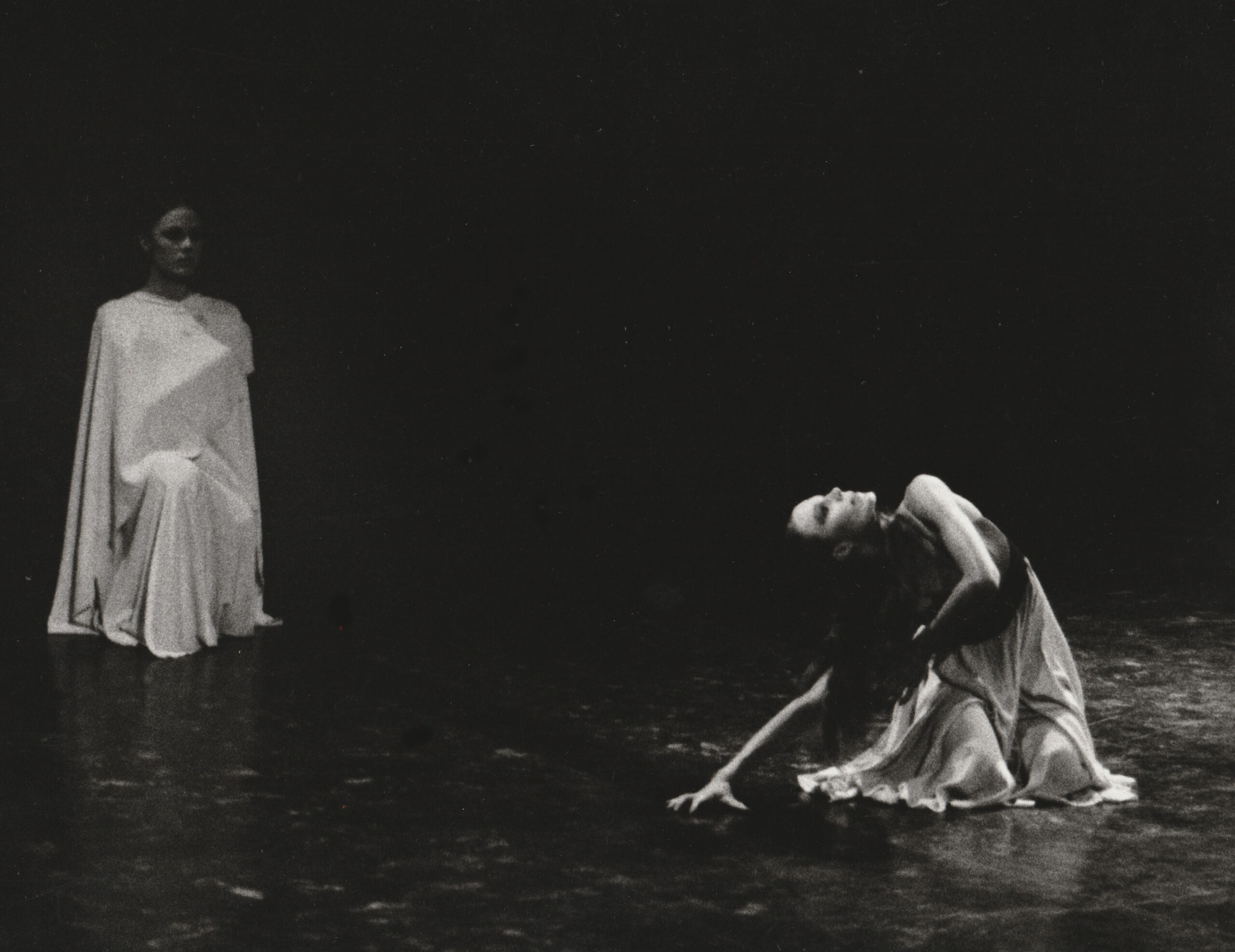
Malou Airaudo and Felicia Norton in Palomas, Washington Square Church, 1974
Another unpleasant surprise was that she found an attitude that bordered on verbal abuse. Although she felt that both Alum and Sanasardo were “great artists,” she had to figure out how to get over the negativity: “Manuel would say to me, ‘You could be the best dancer in New York, but you dance like a truck. You have to put your head together, [not be] crazy all the time. I’m not your father, I’m not your friend, I’m not your boyfriend.’ He was very, very hard on me.”[27] In Airaudo’s case, she admits that he “pushed me to be a better dancer,” partly by sending her to study with Maggie Black. But in the meantime, she found his derision hard to take. (My personal perception: When I heard how she was treated by Alum, it echoed the way I witnessed Sanasardo treating Alum himself in technique class. Although Manuel was beautiful and disciplined, his mentor would denigrate him in front of the rest of the class.) This negativity applied to choreographic efforts as well. Blackstone recalled that when she and her fellow dancers showed their early choreographic efforts to Sanasardo, they were usually met with “harsh criticism.”[28] Of course, this negativity was not limited to Sanasardo and Alum. It was baked into dance training at the time. It was the old-school approach that believes that if the teacher castigates people in class, they will knuckle under and work harder.
In 1969, Sanasardo established the School of Modern Dance at the Saratoga Performing Arts Center in upstate New York, with Alum as assistant director. For five summers the Paul Sanasardo Dance Company was in residence. It was in the summer of 1972 that Alum brought the two dancers he met in France—Airaudo and Mercy—to join the company’s three-week residency. To add to the international mix, Sanasardo invited Pina Bausch, whom he had worked with when she’d been a Juilliard student in 1959-60.[29] For those four weeks, Bausch, Alum, Airaudo and Mercy lived in a house together and became close friends. The following year, Bausch started her company in Wuppertal. Airaudo and Mercy became foundational members of her new company, which ultimately became world famous. She may have also invited Alum to join her company, but he wanted to stay in New York to choreograph. They remained close friends, and whenever she came to New York to perform at the Brooklyn Academy of Music, she stayed in his loft on White Street.
That summer Alum made A Woman of a Mystic Body, Pray for Us for Airaudo. In the video, she stands with a head-to-foot white veil, like the cloak of Mother Mary (or like Ruth St. Denis dressed as the “White Madonna”). On the first note of Verdi’s “Ave Maria,” she throws open the veil/cape and falls forward to the floor. Then she runs, exultant, cape billowing behind her. At one point, she bends over to put on a high-heeled shoe, which she tosses aside abruptly. She’s an angel, a nun, the mother of Jesus, but maybe she wants to try on what real life is like, the role a woman has to wedge herself into. Critic Jennifer Dunning wrote that Airaudo “progresses from stately sorrow to frenzied agony.”[30]
Clive Barnes gave both the choreography and the dancer high praise. He wrote that the solo showed an “unusual ability to build up a cumulative choreographic effect. It was also most exquisitely danced by Miss Airaudo, a statuesque young woman of eloquent dignity.”[31] Village Voice critic Deborah Jowitt, however, used this performance to register an overall complaint. After hailing Airaudo’s “virtuoso performance of emotional and physical pyrotechnics,” she wrote, “but I felt awful about the piece.”[32] She went on to explain that, while she appreciated the excellent dancer and Alum’s choreographic talent, she found the work lacking in development. “For myself, I just wish all his dances lived up to the brilliance of their first few minutes.”[33]
Another person who felt uncomfortable about that solo was Airaudo herself. She was in her early 20s when Alum made it for her. She remembers the characterization of this mystical woman blurring with her own circumstances: “This woman, she doesn’t know really what she wants. This confusion between religion and the woman that I am—what’s happening in the body, the sexuality and the love—and I was so lost in New York, and Manuel was in this feeling of believing [in god]. We never spoke about it.”[34]
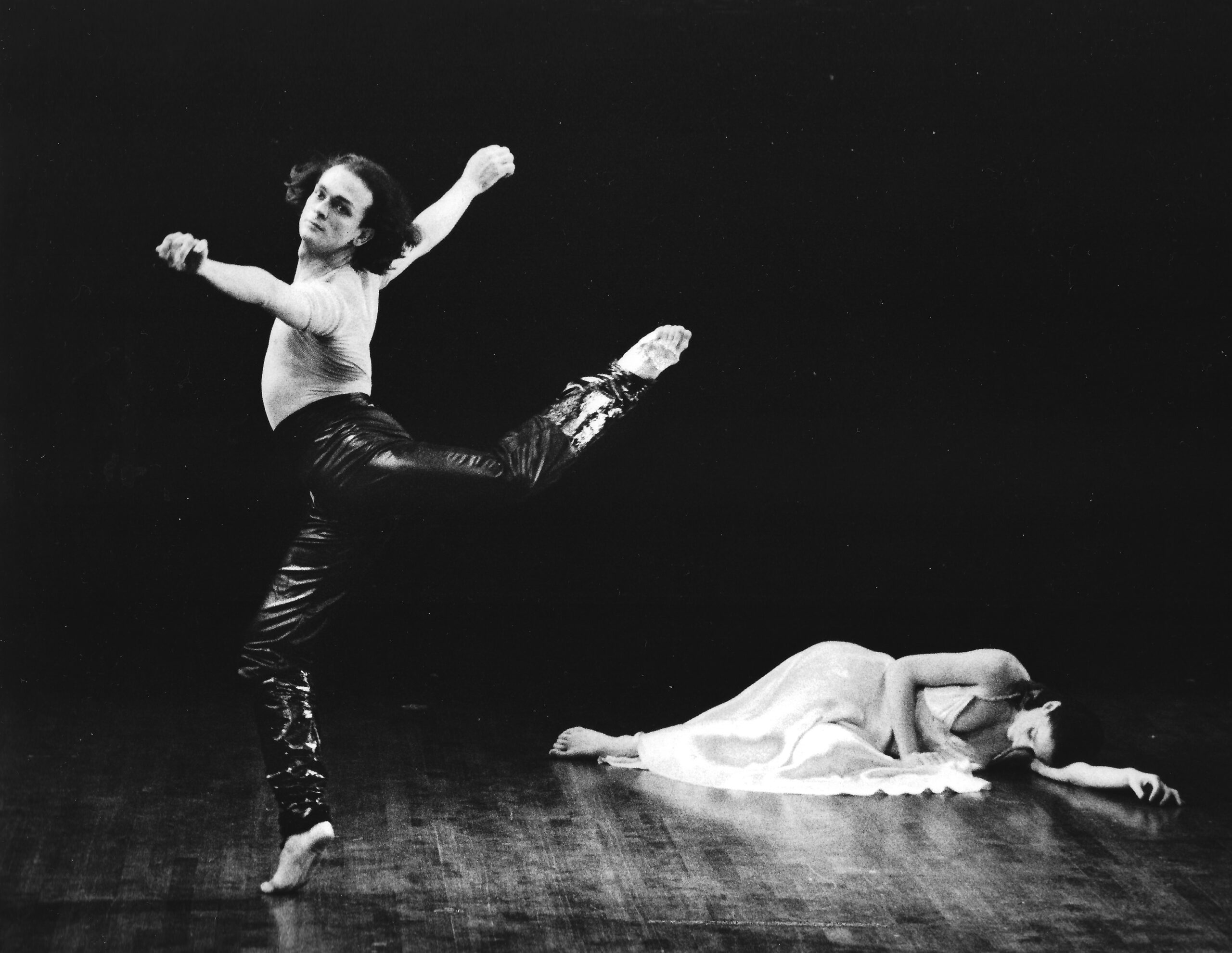
El Tango (1976) with Alum at left, ph Lois Greenfield
That summer of 1972 in Saratoga was also when Felicia Norton, who was to remain a lifelong friend, entered Manuel’s life. A trained ballet dancer with a lovely demeanor, she immediately gravitated to him, and he to her. He gave her solos that took advantage of her long lines and high extensions. A student at Kirkland College when she started dancing with him, she had to finish a year of college before she joined the company in 1973. Her positive reaction to him was immediate: “He was so gorgeous to watch and so clear,” she told me.[35] “His class was beautiful, very deep, a lot of presence. He had clear balletic lines when he moved. He always said, ‘Move with a good feeling. Feel good when you move. Put good energy into every move you make.’ He was so sincere, really heartfelt—and demanding.”[36]
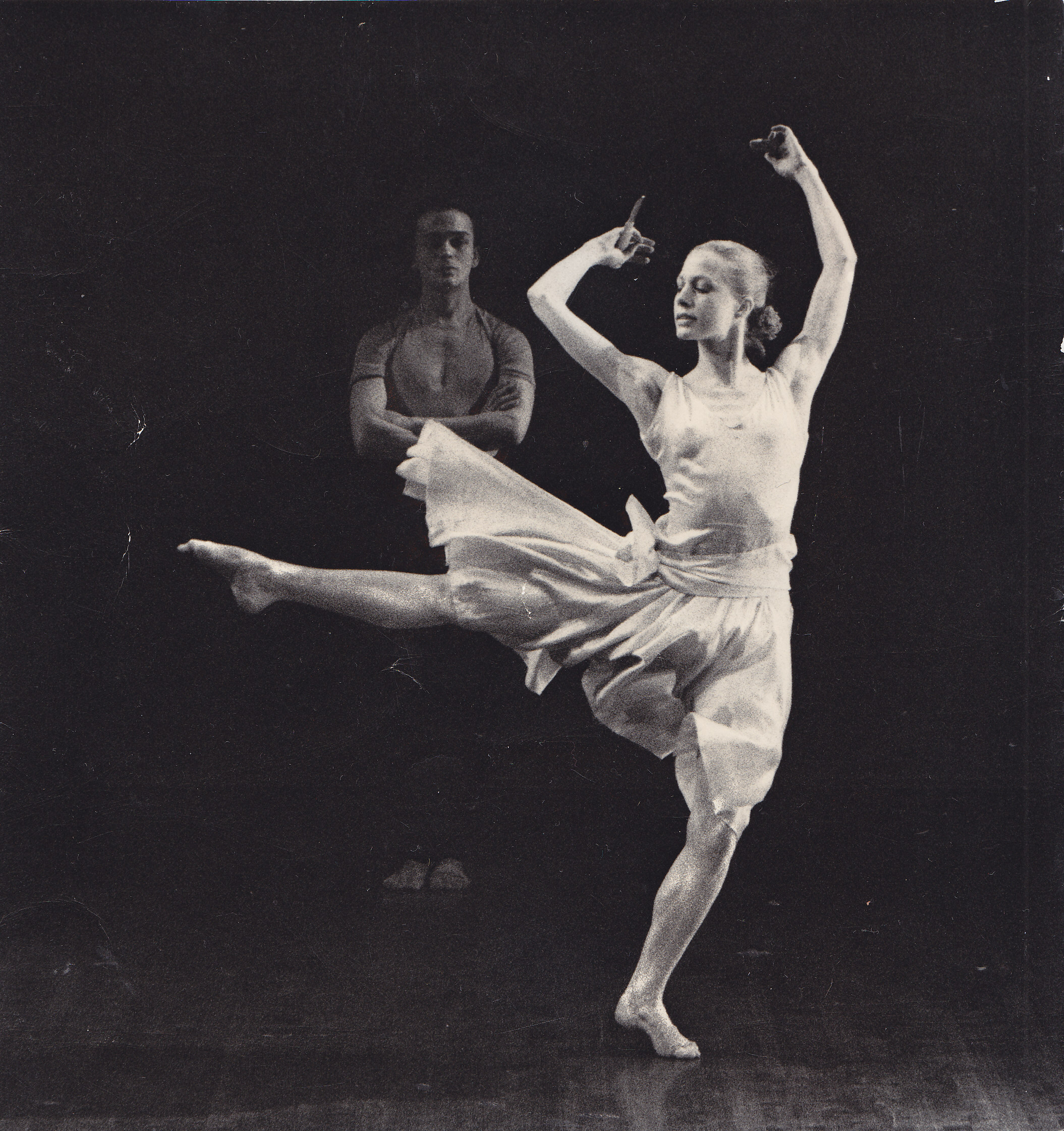
Manuel and Felicia (dagger in hand) in El Tango, 1976, ph Lois Greenfield, Courtesy F. Norton
The rehearsal periods in New York were intense. Because the Sanasardo studio (which had, in 1964, relocated two blocks away and changed its name from Studio for Dance to Modern Dance Artists) was packed with classes, Alum’s group rehearsed in the evenings, sometimes till midnight. Like Airaudo, Norton recalled his negative aspects, but she felt closer to him as a friend: “He was intense, demanding…He was uncompromising in what he wanted. It was hard for me. I didn’t have a lot of dance experience. But he and I had a very close relationship. We were friends. We did everything together…. To me he was very kind, very loving. In the studio, he had a good sense of humor.”[37] She felt she was part of his family. The following decade, when Bausch came to visit, Norton often ended up babysitting her son Solomon.
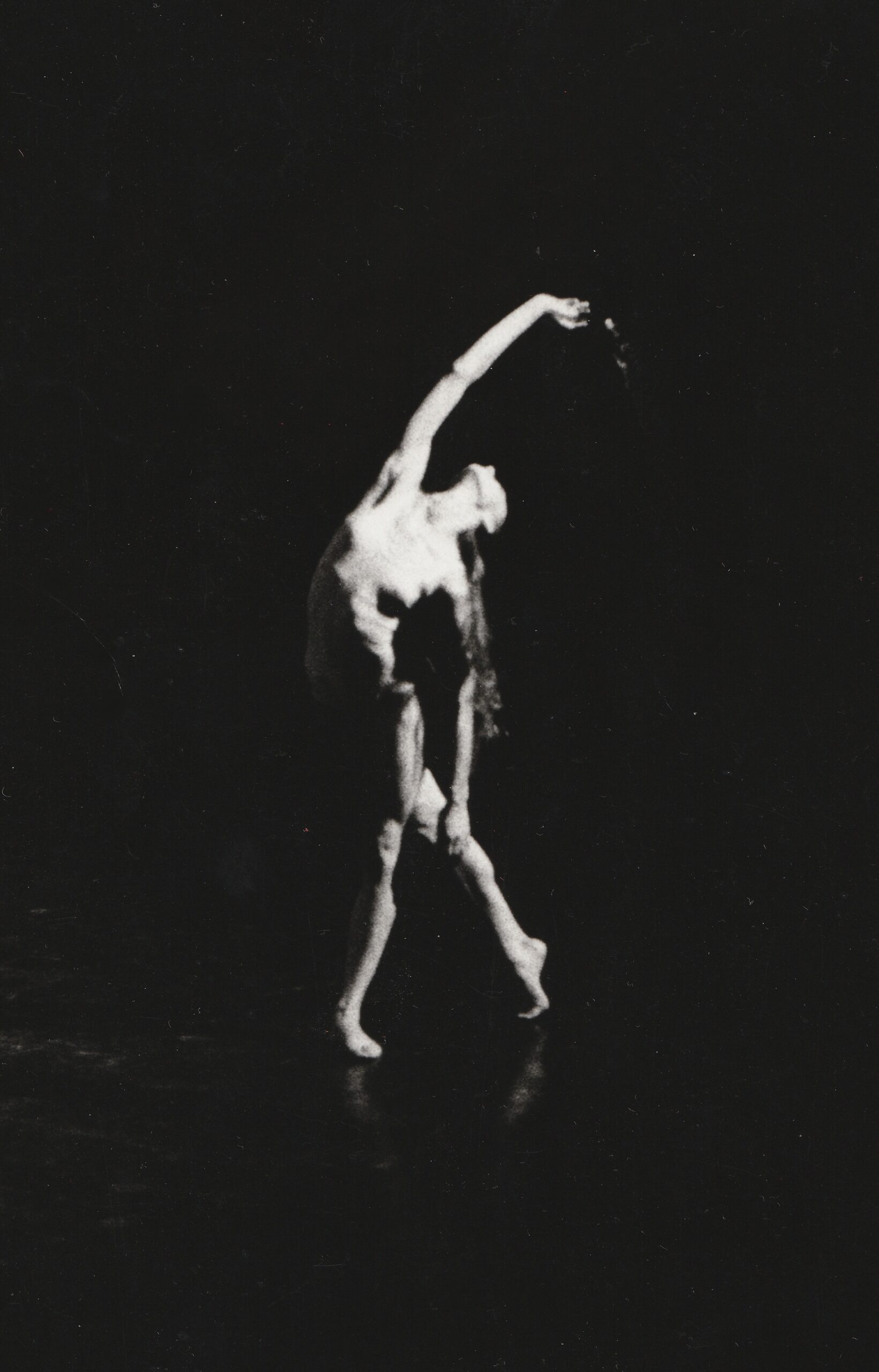
Felicia Norton in Yemaya, 1974
In the summer of 1974, the American Dance Festival at Connecticut College offered Manuel a new challenge: a commission to collaborate with a composer as part of its music-and-dance (“MAD”) project that summer. All four chosen choreographers were fairly well known— Jennifer Muller, Nancy Meehan, Bella Lewitzky, and Alum—and all compositions were to be played live by the fifteen-strong Saint Paul Chamber Orchestra. Alum was paired with Ira Taxin, a young atonal composer who held an assistantship at Juilliard. Together they created Yemaya, a story based on the healing orisha, or goddess of the sea, who, in Yoruba culture, cleanses people of their sins. Taxin came to rehearsals at the Sanasardo studio, improvising on the piano, guided by Alum’s sense of story. In a recent conversation, looking back fifty years, Taxin recalled that during the process Alum was intense, focused, and fast. Taxin’s music, using strings and percussion, supported the energy changes in the choreography. As the dancers passed around a piece of fake seaweed, they each reacted differently to this symbolic sprig of life. When the action became more frenzied, Taxin gave them a rhythmic percussion section. At the end, the whole group waved arms high up, drifting slowly off stage. Taxin created a floating effect with just flute, piano, and a humming vibraphone. The Village Voice music critic Tom Johnson proclaimed their collaboration the most successful of the four. He praised the score for its expressive range, especially the percussion section and the final quiet section.[38] At the premiere, critic Rose Ann Thom wrote about their final exit, “Their effortlessness and complete lack of tension created the illusion of spiritual and physical release.”[39]
————————
In the late 1970s, Alum felt a yearning to explore a different part of the world. With a fellowship from the Japan/U.S. Friendship Commission—the first dancer to be so honored—he traveled to that country to study dance forms there. Intuitively, he felt an aesthetic connection to things Japanese. In an interview in 1987, he said, “I think there must’ve been a Japanese part of me in another lifetime because it made a lot of sense.”[40] Comparing his focused time abroad with his busy life in New York, he recalled his time there with pleasure:
The first time in my life I didn’t have to worry about money because it was a wonderful, generous grant and it was like “solo time.” All I did was study, choreograph, dance, lecture, teach. I was busy doing my thing. Here, I have to sit in my desk doing a lot of paper work all the time. In Japan…I could concentrate on the things that interested me. That was the old things. I found the old Edo, Zen-related arts, more modern than what was going as modern there today…I found that there was a sensibility that I had here before. So it was universal.[41]
Alum told Jennifer Dunning of the New York Times that what was called “modern” there was very dated, with people “running around with scarves to Ravel, dressed in the latest styles of leotards.”[42] (One wonders if he saw any Butoh, the “dance of darkness” that developed during the American occupation after World War II. He might have felt an affinity for the intense concentration and distortions of that genre.) He studied briefly with one of the most revered traditional dancers, Daisuke Fujima. The two planned a shared program in Tokyo, in which they would each perform several solos as well as a new collaborative duet. But the duet never happened. According to Alum, Fujima’s advisors counseled him against it.[43] Alum was “a bit frustrated.”[44]
The video of that shared performance at Noh Theater, Kanazawa, Japan, performed in 1979 and broadcast in 1980, shows that after Shojo, Fujima’s first, slow, ritualistic solo, the traditional music continued playing while Manuel danced his first solo. This suggests that he was willing to engage in Japanese aesthetics without a pretense of having mastered the traditional form. In another performance, at the National Educational Theater (Toranomon Hall) in Tokyo—where he was the first foreigner ever to appear—he received thunderous applause after performing The Cellar.[45]
On a different occasion, Manuel performed Gette no mai, A Moongarden Dance in the International House Garden in Tokyo. It was hard to see in the dimness of the nighttime video, but Alum seemed sensitive to the plant elements, fitting himself into the crook of a tree, running through the garden like a gazelle. Sound pioneer Akio Suzuki played live, probably a Japanese flute —shakuhachi—as well as percussive instruments that sounded like a washboard, a kalimba, or just sticks clacking. It was all very evocative of a nature poem come to life.
Upon his return to New York, Manuel presented Made in Japan (1980), which he called a “kinetic diary,” at Japan House. In the first of three sections, wearing all black (head scarf, leotard top, flared trousers to the knees, and calf warmers), he began dancing above the audience on a hanamachi, the traditional ramp used in Kabuki theater, then staggered down the incline to the main performance area. He wove together various movements: running with arms wide open, turns, leaps, big tilts, and smaller moves like squatting with a hand or foot circling, as though isolated from the body. At one point Alum bowed repeatedly, accelerating until he was maniacally bobbing and jittering off balance. After changing into a white outfit, his dancing gathered momentum. A Kuroko (a black-clad, Noh-style assistant) entered to wrap a cloth around Alum’s knees, making him hobble wildly until the Kuroko returned to remove it. The first three sections broke through the usual decorum of Japanese classical dance. In the final section, he appeared resplendent in white organdy ceremonial robes and mask, designed by the Belca House of Kyoto, while brandishing a fan. The sound by Fluxus-inflected sound artist Yoshi Wada, ranged from long tones, traditional Japanese voice with wood block and bell tones, to vocal rasps and growls.
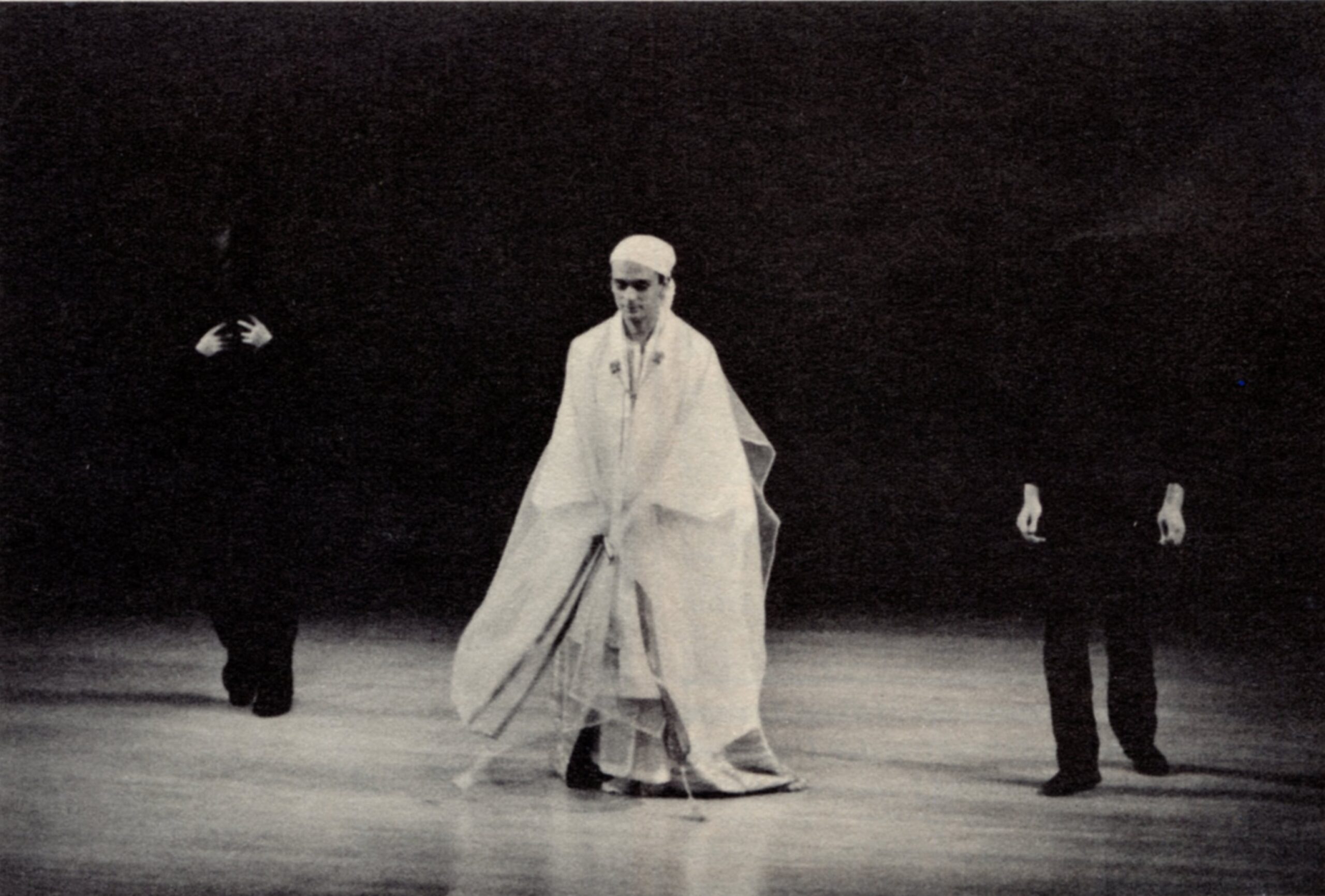
Made in Japan, Japan Society 1980, ph O. Honda
Writer/editor Francis Mason raved about the piece in his slot on WQXR Radio, saying he witnessed an “inward journey” of this “astonishing dancer.”[46] Mason referred to the various sections that were named in the program notes: “He involves us in a series of collages about rice fields, salutation, Hiroshima, Japanese gardens, Martial Arts, Kabuki, Nō, earthquakes, Zen tea ceremony and other things he saw and learned.”[47] Lillie F. Rosen, reviewing for Dance News, wrote that he showed “all his former talent and appeal plus an added sensitivity and rhythmic shading, a distinctive inner probing that proved the catalyst for a rare and beautiful evening of creativity.”[48] The choreographer Muna Tseng, who was also in the audience, observed that Alum’s Made in Japan “was stunningly magnificent and subtle, like a strong silk cloth.”[49] The performance was so well received that Japan Society invited him back for a return engagement in March, 1981.
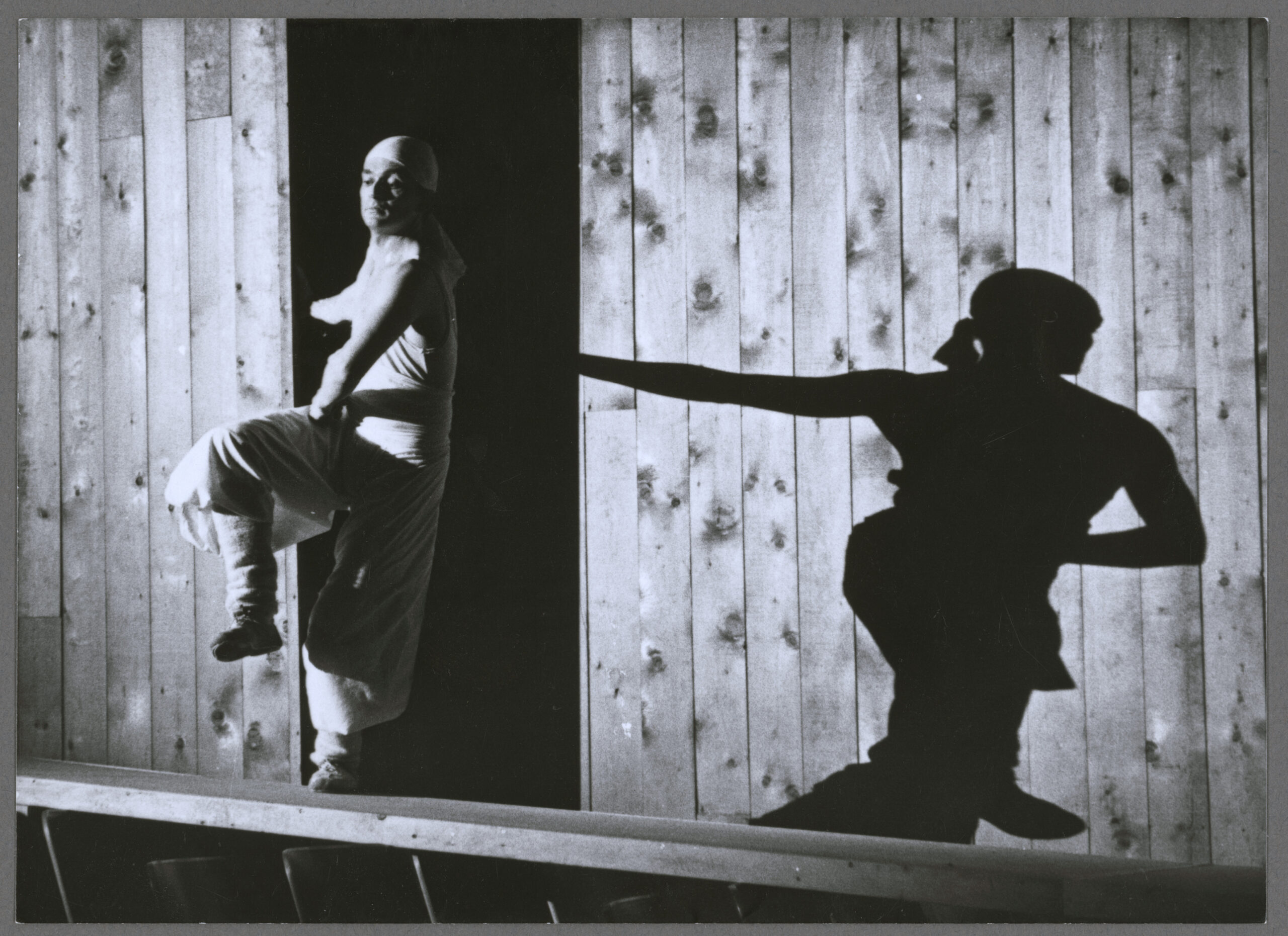
Made in Japan, Jacob’s Pillow, ph Stephan Driscoll, 1981
Made in Japan was repeated at Jacob’s Pillow in July, 1981. For this production of Made in Japan, he wrote a foreword, calling the piece “a diary made up of observations, reactions, imagery and impressions that Japan revealed to me.”[50] In the video in the Pillow’s Dance Interactive, we see that he again built a hanamachi. To sustained tones by Yoshi Wada, he vibrated his whole body, then staggered downward on the long hanamachi toward the regular stage.
The icing on the cake of his trip to Japan was that shortly after he returned, the Japanese composer Minoru Miki hired him to perform the role of the Actor, a female character, in the opera An Actor’s Revenge. Billed as a “kabuki opera,” it was produced at Opera Theater of St. Louis in June 1981. To prepare, Alum trained with Kinnosuke Hanayagi of the Hanayagi classical tradition. For Alum, “This satisfied my ambition to work with the two major schools of Japanese classical dance: Hanayagi and Fujima.”[51]
Alum’s Japan experience helped him extricate from the negative aspects of his relationship with Sanasardo. Dance artist Phyllis Lamhut, who directed him in her quartet titled MAN in 1989, told me, “His creativity was too dominated by the presence of Paul. Paul had a huge ego…Eventually, Manuel got his act together … and he felt his creativity was worth something, not put under the rug by Paul’s constant critique.”[52]
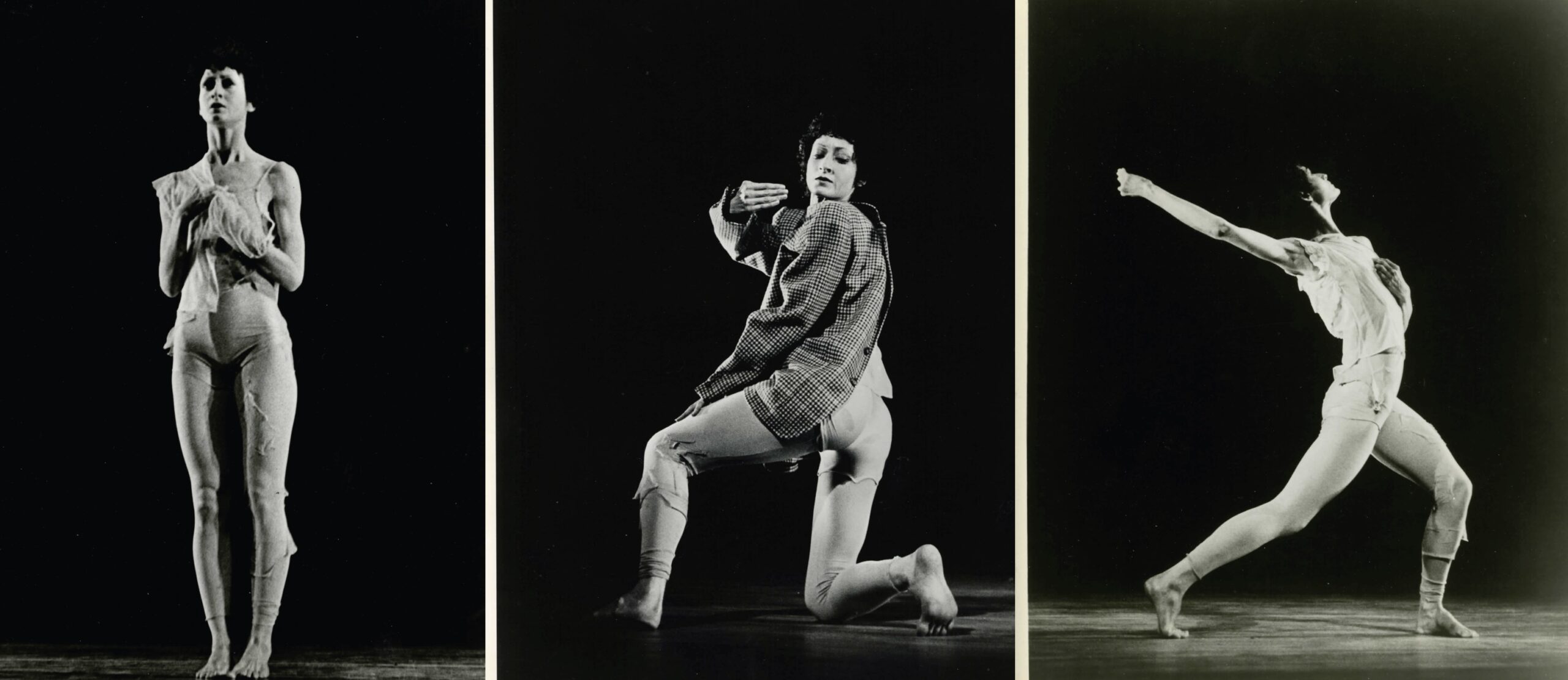
Ellen Kogan in Alum’s Somewhere Between Hours, ph Stephan Driscoll, Courtesy Kogan
To go back to that 1981 program at the Pillow, he also made a new solo for fellow dancer Ellen Kogan with music again by Suzuki. According to Kogan, Somewhere Between Hours (first titled Somewhere Between 9 and 5) “follows a woman who momentarily steps outside the demands and rituals of ordinary life to confront the private, thwarted, and deeply honest impulses of her inner world.” In a recent email, she told me how valuable her experience with Manuel was:
Manuel taught me to show my concentration, not my technique. He taught me to journey inward, to articulate, to carve space, and—above all—to be real. He was a no-nonsense choreographer: no excuses, no self-doubt, no hesitation, no boundaries…Each movement had its own arc in space, its own sense of time, its own energy, its own power. He was relentless in his pursuit of purity and clarity, insisting on an unobstructed view of movement in its truest form. Some people thought it was too much, too tough. I didn’t. It worked for me because he worked with me. He pushed me to think about what I was showing—what it looked like, not just what it felt like.[53]
Manuel was gaining traction in making work for others. Another instance is his major group work Monte (1987). Exuberantly danced to Mozart’s delightful Divertimento in E Flat Major, it had none of the darkness he inherited from Sanasardo. It was so successful that Ballet Hispanico asked to mount it the following year. In the video of that company performing Monte, one can see that the dancers swept across the stage in an organic flow, reaching peaks of joy along the way. The opening section swirled with pools and eddies of motion that, in their uplift, were worthy of Mozart. A motif of planting in the earth recurred throughout, along with the more airborne soaring, reminding us that all life starts in the earth. The second, quiet section, with one woman sitting alone as others make a chain around her, deepened the sense of humanity. The third movement ended with strong, energetic moving tableaux that lavished attention to individuals as well as the group. New York Times critic Jennifer Dunning called Monte “a rich, churning chain of movers toward the light.”[54]
When asked about the origin of Monte, Alum spoke about the spirituality of Mozart and mountain:
I listen to Mozart always as more like being in a mountain…There are certain truths that are universal, that people all share no matter where they’re from, what country, or what they do. There’s a spirituality that a mountain has, the spiral ascending. I also had read about that from Jetsun Milarepa, the eleventh-century philosopher, who spoke a great deal about this spiral ascending. [Constantin] Brancusi also spoke a great deal about that. I’ve always been attracted to that. It is spiritual because it shows people dealing and living and working and having deep joy and having sadness, experiencing all the odd experiences. Putting that together and then trying to make a community of it was an interesting thing and I felt the music of Mozart was perfect for what I had in mind. Actually, I think my early dances had the seeds and I’m just right now growing, blossoming those early seeds. So there is a signature in all the more than fifty pieces that I have done, they all have the same kind of, as I say, religiosity.[55]
From what I’ve seen, Alum embraced two kinds of religiosity in his works. One kind, as in Monte, is connected with nature and/or music. The other strain is more specifically aligned with religious symbols. An example is The Offering (1969), in which the central male figure is lifted up by his two white-garbed (angelic) female assistants. When he spreads his arms wide, he’s the suffering Christ figure. In the many lists Alum made in his notebooks, the crucifix and Christianity crop up often. Other hints are words like pieta, confessions, Magdalena, La Penitentas, purgatory, and angels. As he wrote in his notebook, certain pieces deal directly with religion, whether his own or faiths of different cultures. Those he listed are The Offering, East to Nijinsky (1970, which is danced to a Hebrew chant), Yamaya (based on a Yoruban deity), Woman of the Mystic Body, and Of Wings I Lack (with the aforementioned crucifix).”[56]
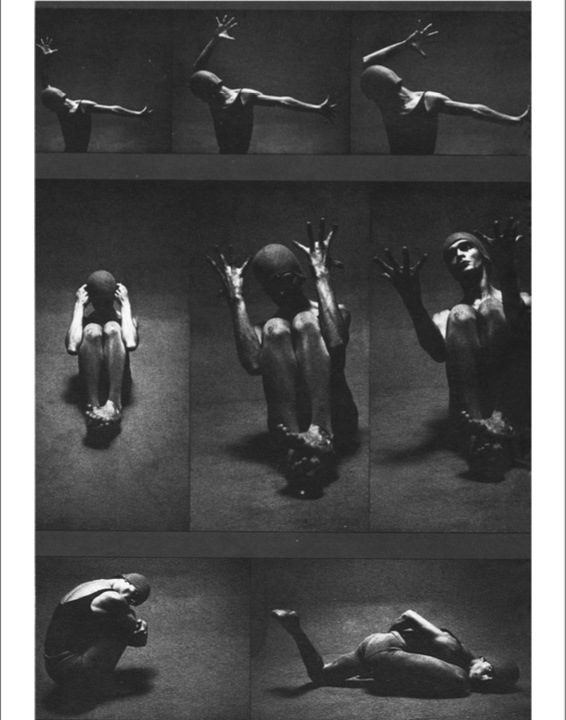
Max Waldman’s Photo Interpretation, TDR, page 10
I would submit that when Alum’s spirituality is engaged with nature, as in Monte or the much earlier Nightbloom, the piece is more successful than when his spirituality is more literally about Christianity or other religions. Although his notebooks are filled with lists of religious references and events, he has also compiled lists of words like homophobia, abortion, sexual freedom, and sexual hypocrisy. He had a fraught relationship with the church, as would any gay Catholic man, especially during the AIDS epidemic. In 1986, he may have already been diagnosed with AIDS; if not, he certainly had friends who had been. In his notebook he wrote the following dedication for his solo, Saeta al Gran Poder:
I dedicate this work to those that, today, when they most need compassion, in the face of death, are told by the dominant voice of the religious community that their “disease” is punishment for a sinful way of life. As well as the 30,000 persons that were tortured and killed in Argentina [during the military dictatorship 1976–1983], the millions of the holocaust of Nazi Germany and to many throughout history that looked up for help to the church while it stayed silent.[57]
This solo, which he performed in 1987 at Washington Square Methodist Church on the same program with Monte, was not visibly about AIDS or any other form of affliction. But he wore a very different look than earlier solos; he allowed his Hispanic heritage to seep through. Instead of wearing a form-fitting leotard as in most of his previous solos, he wore a black head scarf, loose-fitting ruby red shirt and black pants, looking like a Latino youth you’d see on the street. And it’s one of his best solos. His arms hang loosely and his shoulders start to shake to the recorded voice of Manolo Caracol. He gradually builds, letting each movement change from the inside, sometimes slowly, sometimes suddenly. There’s a truth to this solo—no dancerly posing, no conquering the space—that makes it satisfying to watch, even on video—which is unexpectedly ironic considering the tearing realization that the church betrayed the people afflicted.
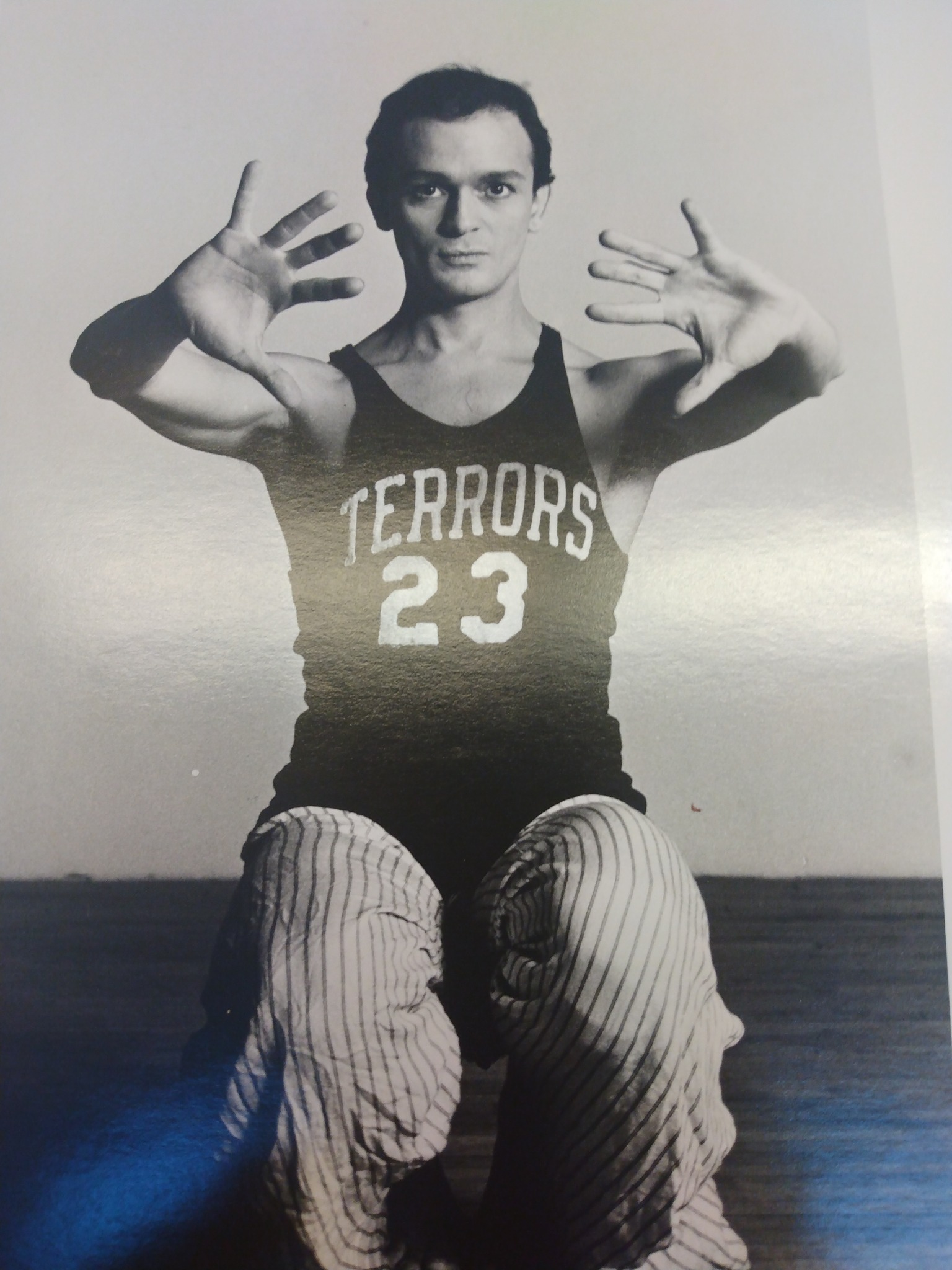
Undated photo from Facebook page of Image Quilt Cinema
The following year, 1988, Manuel decided to explore his Latino heritage further. He premiered C.O.C.A. (Collage of Central America), as part of Hispanic Heritage Month at the Triplex Performing Arts Center at Borough of Manhattan Community College. The six countries he focused on were El Salvador, Costa Rica, Nicaragua, Honduras, Guatemala and Mexico. In his notebook he sketched a floor plan for each. According to Jack Anderson’s review in the New York Times, there were scenes of beggars, revolutionaries, and prisoners.[58] Alum dedicated this piece to “all hostages, prisoners and innocent people who are incarcerated daily throughout the world.”[59] In his notebook, he referenced the Mexican revolution of 1910, which had been reflected in Mexican artist Diego Rivera’s murals. Related to that, he jotted down this equation: “Sex, machismo, tragedy = Mexico.” The notebooks reveal a restlessly active, enquiring mind, and the courage to confront suffering head on.
One further observation about his notebooks: Voluminous lists of action verbs, of physical qualities, and Concepts and Ideas, show flecks of humor. One list includes “Yemaya to Mountain,” “Spontaneity with precision,” and “Blow job and women’s diagonal.” He also sprinkled his jottings with references to artistic figures like painters Marc Chagall and Odilon Redon and literary figures Henry James and Ezra Pound.
I’ve discussed only a few of Alum’s more than fifty works. To give you an idea of the diversity of his full oeuvre, I point to a smattering of other titles: ToGetHer (1976), an inventive duet that was both combative and tender; Deadlines (1975), a romp to Bach wherein the lead male dancer dons a dress; Roly Poly (1970), which depicts the dancers as children with many toys; and a stream of dream pieces called the R.E.M. series. Some of these are haunting in their slow, unaccented, dreamlike quality.
While Alum was not at all part of the post-moderns, he felt an affinity with experimental composers like Pauline Oliveros and Yoshi Wada, who were influenced by John Cage’s philosophy that any sound can be music. Manuel applied that concept when he made Steps — A Construction (1979), in which he used the jarring, scraping sounds of a huge Alexander Calder sculpture being moved from one place to another. The composer he met in Japan, Akio Suzuki, was a pioneering sound artist.[60] Like Cage, Suzuki uses objects—a bottle, a funnel, a slinky—to make sounds. Manuel did not follow the Merce Cunningham/John Cage method of separating the creation of music and dance, but he liked composers who were adventurous with finding new sounds.
Another way that Manuel departed from the Sokolow/Sanasardo lineage is that he occasionally used improvisation in performance. Improvising onstage was common with jazz musicians, but not with dancers. The only dance groups that improvised regularly in the Seventies were the Grand Union, made up of Judson postmoderns,[61] and Dianne McIntyre’s Sounds in Motion, which united dancers and jazz musicians. You may recall that Sybil Shearer, the modern dance soloist who inspired Alum, was an improvisor. Possibly with her example as a challenge, he improvised for a small audience at Washington Square Methodist Church in Greenwich Village in 1974. His collaborator, Eugene Lester, who had accompanied dance classes and composed for Sanasardo, played the organ. From the video, one can see that Alum explored the spaces of the church and Lester’s music with great imagination.
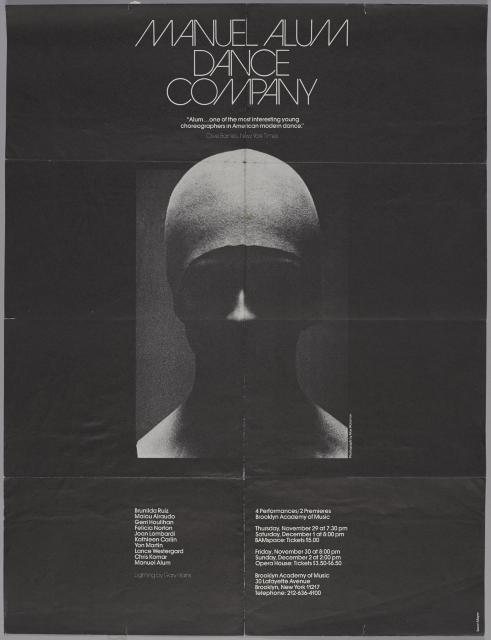
Poster for BAM, 1973
Why has Alum, so talented and transcendent in some ways, fallen into the “forgotten” bin of dance history? Going back to Barnes’ conjecture that this young dance artist had major potential, what happened to that potential? He choreographed more than fifty works, which elicited a range of responses. The many videos from his choreographic trajectory show that his craft, range, and audacity were sustained consistently. But most of the works, except for The Cellar and Monte, did not have a lasting impact. It has occurred to me that he could have used a guiding voice or dramaturg to strengthen his choreography. In fact, some critics have suggested something similar. Kitty Cunningham said the program she saw at Jacob’s Pillow “needed some judicious pruning.” Jennifer Dunning, writing in the New York Times, pointed to a “lack of focus” in his later works.[62] Aaron Cohen, writing for Gaysweek, was fascinated by Alum’s short Dream R.E.M. pieces, but felt the program as a whole didn’t quite work. “He can undoubtedly use a friendly adviser out front to counsel him about the overall arc of his program.”[63]
Another factor was that there was a shift in aesthetics around that time. The explosion of experimentation known as Judson Dance Theater, just a few blocks south of the Studio for Dance, questioned the existing aesthetics and structures of modern dance. As audience taste shifted away from the expressionism of Graham and Sokolow (just as, in visual art there was a shift away from Abstract Expressionism toward Minimalism), they were drawn toward either Alvin Ailey (loosely labeled “Black dance”) or Merce Cunningham (loosely labeled “abstract” dance). The expressionistic, angst-ridden style of Graham and Limón eventually was perceived as heavy-handed. Twyla Tharp and Trisha Brown were coming up at that time, each with a different mode of distinctive contemporaneity. Alum’s work, along with that of many modern dancers, started looking strained compared to the looseness of Tharp and Brown.
To my eye, his solo Saeta al Gran Poder, opened a fresh approach, with a more relaxed body carriage and an improvisational attitude. Part of the tragedy of Alum dying so young is that it’s possible he could have developed further in that direction. Although he had a distinctive movement vocabulary, his pieces were sometimes perceived as following in the style of Sanasardo, whose work threw a blanket of sometimes sinister darkness over everything. As Borek suggested in his 1971 Dance Magazine review, “I hope that Alum’s choreographic pursuits do not forever parallel Sanasardo’s notion of dance, powerful though it is, but that he arrives at a more unique expression of himself.”[64] A counter opinion to Borek’s perception was held by Diane Germaine, who felt that Manuel’s work was basically physical while Paul’s work was basically theatrical.[65] In any case, I think that after Alum had been to Japan, his work acquired new influences. During a lec-dem in Japan, he said, “Pure movement can be the subject itself. Just moving through space can say something that words cannot.”[66]
———————
In the late 1980s or early ’90s, Alum was stricken with the AIDS virus. In that condition, he still pulled off his last commission. He was sent by the Asia Society to Malaysia in 1991 to produce a dance, as he had done after his Japan visit a decade earlier. For Made in Malaysia: A Shamanic Journey, he gathered Malaysian performers and basically allowed them to dance as they would in their communities. The New York Times critic Anna Kisselgoff reviewed the piece, which appeared as part of the 1991 New York International Festival of the Arts: “Mr. Alum selected the artists in Malaysia and collaborated with them on a performance that used their idiom as an expressive language extended into a contemporary presentation.…the traditional-contemporary fusion was somewhat self-conscious but never less than beautiful.”[67]
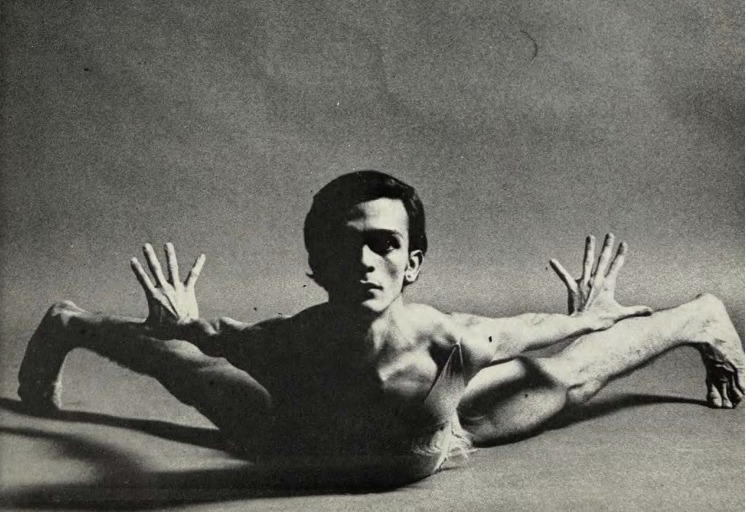
Manuel Alum photo Zachary Freyman for Dance Magazine, 1969
Margaret (Margie) Beals, Alum’s neighbor and friend, visited him in his loft. In this Vimeo she tells her story about Manuel: “In his exotic mode, he served me a Japanese cup of tea and told me that he was sick and wouldn’t survive.”[68] She was surprised that he took on the Malaysia project when he was so frail. She knew he needed to rest, so she offered for him to stay at a large empty house her family owned in Cape Cod. He enjoyed it there, soaking up sun and sand in his weakness. Then she arranged for Manuel to go home to Puerto Rico to his mother. She received this postcard, written on his 50th birthday: “Dear Margie, I spoke to you from Puerto Rico. I hope you heard me. It was beautiful, strange feeling, difficult. For me, 1993 is made of 525,600 minutes, and I intend to make the most out of each one of them…God is within me, for I made it so far, and I know I will make the most of it.”[69] And then he seemed to be inviting her to come down to Puerto Rico: “Come on Margie, Come. Time is short! And life is so amazing!”
¶¶¶
Special thanks to the dancers I interviewed and to Denivia Rivera an Khara Hanlon. And of course, thanks to the Jerome Robbins Dance Division of the NY Public Library for the Performing Arts, which holds such treasures in relation to Manuel Alum and many other dance artists.
Selected Bibliography
Franko, Mark. Excursion for Miracles: Paul Sanasardo, Donya Feuer and Studio for Dance (1955–1964).
Footnotes
[1] Margaret Beals, Pathways: Manuel Alum, 1998. Website video.
[2] Mark Franko, Excursion for Miracles: Paul Sanasardo, Donya Feuer and Studio for Dance (1955–1964), 176 N 23.
[3] Zita Allen, “Alum: the precision of a falcon,” The Chelsea-Clinton News, January 1972.
[4] Linda Winer, “Alum: A Wizard of Mind and Body,” Chicago Tribune, January 16, 1974.
[5] Franko. Excursion for Miracles, 176 N 23.
[6] Jennifer Dunning, “A Choreographic Collage ‘Made in Japan,’” New York Times, October 31, 1980.
[7] Lecture demonstration, Tokyo, 1979, MGZDIF 7752.
[8] Marguerite Oerlemans-Bunn, “The Body Cannot Lie: Manuel Alum on the Creative Process,” 80 Grados Prensasinprisa, Publicado, 11 de Abril de 2020, accessed August 20, 2024.
[9] Quoted in Franko, Excursion for Miracles, 30.
[10] Franko, Excursion for Miracles, 10.
[11] Franko, Excursion for Miracles, 87.
[12] Lecture demonstration, Tokyo, 1979, MGZDIF 7752.
[13] Don McDonagh, “Manuel Alum Offers Dark‐Hued Dances With Hint of Humor,” New York Times, August 18, 1974, 40.
[14] Clive Barnes, “Dance: New Choreographer Arrives,” New York Times, November 23, 1970, 47. Accessed August 23, 2024.
[15] Don McDonagh, “Manuel Alum Offers Dark-Hued Dances.”
[16] Tom Borek, review, Dance Magazine, January 1971, 74.
[17] Email to author, September 27, 2024.
[18] Barnes, “Dance: New Choreographer Arrives”
[19] Barnes, “Dance: New Choreographer,”
[20] Phone interview with author, September 30, 2024.
[21] Doris Hering, “A Darkening Pond: Paul Sanasardo Reviewed,” Dance Magazine, August 1971, 73.
[22] Phone interview with author, October 1, 2024.
[23] Phone interview with Diane Germaine, September 30, 2024.
[24] Omonike Akinyei, “Manuel Alum…Close to the Earth,” a presentation at the NY Public Library for the Performing Arts, December 4, 2023.
[25] Akinyei, “Manuel Alum…Close to the Earth.”
[26] Zoom with the author, October 3, 2024.
[27] Zoom meeting with author, October 3, 2024
[28] Phone interview with the author, October 1, 2024.
[29] At the age of 18, Pina Bausch had a government grant from Germany to study at Juilliard for one year. Antony Tudor, one of her teachers there, suggested that she might like to work with Sanasardo. So in the fall of 1959, in addition to a full load at Juilliard, she went downtown to rehearse, and even collaborate with Sanasardo and Feuer. She performed in their evening at the 92nd Street Y in December, 1959. She extended her time in New York an additional year. For more on that crucial period in her life, see my historical essay about Pina Bausch in that period.
[30] Jennifer Dunning, “Alum Dancers at BAMspace offer ‘W.O.M.B—Pray for Us,’” New York Times, December 3, 1973.
[31] Clive Barnes, “Dance: Alum Company,” New York Times, December 16, 1972, accessed June 8, 2024
[32] Deborah Jowitt, “I Ate the Whole Thing,” Village Voice, December 28, 1972, 24-26.
[33] Jowitt, “I Ate,” 24.
[34] Zoom with the author, October 3, 2024.
[35] Phone interview with the author, June 14, 2024.
[36] Phone interview with the author.
[37] Phone interview with the author.
[38] Tom Johnson, “The American Dance Festival at Connecticut College,” Village Voice, August 1, 1974, Courtesy Ira Taxin.
[39] Rose Ann Thom, “Innovation or Inundation,” Dance Magazine, October 1974, 22.
[40] Oerlemans-Bunn, “The Body Cannot Lie.”
[41] Oerlemans-Bunn, “The Body Cannot Lie.”
[42] Quoted in Jennifer Dunning, “A Choreographic Collage.”
[43] Henry Scott Stokes, “Manuel Alum Discovers a Difference in Cultures,” Special to the New York Times, October 21, 1979, 60. Accessed October 6, 2024.
[44] Stokes, “Manuel Alum Discovers.”
[45] Call number *MGZIC 9-4849, Jerome Robbins Dance Division, NY Public Library for the Performing Arts.
[46] Francis Mason, broadcast of “New York at Night,” WQXR Radio, November 2, 1981, found in Manuel Alum Papers, Jerome Robbins Dance Division, NY Public Library for the Performing Arts.
[47] Mason, “New York at Night.”
[48] Lillie F. Rosen, “Reviews,” Dance News, February 1981, 11.
[49] Originally posted on Facebook, confirmed on email to author, November 13, 2024.
[50] Jennifer Dunning, “A Choreographic Collage.”
[51] Dunning, “A Choreographic Collage.”
[52] Phone interview with author October 7, 2024.
[53] E-mail with author, February 12, 2026.
[54] Jennifer Dunning, “Dance: Alum’s ‘Monte,’” New York Times, June 26, 1987, C10.
[55] Oerlemans-Bunn,“The Body Cannot Lie.”
[56] Manuel Alum Papers, c. 1970–1991. (S) *MGZMD 95-3, Jerome Robbins Dance Division, NY Public Library for the Performing Arts.
[57] Manuel Alum Papers.
[58] Jack Anderson, “Central American Tensions,” New York Times, November 14, 1988. Accessed October 18, 2024.
[59] Quoted in Anderson, “Central American Tensions.”
[60] An example of Akio Suzuki’s music was recorded at Issue Project Room in 2016, accessed November 11, 2024.
[61] Wendy Perron, The Grand Union: Accidental Anarchists of Downtown Dance, 1970–1976. Explains how this legendary improvisation group emerged from Judson Dance Theater.
[62] Jennifer Dunning, “Alum Dancers at BAMSpace.”
[63] Aaron Cohen, “Hype, Hope, and Hooray,” Gaysweek, March 5, 1979, 13.
[64] Tom Borek, review of Manuel Alum, Dance Magazine, January 1971.
[65] Diane Germaine interview with the author, September 30, 2024.
[66] Lecture-demonstration in Tokyo, 1979.
[67] Anna Kisselgoff, “Dance View: Extraordinary Experimentation from Overseas,” New York Times, June 30, 1991.
[68] Interview with the author, September 23, 2024.
[69] Quoted in “Pathways: Manuel Alum” by Margaret Beals, 1998,
Unsung Heroes of Dance History 8