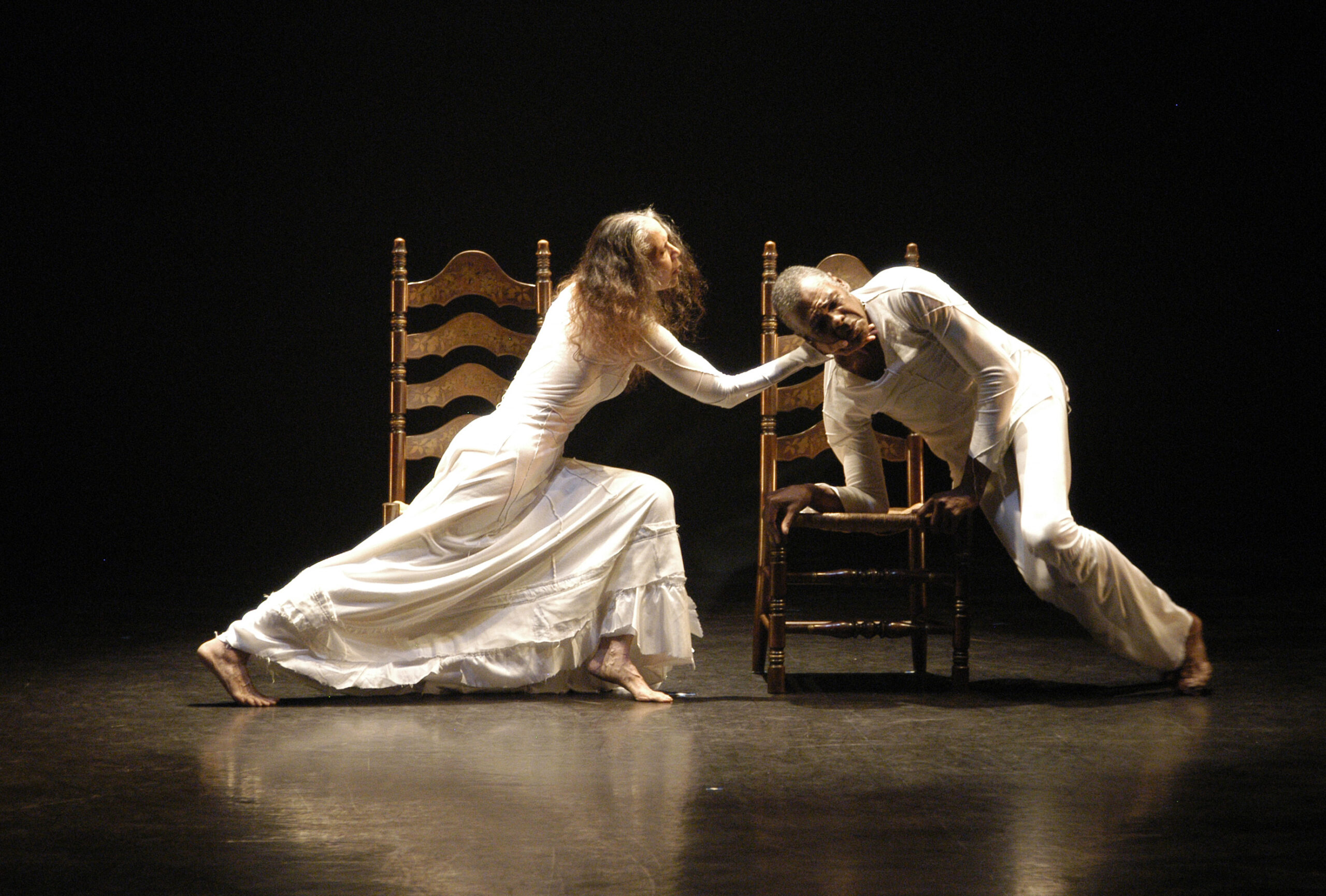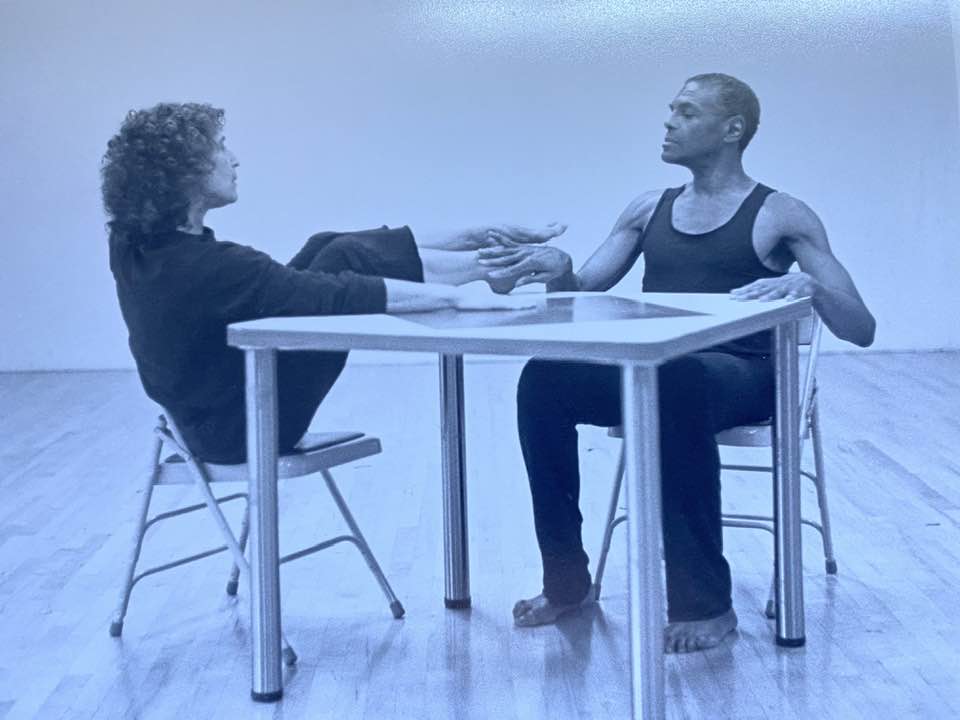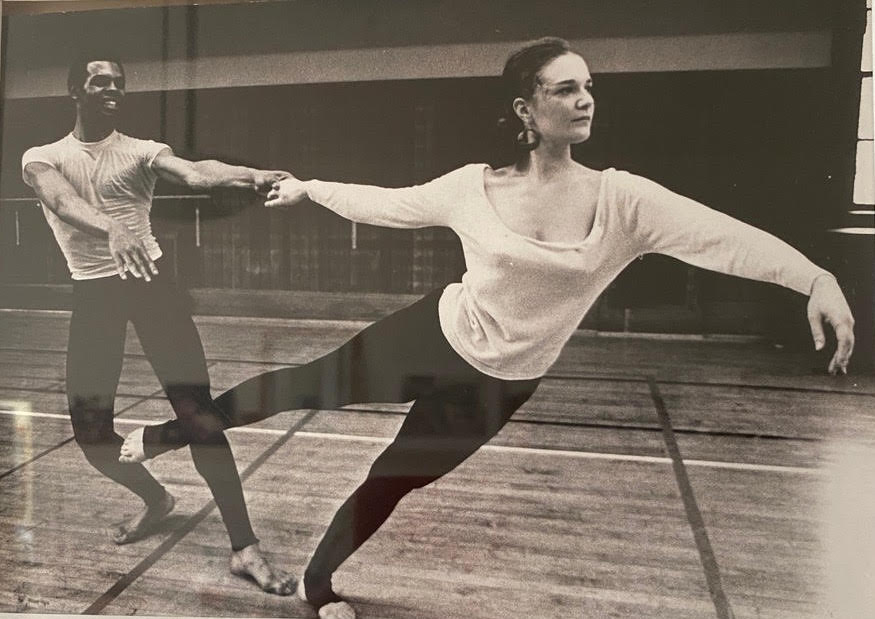
In Memoriam: Paul Sanasardo (1928–2026)

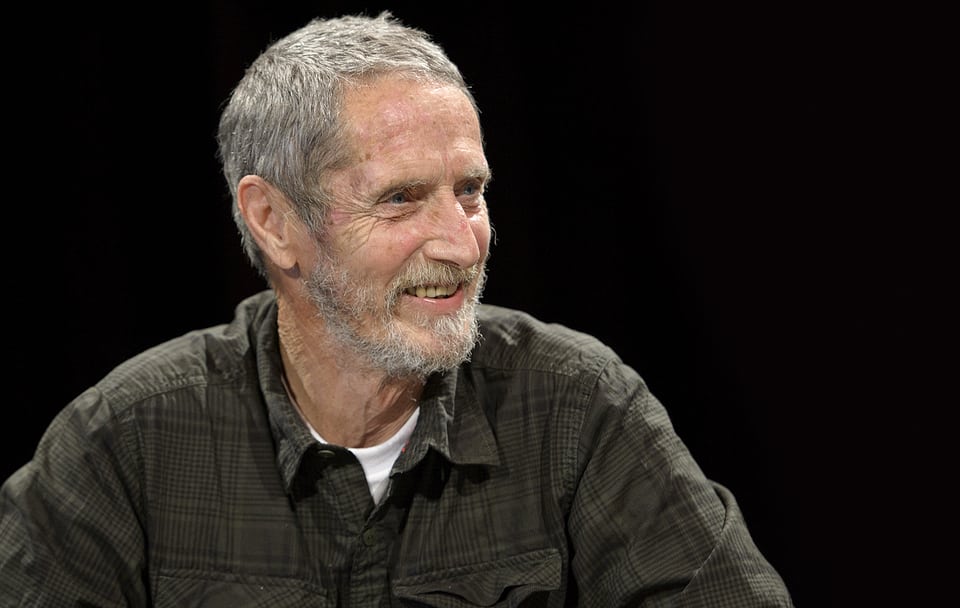
One of the fascinating dancer/choreographers of mid-20th-century American modern dance, Paul Sanasardo died on July 23 at the age of 97. He made works in the intense expressionist mode of Anna Sokolow, co-created an experimental space called the Studio for Dance, and taught rigorous technique classes for decades. He made more than eighty ballets, many of them full-evening works.

Born in Chicago, Sanasardo studied painting at the Art Institute of Chicago. He took ballet lessons with Bentley Stone and occasionally with modern dance improvisor Sybil Shearer. He served in the army from 1952 to 1954, but his longtime friend Douglas Nielsen, says, “Paul conscientiously objected to using a gun, so he was assigned to be a cook.” On his time off, he studied in Washington, DC, with Erika Thimey, a proponent of the Mary Wigman/Hanya Holm style, and danced with the Washington Dance Theatre. In 1954 he moved to New York, where he studied on scholarship at the Martha Graham School and also with Antony Tudor, Margaret Craske, Mia Slavenska, and Karel Shook. He danced with Anna Sokolow, who cast him in the original “Panic” solo in her masterwork Rooms (1955). For years, he was a guest artist with Pearl Lang, partnering her often, and also appeared on live television and Broadway.
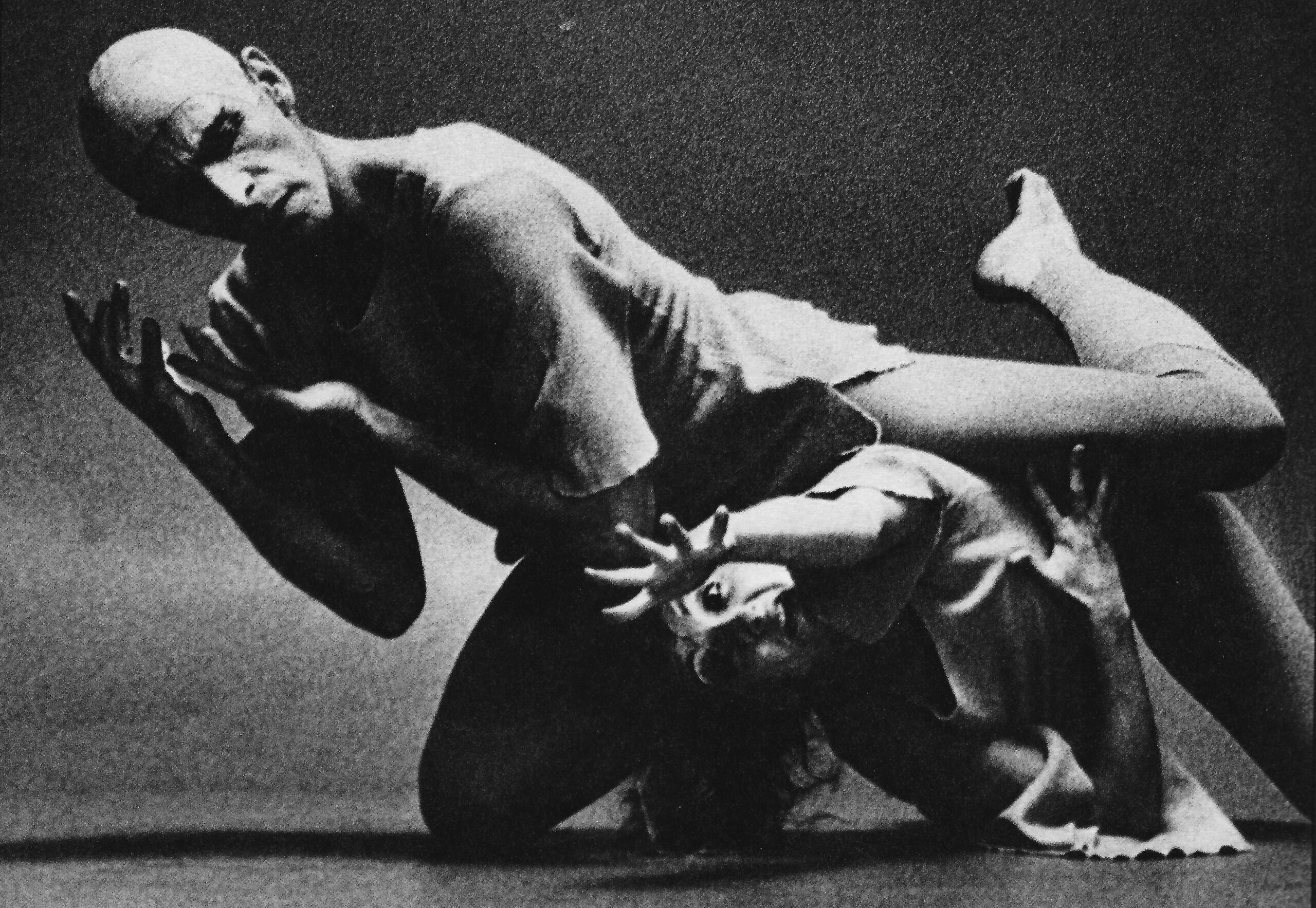
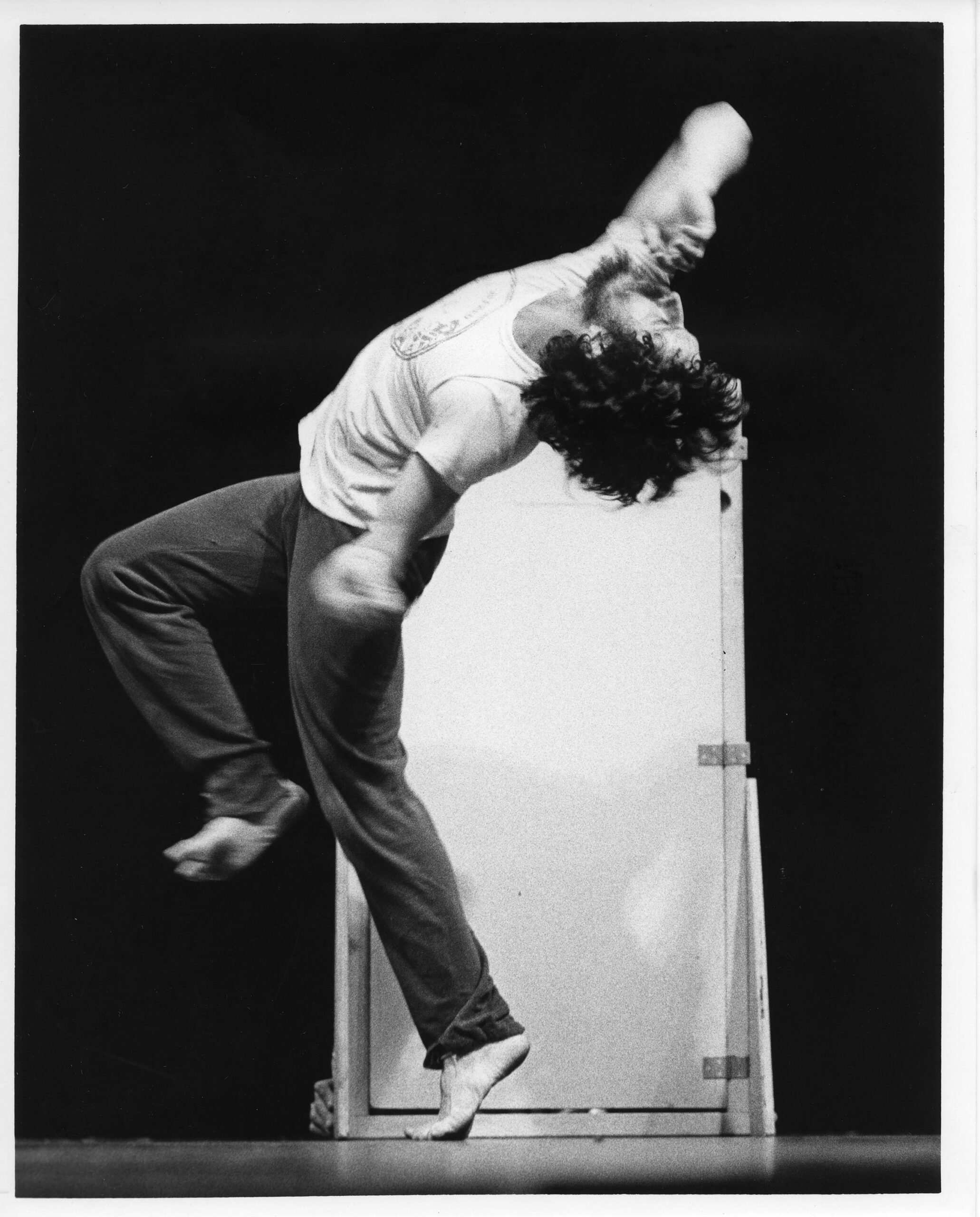
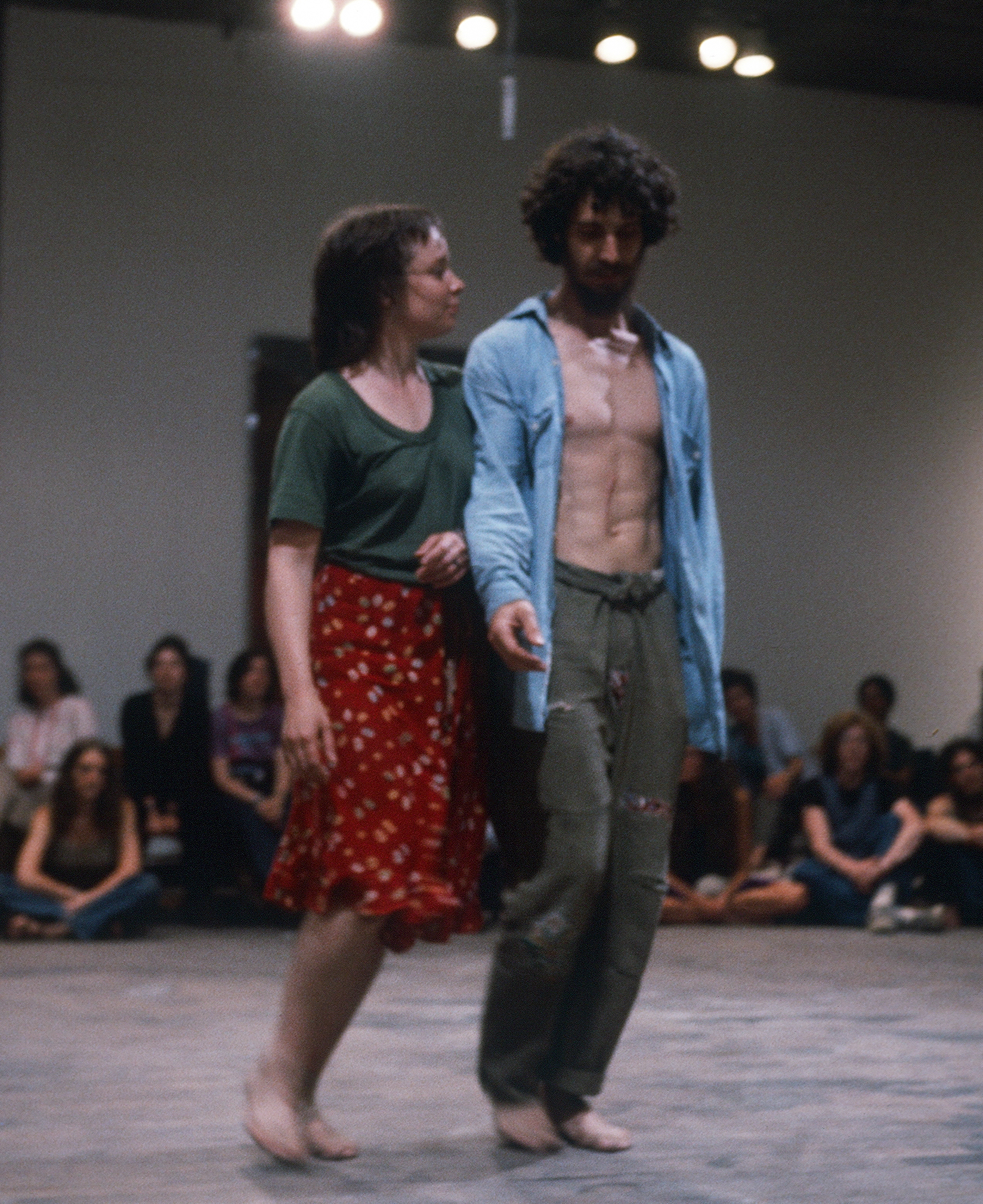
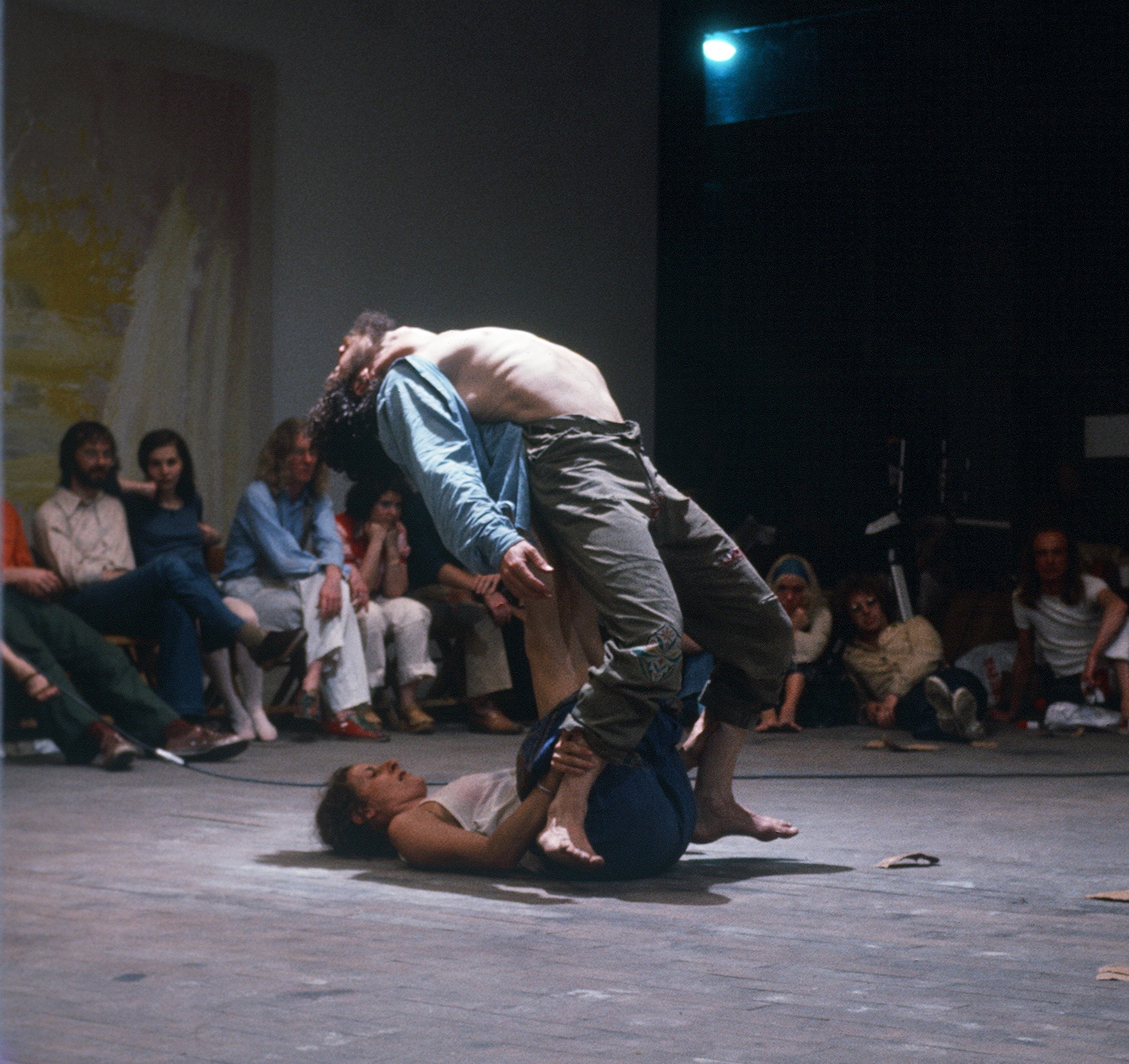
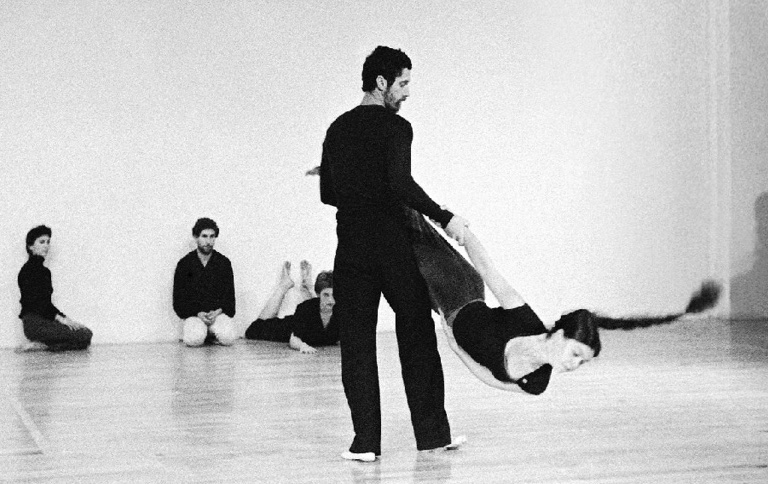
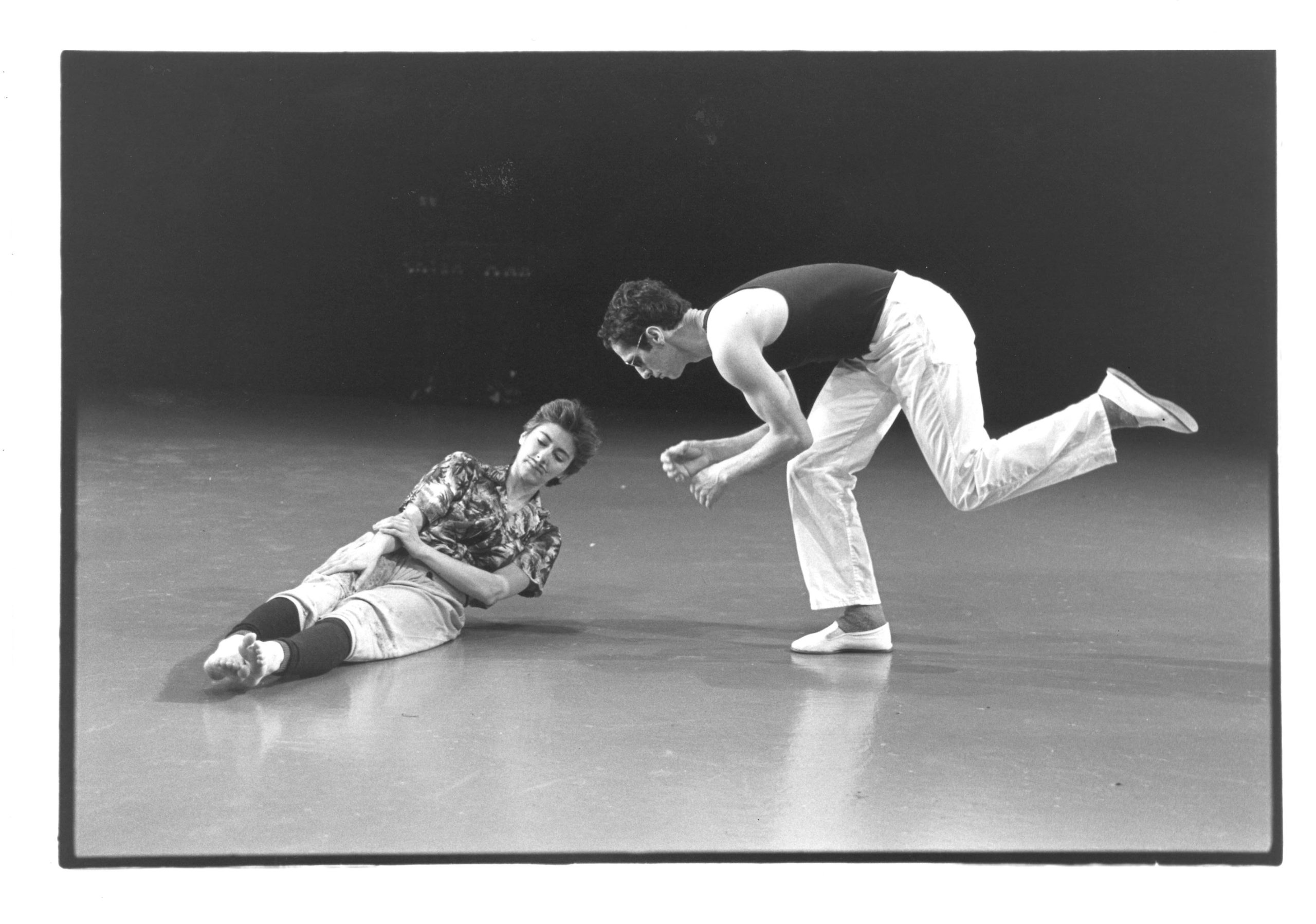
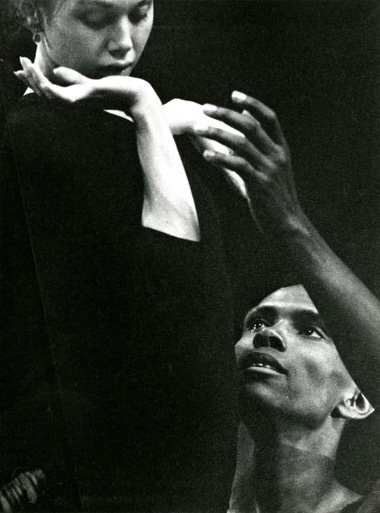
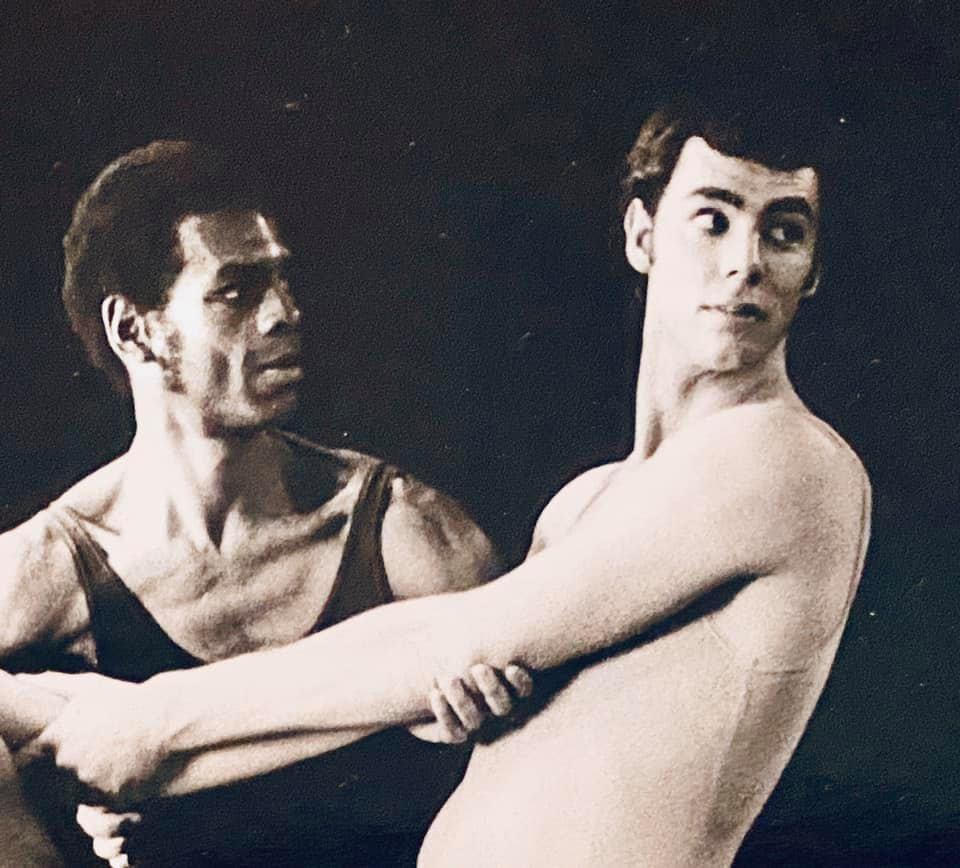
The Path (1972), Sanasardo with Michele Rebeaud, ph © Max Waldman

In 1958 he teamed up with Donya Feuer, a Juilliard grad who had danced with Graham, to establish the Studio for Dance (later Modern Dance Artists), a hub of experimental work that tended toward dance theater. (See Mark Franko’s excellent book Excursion for Miracles: Paul Sanasardo, Donya Feuer, and Studio for Dance, 1955–1964.) At Tudor’s urging, Sanasardo invited Pina Bausch, who was in New York on a grant to attend Juilliard, to work with them. She collaborated with them in Phases of Madness (1960), about which Paul joked, “We just beat each other up onstage.”[1] She performed with them at the 92nd Street Y while still a student. (For my essay about Bausch’s time in NYC, I interviewed Sanasardo about his influence on her.)

One of the extraordinary aspects about the Studio for Dance is that it nurtured a children’s company. It wasn’t just annual recitals, but these kids were serious players in the works. Eleven of them performed in In View of God (1959). Pina’s observation: “There was nothing childish. They were like adults, only very young ones: Young human beings. There was nothing cute. It was very simple.”[2]
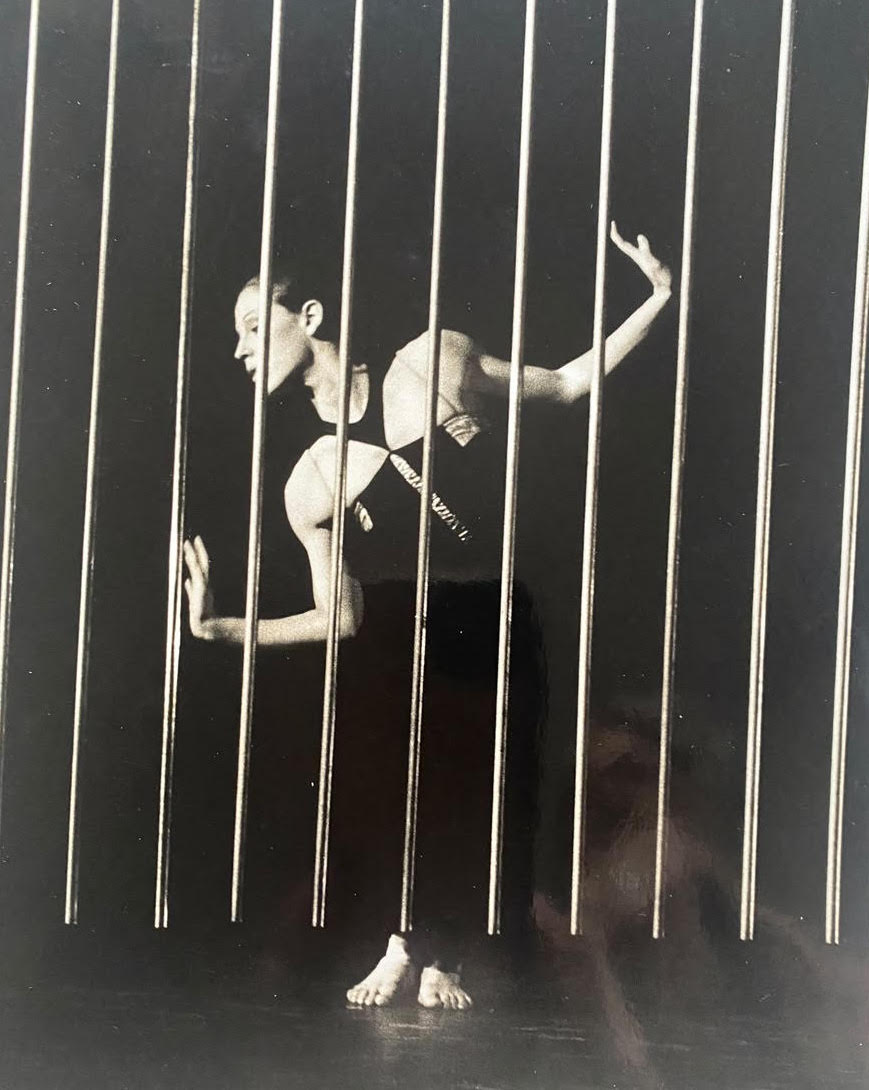
Metallics (1964) with Holly Cavrell, Courtesy Cavrell

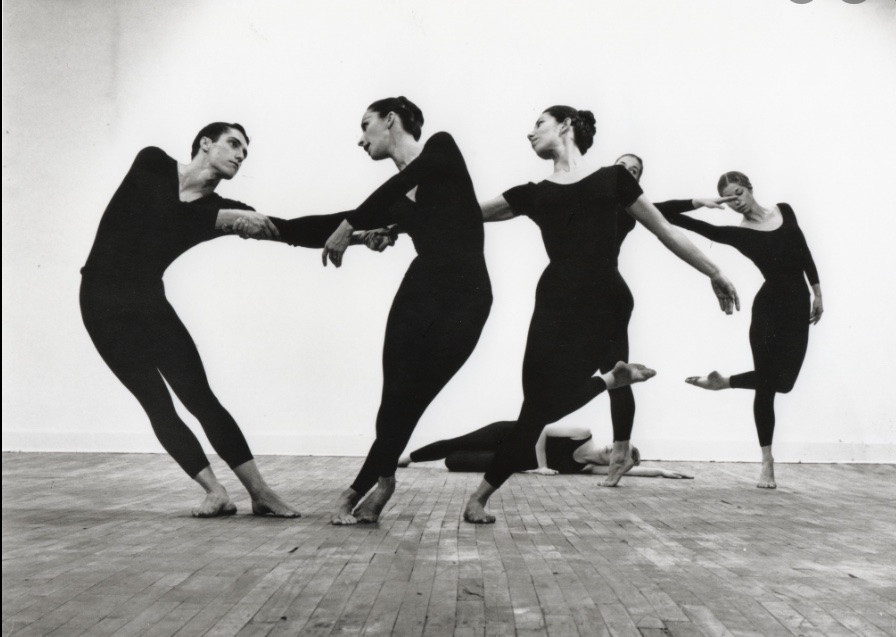
After Feuer decamped for Sweden in 1963, Sanasardo started the Sanasardo Dance Company, which quickly attracted both audiences and critics. As a performer, he had a double-edged intensity. As Doris Hering noted, “He could be simultaneously evil and heroic.”[3] According to Nielsen, he created his best work in the 1960s including Metallics, Shadows, The Path, and Pain. Anna Kisselgoff described Metallics, which entered the reps of both Ailey and Nederlands Dans Theater, as “an enigmatic psychological study in solitude.” Deborah Jowitt wrote in the Village Voice, “Sanasardo is concerned with human feeling, with powerful emotion. His dancers are all steel-and-fire supermen—beautiful and almost terrifying in their strength.”[4]
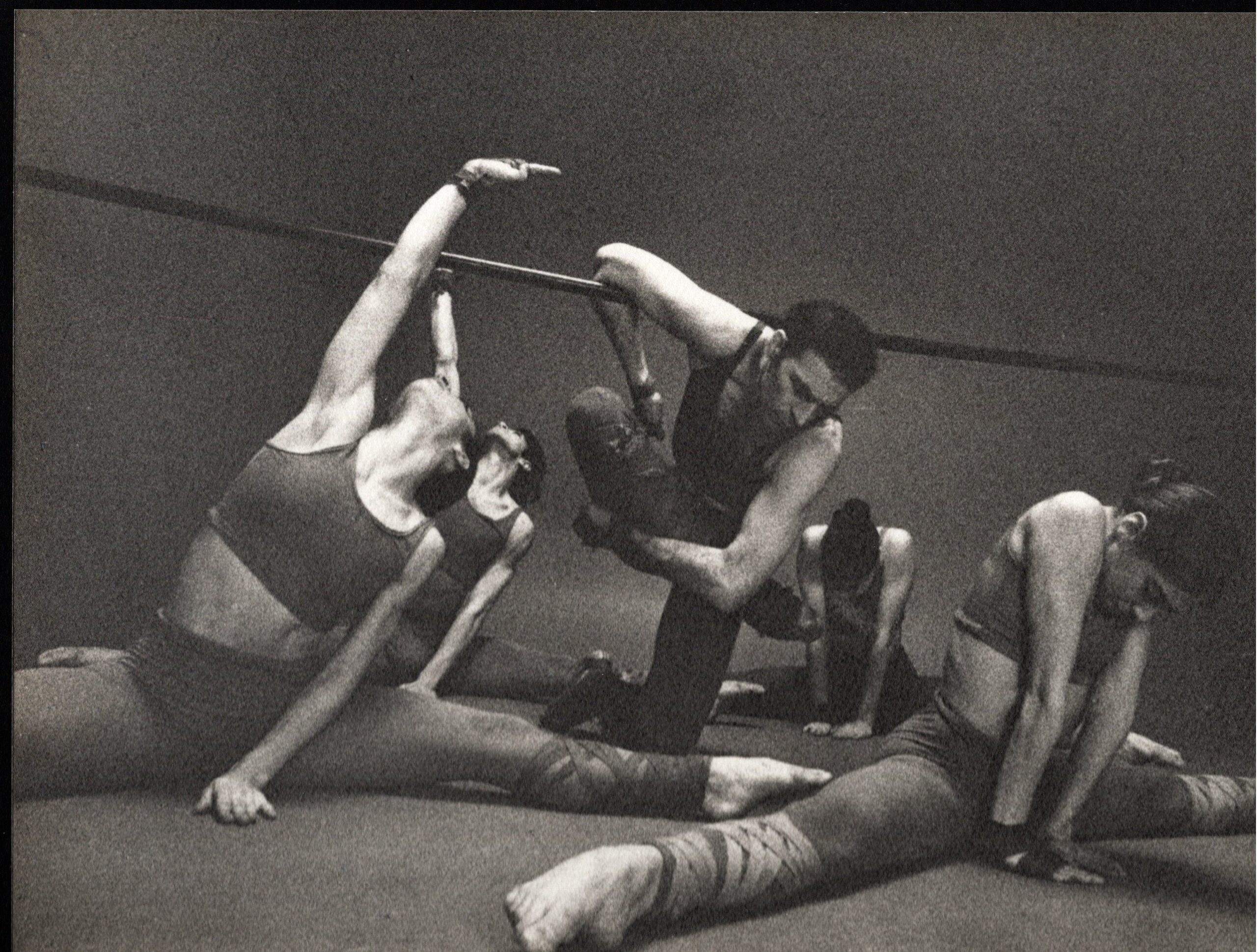
 

Pain (1969), with Sanasardo, center, ph © Max Waldman, 1970
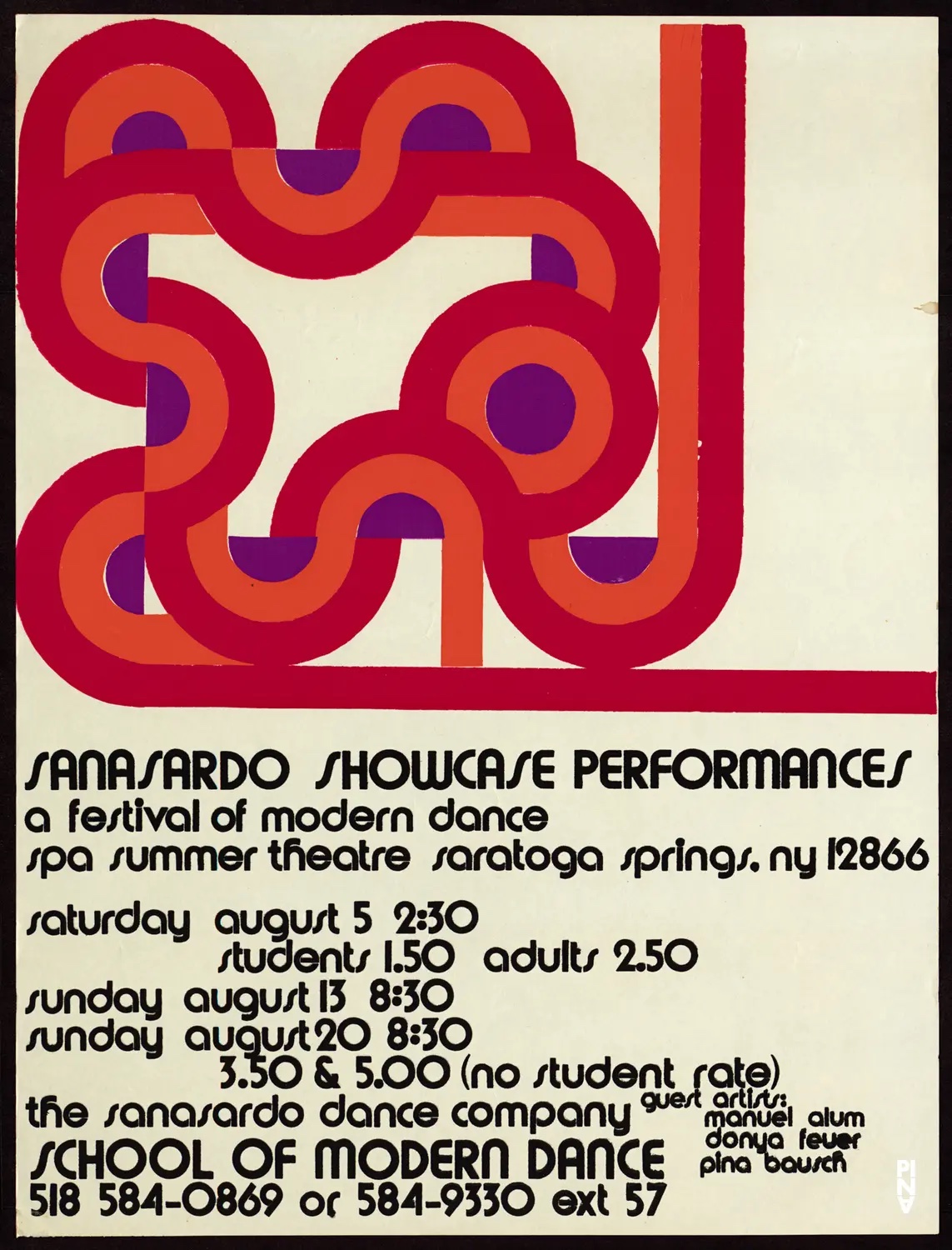
Poster forfrom Bausch Fndn

Sanasardo was a revered teacher, fielding requests from all over the country, including for the Ailey company. From 1969 to 1974, he founded and led the School for Modern Dance at Saratoga Performing Arts Center in Saratoga Springs, NY, with his protégé Manuel Alum as assistant director. During the summer of 1972, Pina Bausch joined his  residency, and that summer the showcase included works by guest artists Alum and Bausch. Pina showed Nachnull (After Zero) and PHILIPS 836 887 DSY, and Manuel showed Sextetrahedron. French dancers Dominique Mercy and Malou Ariado, whom Alum had met in France, were part of the company that summer. When Paul could no longer procure visas for them, they both became founding members of Pina Bausch’s company in Wuppertal the following year.
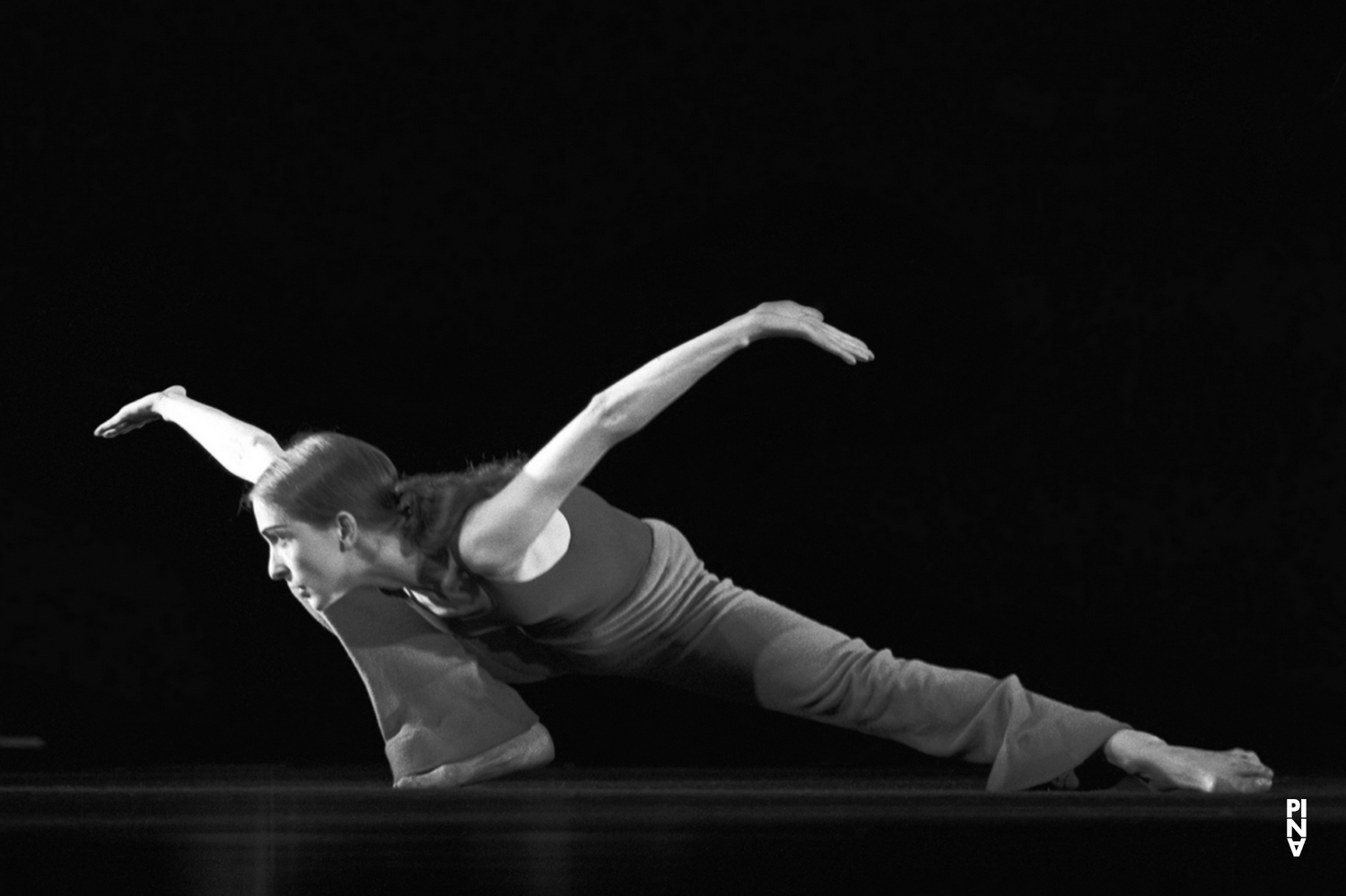
Pina Bausch in her solo PHILIPS 836 887 DSY, included in the Sanasardo Showcase, 1972, Bausch Fndn

In 1971, Doris Hering, reviewing a concert that Sanasardo shared with Alum, wrote, “What I like most in the choreography of both Sanasardo and Alum is the deep sense of responsibility. It extends them beyond themselves. More than that, it affects their beautifully trained and obviously committed company. It also frees their choreography.”[5] However the constant pitch of angst was sometimes hard to sit through, causing Anna Kisselgoff to remark, “No one leaves a Sanasardo concert laughing.”[6]
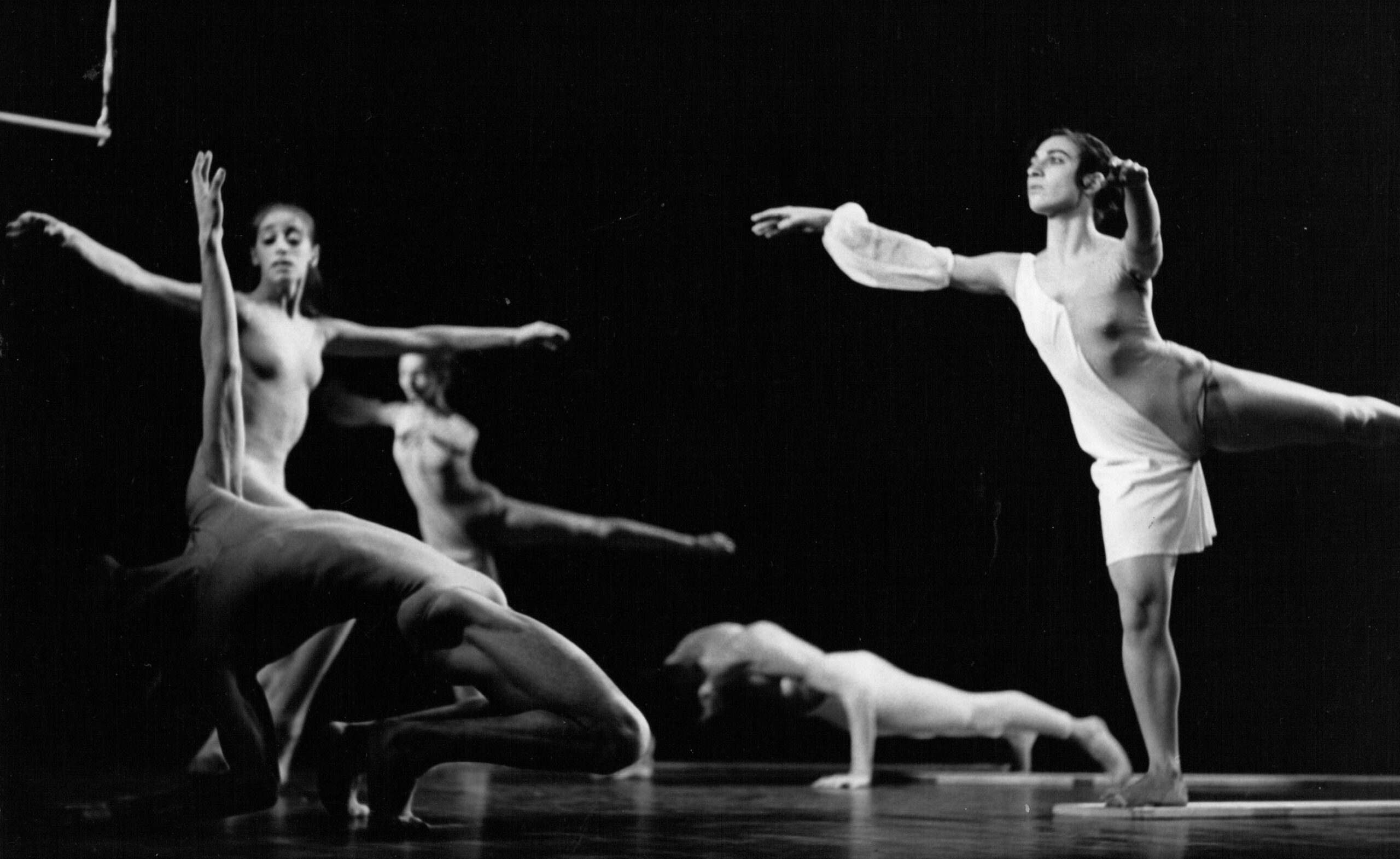
Cut Flowers (1966) with Mark Franko at right, ph Oleaga, Courtesy Franko
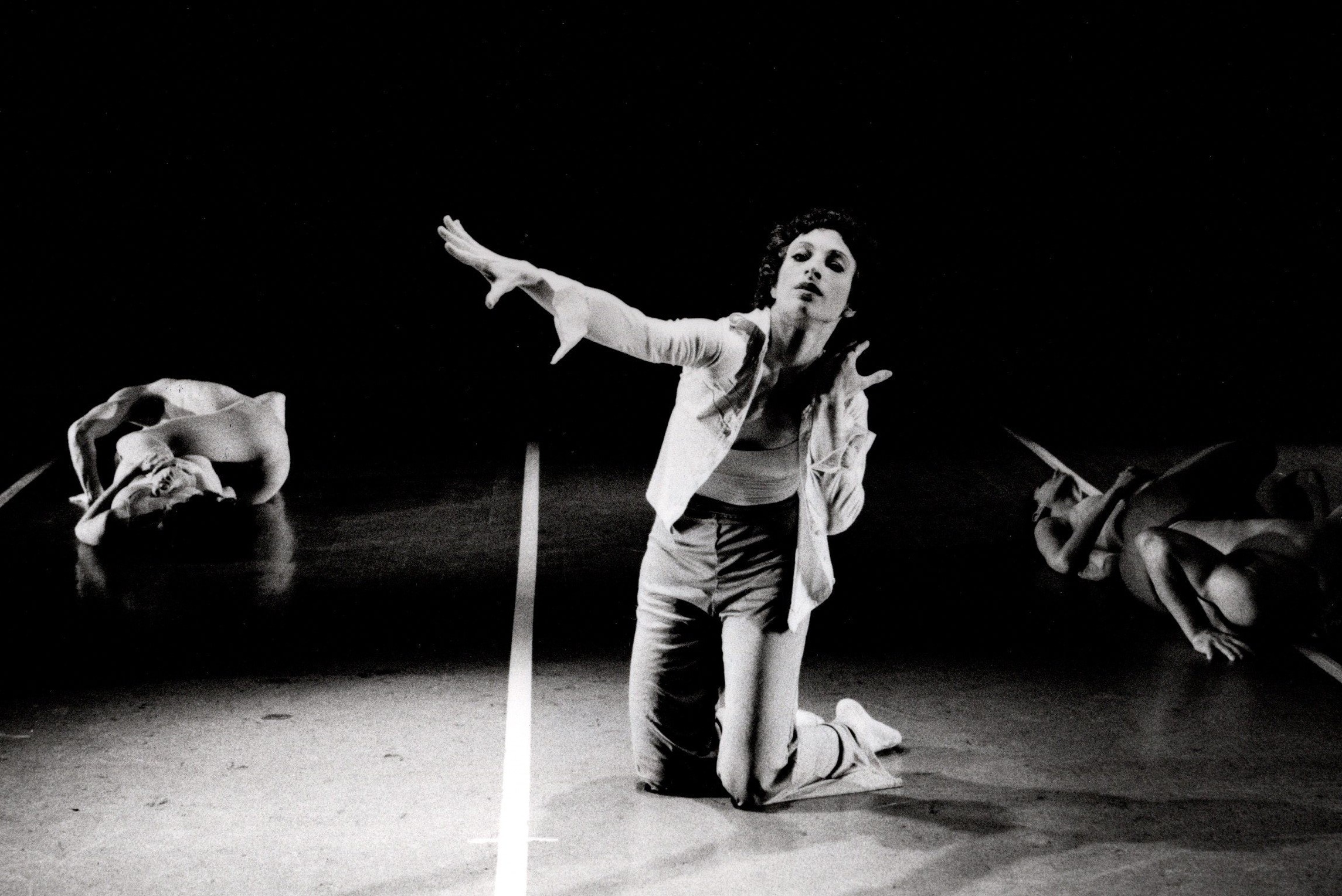
A Consort for Dancers (1975), with Diane Germaine as Anne Sexton, ph Lois Greenfield, Courtesy Germaine


But Sanasardo was finding his way. “You learn by doing,” he said in an interview. “Your dancers have a tremendous influence on you.” [7] As if to prove that, Sanasardo generously gave opportunities to his main dancers to show their own choreography. They included Willa Kahn, Diane Germaine, Gerri Houlihan, Joan Lombardi, and Manuel Alum. It was risky for Sanasardo. On at least one occasion, Alum, who was an extraordinary dance artist, was reviewed more favorably than Sanasardo. (My historical essay on Alum as one of my Unsung Heroes of Dance History is here.) In 1971, Clive Barnes wrote in the New York Times, that Sanasardo’s

works have a high degree of polish and finesse. What they do not have is that quality of raw creativity that ironically enough is quite often shown by Mr. Sanasardo’s best‐known student and leading dancer, Manuel Alum. Mr. Alum is a disciple of all of Mr. Sanasardo’s virtues and adds a certain abrasive quality of his own.[8]

Sanasardo put his company on hold in 1978 when he went to Tel Aviv to direct the Batsheva Dance Company on a three-year contract. When he returned three years later, he resumed making dances, and Kisselgoff wrote that “Mr. Sanasardo is still at his best when he is exorcising his demons.”[9] But, as Nielsen says, “His heart wasn’t in it.” He disbanded his company in 1986. He and his life partner, William Weaver, moved to a small farmhouse in Cooperstown, NY, where he could paint in a silo. After Weaver died, in 2003 he returned to Chicago, where he was active, teaching steadily (free of charge) and choreographing with Larry Long at the Ruth Page Center for the Arts. He made a new ballet for Joel Hall Dancers to recordings by Nina Simone (an idea that he had hatched earlier with Alvin Ailey). And he continued painting.

In 2011, he was honored by the American Dance Guild with a Lifetime Achievement Award.

§§§
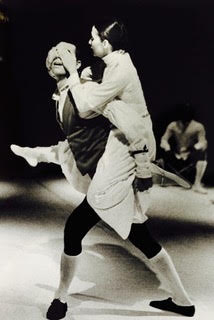
Memory Suite (1975) with Nielsen and Janet Panetta, Courtesy Nielsen

Sources: Douglas Nielsen, David von Ehrlicher, Chicago Dance History Project 2016 interview, my essays on Pina Bausch and Manuel Alum, the International Dictionary of Modern Dance, and Mark Franko’s book, Excursion for Miracles.

Memories from his dancers…

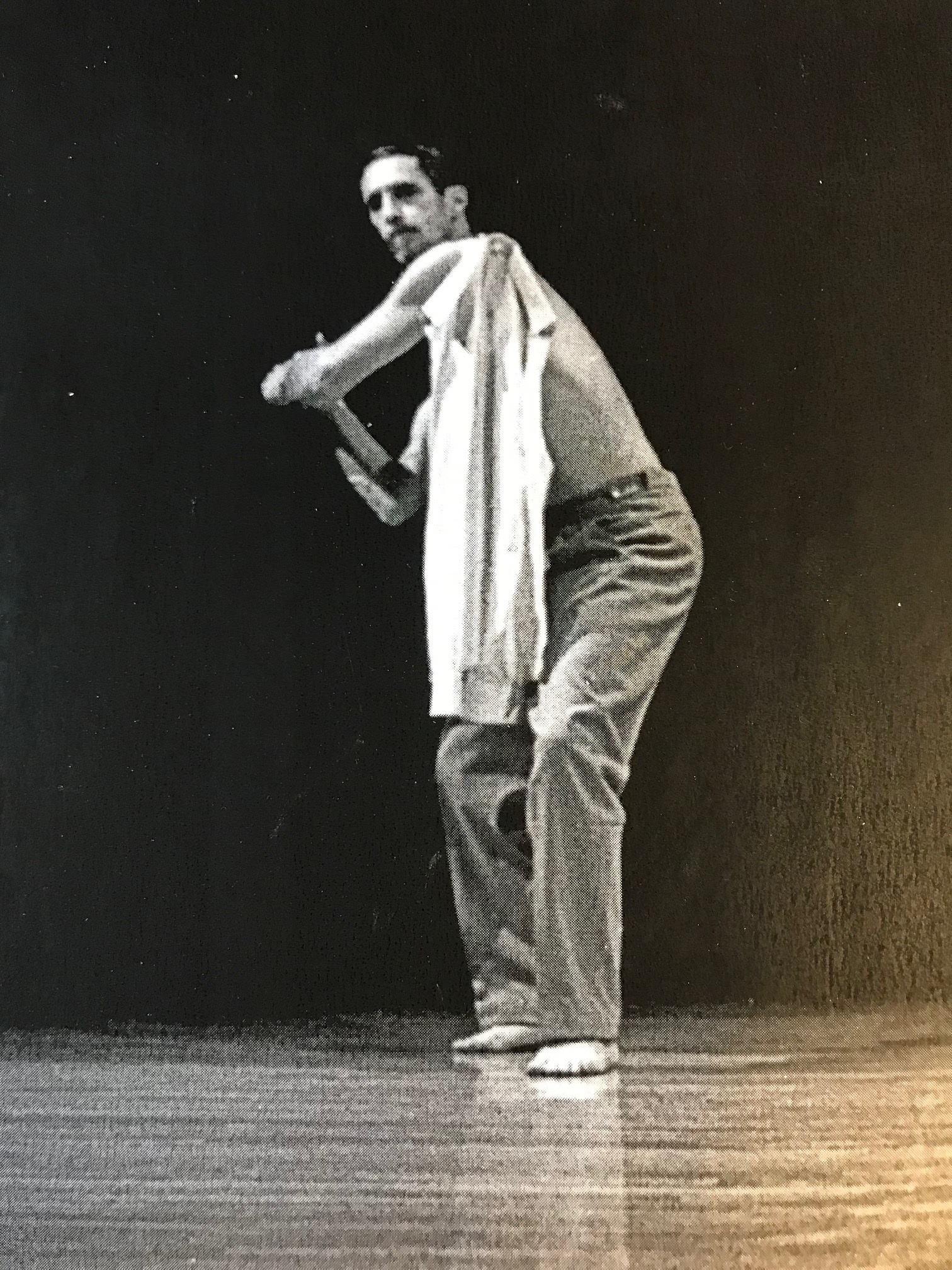
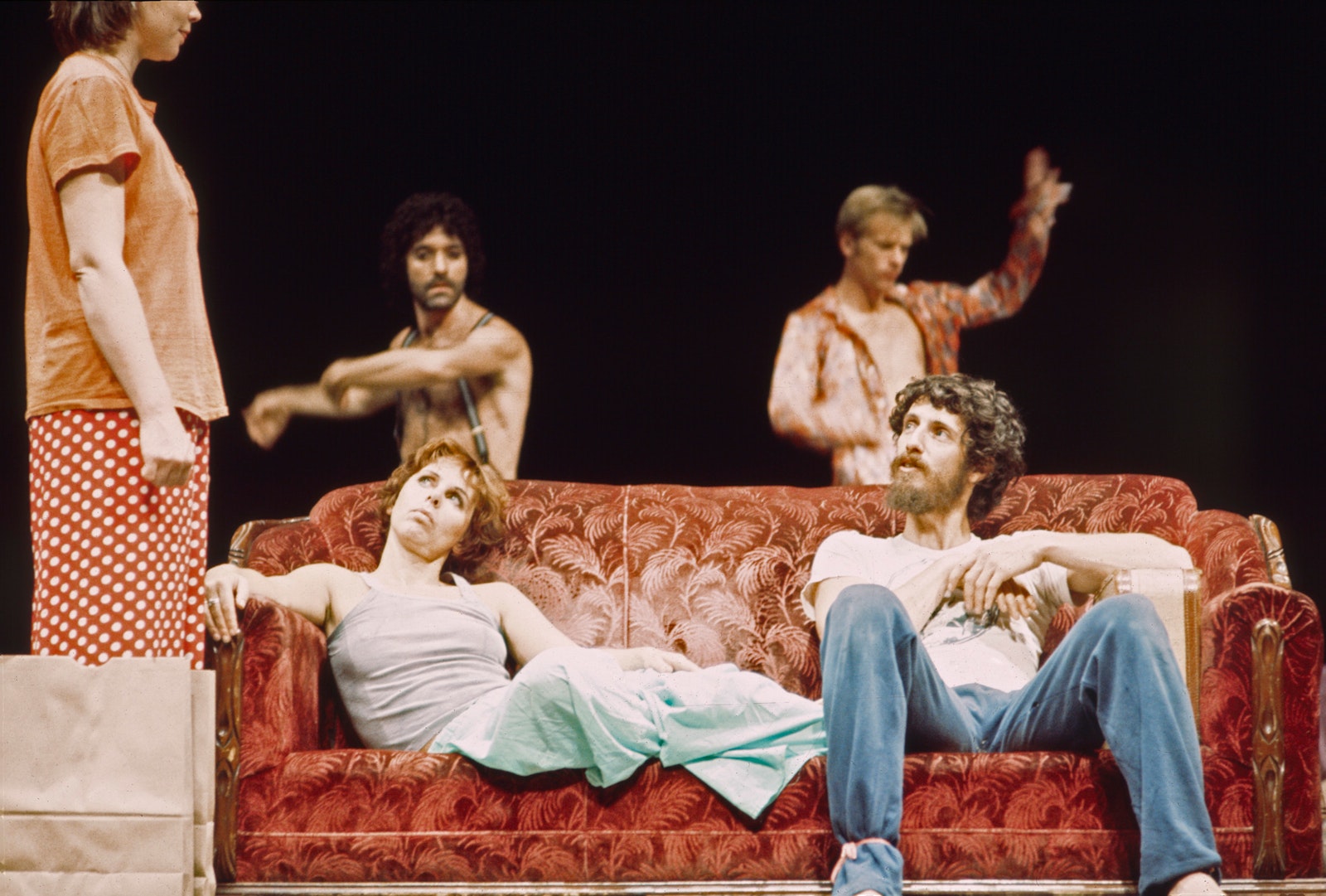
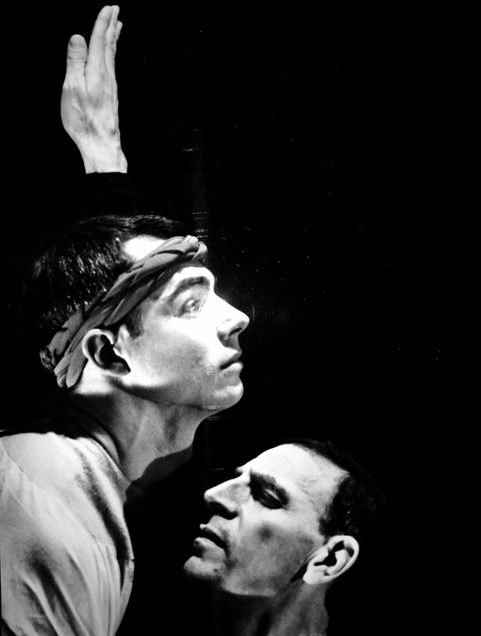
Paul always told the story that when Antony Tudor first saw Paul dance a solo, he said, “You couldn’t teach that to anyone” In four words: Feelings. Action. Drama. Humanity. No steps. Who but Paul Sanasardo would dare choreograph an entire evening to the spoken word from The Death Notebooks by poet Anne Sexton? (A Consort for Dancers, City Center Downstairs, NY, 1975.) We were actors who danced. After that Paul choreographed a duet, Abandoned Prayer, based on Christ and Judas. Paul was Judas. In rehearsal he kissed me on the cheek, but onstage he kissed me on the mouth. When Paul became the director of Batsheva Dance Company, I went with him and stayed three years. When we got back to NYC, Paul and I collaborated on a duet, Five Cases, which again felt more like a play without words.
—Douglas Nielsen is a performer, choreographer, teacher, art collector and former professor in the University of Arizona School of Dance. After performing and teaching in many countries, he founded his own group in 1981.
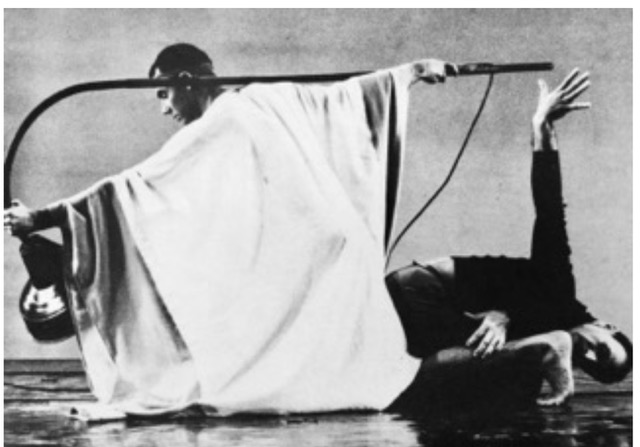
Both photos: Abandoned Prayer, with Nielsen and Sanasardo, Courtesy Nielsen


Paul was complex—a storyteller who could not be reined in, an old school taskmaster, passionate and overwhelming, not at all politically correct. Deep and dark and emotionally direct, Paul was also so very sentimental and generous in every way with a beautiful smile full of warmth and vitality. Through my magical introduction to dance as a member of his children’s company, my memories revolve around the tender treatment of his “children” in the dances that he and Donya Feuer created in that unique time and place in the late 1950’s/early 60’s at Studio for Dance. In the numerous times we connected throughout Paul’s long life, I was forever 12-year-old Judy Canner, one of his “children.” I am so grateful for Paul’s love and artistry, his forceful nature and his giving heart.
—Judith Canner Moss, Dancer/Choreographer/Teacher, on the faculty of Queensborough Community College
—I am also including this link to the short film/interview with Paul made by Sally Bowden and me in 2007, videotaped by Michael Moss with post-production/editing by Andrew Gurian.
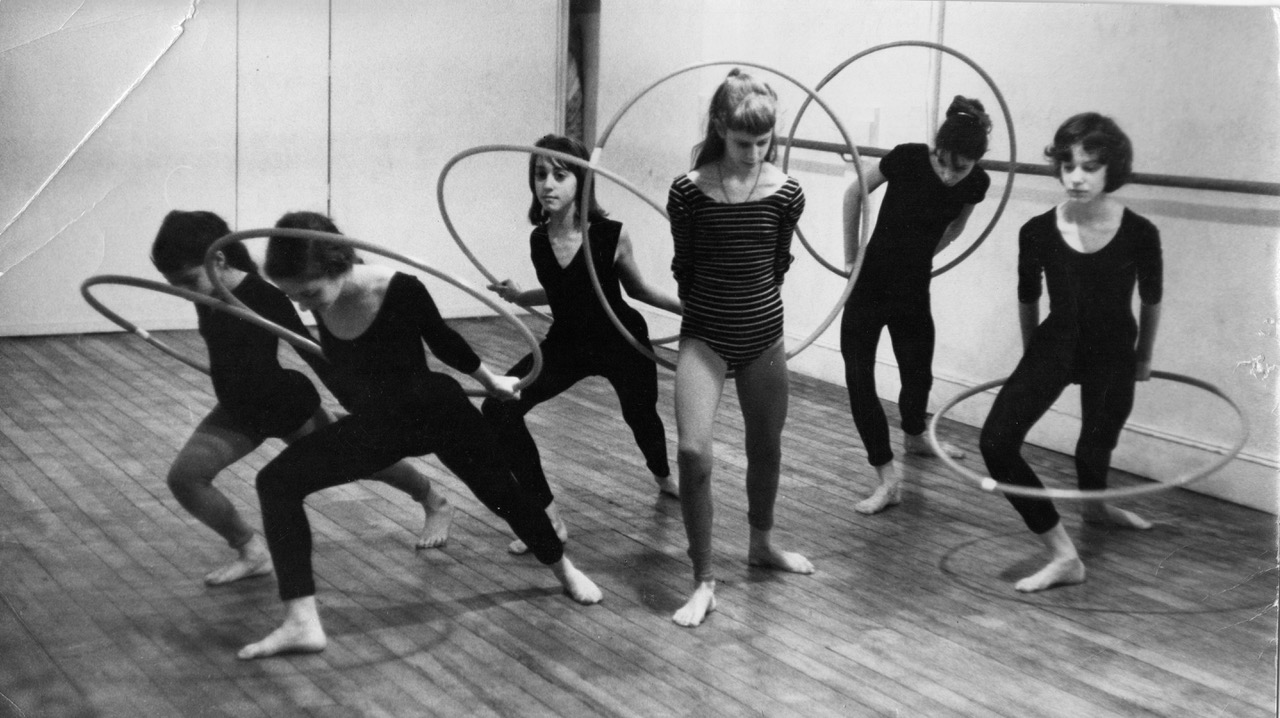
Children rehearsing: Ruth Frank, Ellen Shookhoff
Judith Blackstone, Kathy Bushnell, Willa Kahn, Judith Canner Moss, Courtesy Moss
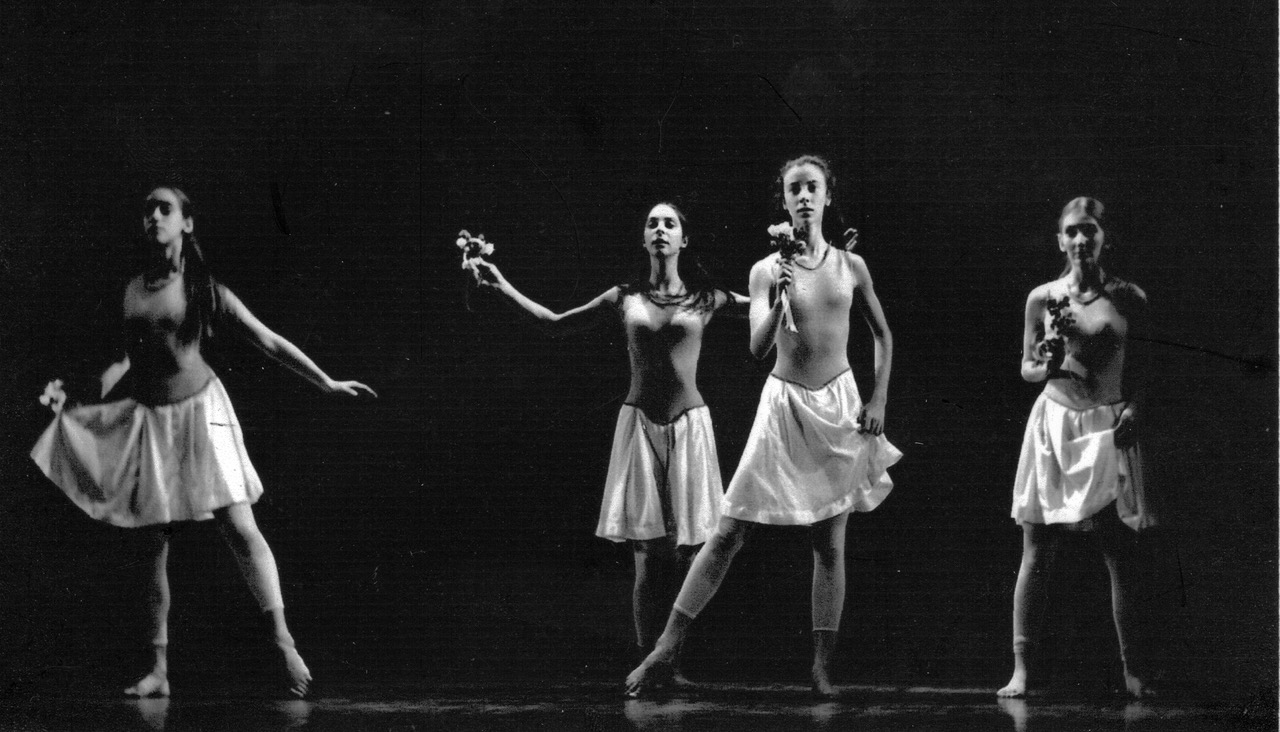
The Children’s Group in Sanasardo’s Pictures in Our House (1964): L to R: Judith Blackstone, Willa Kahn, Judith Canner Moss, Sally Bowden, Courtesy Moss

Paul’s advanced classes were unusually diverse even for the 1960s. Company members included at different times across the decade Loretta Abbott, Gus Solomons, jr., Martin Bland, Strody Meekins (who also danced with Eleo Pomare), Brenda Dixon-Gottschild, Diana Ramos, Michelle Llauger and Milagro Llauger, and, of course, Manuel Alum. In class one could see Juan Antonio, Ulysses Dove, Roberta Pikser, Clyde Morgan, Dyanne Harvey-Salaam, John Parks, Zita Allen, Uttara Coorlawala, and Virginia Johnson. Paul’s classes were a who’s who of New York dance—ballet and modern. Doing combinations across the floor toward the end of class invariably accelerated into a performance that all could see as well as be part of. With so much talent in the room and Paul’s demanding and inspiring way of teaching, nothing could be done by rote.
—Mark Franko, Dancer/choreographer/scholar, Emeritus UC Santa Cruz and Temple University, author of Excursion for Miracles.
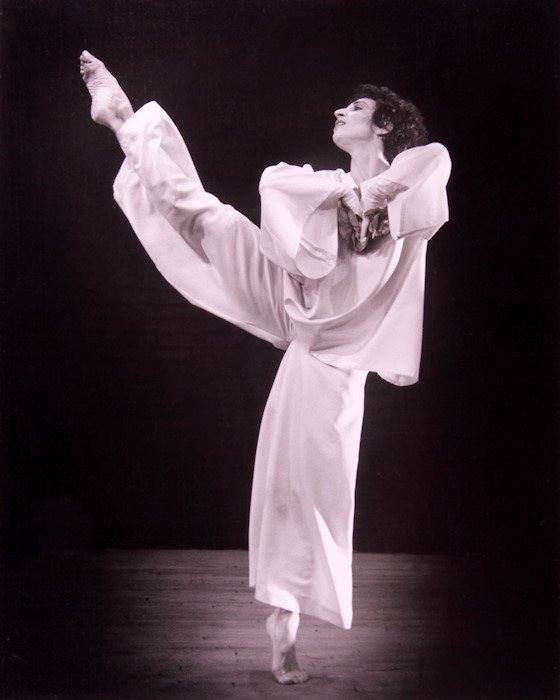
 

Diane Germaine in Shadows (1973), ph David Fullard, Courtesy Germaine

Paul Sanasardo was a humane mentor, friend, and very physical creator; his technique was nuanced, energetic, thorough and often collaborative.  Paul was a strong, verbal, and poetic man full of communicated imagery and philosophy to invest a role we might be working on, or further our mastery of technique, or understand our life. Paul could be kind, he could be difficult,  but working with him for thirteen years as his principal dancer became the important and continuing base for me to be able to continue later as my own artist in the field as choreographer and writer.
—Diane Germaine, Dancer/choreographer/writer.


I started dancing with Donya (Feuer) and Paul in their children’s company when I was 10. Although we were kids, there was nothing childish about the pieces they choreographed and we performed. A lot was expected of us and as a result, we gave a lot. Working with them then was wonderful. It shaped my childhood until I started dancing in the adult company when I was in my teens. Almost 70 years later I still have close ties to several of those “kids.”
—Willa Kahn
—After I left performing, I taught for several years and ultimately went back to school to become a doctor. I jokingly say I was looking for another profession with a ‘d’ but really I wanted to give back. For 30 years, I served an indigent population as a family doctor, retiring 7 years ago. While it was fulfilling work, it never had the transcendency of dance. I feel so lucky to have been able to do them both.
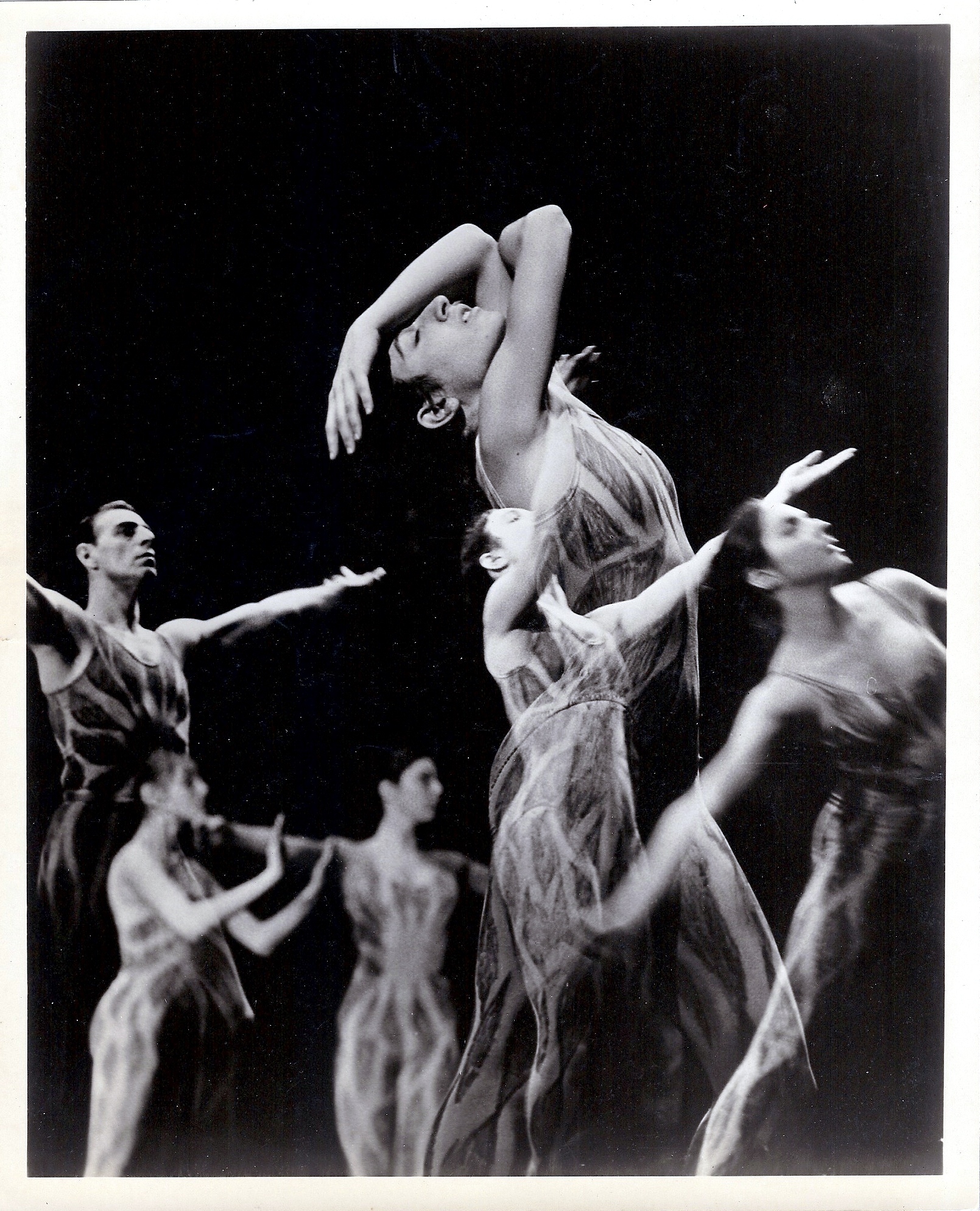
Fatal Birds (1965) composite, L to R: Sanasardo, Judith Blackstone, Willa Kahn, Germaine doubled, Willa Kahn, Courtesy Germaine

In February 1971, I was a beginner dancer arriving from France, striving to study modern dance, which I had discovered just a few months ahead. Having heard of Paul’s classes on 21st Street, I dropped by his studio. I took his class every day. His approach of technique was unique and extremely efficient, mixing Graham and ballet exercises in a perfect balance. It was gradual and altogether very dynamic. He made me progress so rapidly that he took me into his company after just a year and a half of training with him!
—Dominique Petit, who danced in Sanasardo’s company 1972-74, later danced with Carolyn Carlson and had his own company. He has recently worked with Akram Khan in Outwitting the Devil
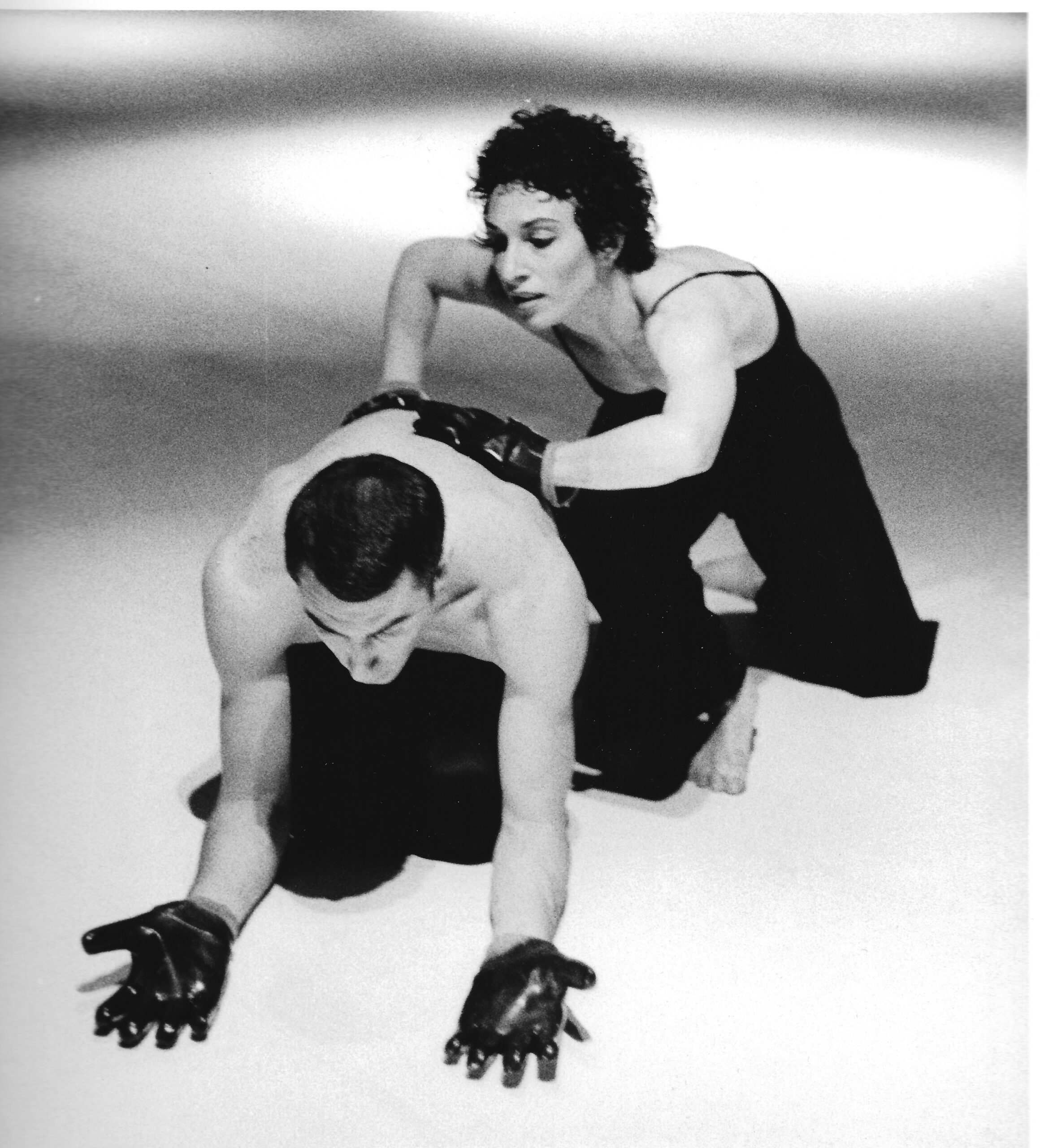
The Path (1972) with Nielsen and Germaine, ph © Lois Greenfield

Paul was inspirational, intelligent, intense, playful, expressive, theatrical and charismatic. Class was Paul’s vehicle for conveying his philosophy and thoughts. The essence of dance for Paul was to express ideas and emotions arising from life’s vital struggles. In his class, technique was strongly applied at the barre. For musical accompaniment Paul turned to Gene Lester on the piano, but Paul often added drums, cymbals, his voice, chants, all of which built intensity. His training helped mold me into the dancer/person I became. His imaginative spirit gave me the understanding, knowledge, and motivation to seek the expressivity of ideas and the potential for building a creative career as a choreographer, teacher, architectural designer, and painter.
—Joan Lombardi, member of Sanasardo Dance Company 1962–1984
Santa Fe, NM
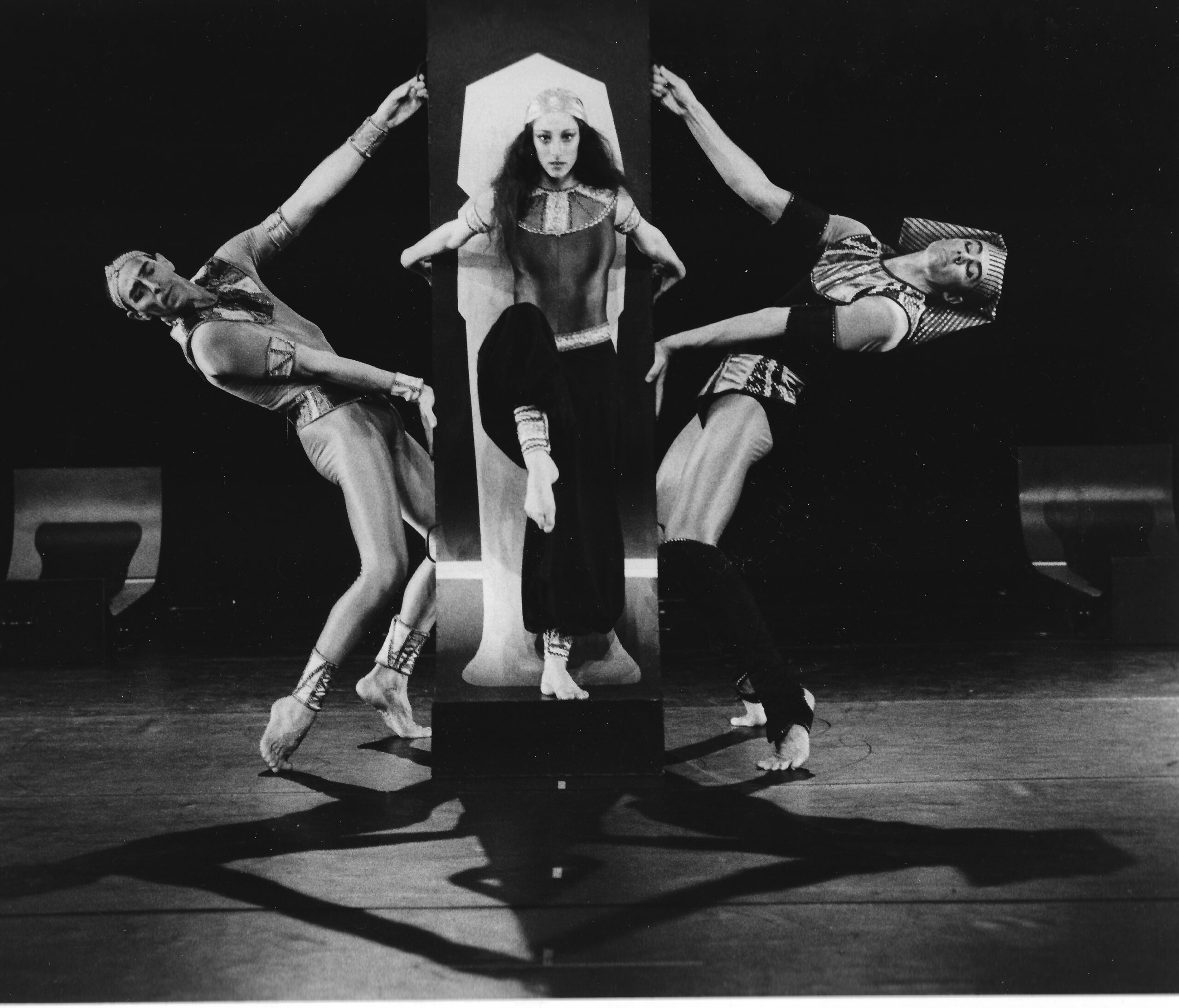
Triad (1977); L to R: Sanasardo as Julius Caesar, Naomi Sorkin as Cleopatra, Nielsen as Mark Anthony, ph @Lois Greenfield

Footnotes

[1] From Chicago Dance History interview

[2] Quoted in Excursion for Miracles, 65.

[3] Doris Hering, “A Darkening Pond: Paul Sanasardo Reviewed,” Dance Magazine, August 1971, 73-74.

[4] This quote came via Doug Nielsen.

[5] Doris Hering, “A Darkening Pond: Paul Sanasardo Reviewed,” Dance Magazine, August 1971, 73.

[6] Kisselgoff, “Dance: Sanasardo Group,” New York Times, April 28, 1973.

[7] Chicago Dance History Project interview, 2016. Accessed August 7, 2026.

[8] Barnes, “Dance: Three Works by Sanasardo,” New York Times, May 22, 1971.

[9] Kisselgoff, “Dance: Sanasardo,” New York Times, May 20, 1982.

Like this In Memoriam Uncategorized 4

What Carolyn Brown left us

I loved Carolyn Brown’s book so much when it came out in 2007 that I gushed about it on dancemagazine.com. Now that she has passed away, I’m feeling a great loss and am re-posting it here.

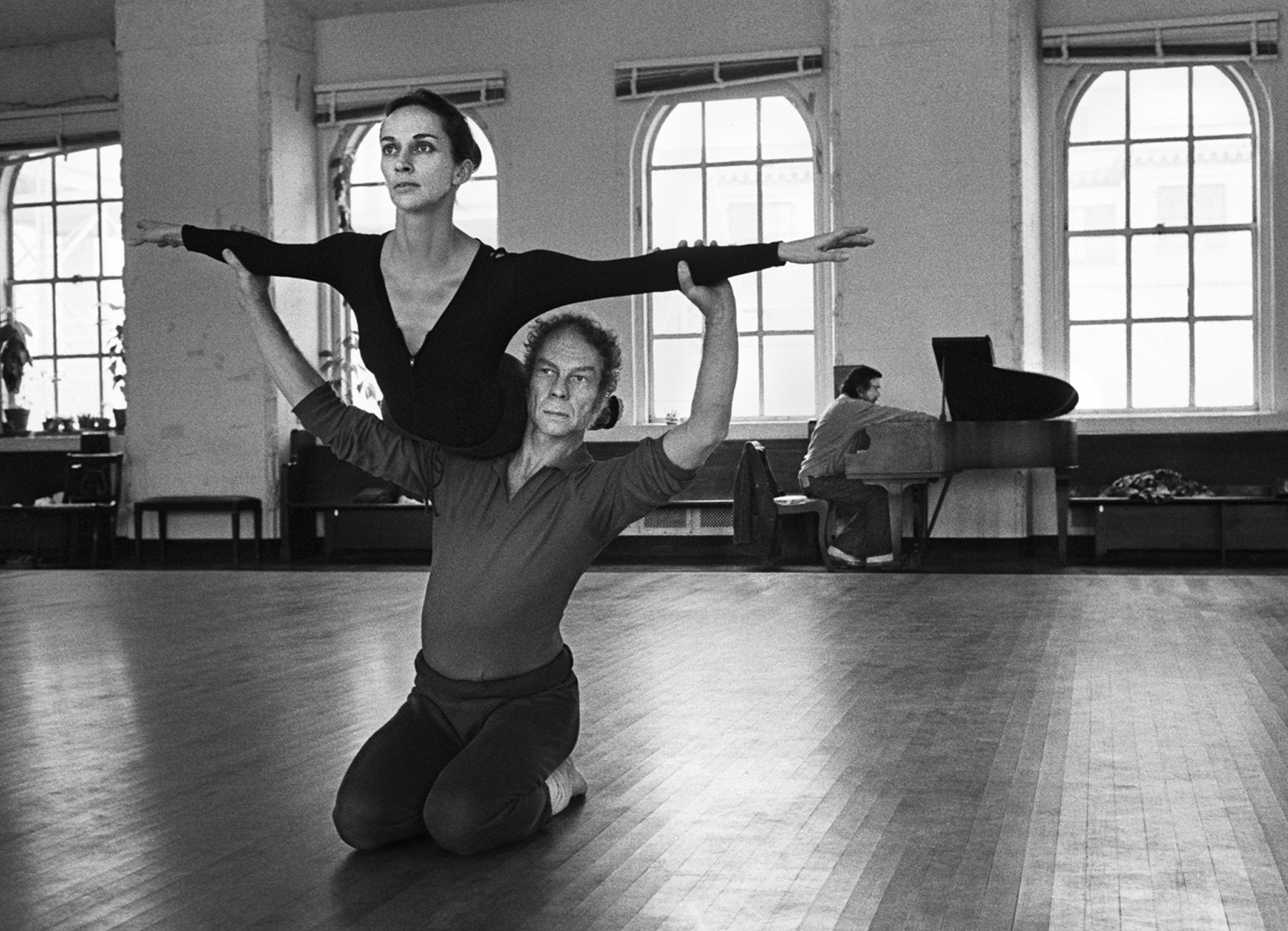
Carolyn Brown and Merce Cunningham rehearsing Suite, 1972, with John Cage at the piano, photo James Klosty

For anyone who has devoted herself to a choreographer and still wonders what he/she thinks of her,

For anyone who has been puzzled by Merce Cunningham and John Cage’s work,

For anyone who loves the Cage/Cunningham work,

For anyone who has ever seen Carolyn Brown dance,

For anyone who separates modern from ballet, Cunningham from Denishawn,

For anyone who sees a continuum between all forms of dance,

For anyone who wants to understand how modern dance morphed into postmodern dance,

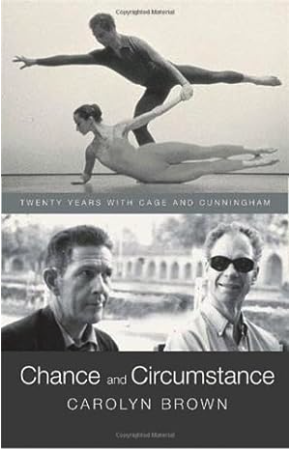
Chance and Circumstance: Twenty Years with Cage and Cunningham (Knopf, 2007), by sublime dancer Carolyn Brown, will give you hours of pleasure, demystification, and insight. This book is one dancer’s account of working with one choreographer. I learned so much about Cunningham’s early work that it made me want to re-see his work right away and apply the new knowledge. Not theoretical knowledge, but something more real: knowing what a struggle it was to become accepted…how many years and tours when their audiences were either indifferent or battling each other…how many years Cunningham, with his unstoppable passion for dance and making dances, met with scant success…how many years John Cage’s enthusiasm and love for Merce kept the company going—in finding performance dates, organizing the tours, keeping the dancers cheerful, and of course, providing music ideas and the idea that was the conceptual foundation of the Cage/Cunningham work. (Which was that separating the choreography, music, and visual decor in the creative process produces an entity in the eyes of the viewer that is different for each person but valid for everyone.)

If you want to know about Cunningham, Cage, Rauschenberg—the people, not the theories—gorge yourself on these 600 pages. Every page has insights and realizations, small and huge, that help us understand the evolution of dance (and art) in the 20th century. Every page carries Brown’s absolute honesty—about herself, her insecurities, her interactions, her observations about Merce. About John. About Merce and John. About Merce and John and Bob (Rauschenberg). You start to realize that though there were many obstacles and few triumphs during those years (1953–73), Merce and John and Bob were a charmed circle that collectively exploded all previous rules of choreography. Their three-way collaboration (though there were other major players like pianist/composer David Tudor) was the crucible in which all of Cunningham’s work is made.

One of the surprises is that Brown, for years, flirted with possibly dancing with the Metropolitan Opera and with Antony Tudor. (She did occasionally take gigs as an extra.) She adored Margaret Craske’s ballet class and would nearly go broke paying up her debt on classes. Another surprise (or non-surprise) is that the book is written beautifully.

Though Brown’s dancing was serene, she was not. Her life was filled with ups and downs and doubts galore. Like any dancer who strives, falters, gets frustrated, gets tunnel-minded, opens up, loses her footing as a performer, has exhilarating moments onstage, she sometimes gets depressed. And Cunningham has his moments of bad behavior, i.e. non-communicativeness, relying on others to do damage control.

But this is also a book about love. The love between a choreographer and dancer of longstanding partnership, however unspoken, demonstrated solely in the gifts they gave each other. He gave her many challenging roles to dance, and she gave him her beautifully fluid and alert dancing, which nudged his ideas of pure movement onto a heavenly plane of existence.

Like this Featured In Memoriam Leave a comment

Steve Paxton (1939–2024): A Lifetime of Burning Questions

Ph Monika Rittershaus

A mesmerizing dancer and an intellectual force in the field, Steve Paxton asked the most basic questions—about movement, performance, and hierarchies of all kinds. His curiosity led him to become a leading figure in three historic collaborative entities: Judson Dance Theater, Grand Union, and Contact Improvisation. For almost six decades, Paxton performed and taught around the world, earning the Golden Lion for lifetime achievement at the Venice Biennial in 2014. Since his death at Mad Brook Farm in Vermont on February 20, at the age of 85, expressions of intense gratitude have appeared across social media.


Paxton grew up in Tucson, Arizona, where he excelled in gymnastics. He also took Graham-based dance classes in community centers. To hear it from his childhood friend, the critic and educator Sally Sommer, “We partied all the time because we hung out at a friend’s ranch house, played records, and danced. We also danced at night on the tarmac of empty roads—turned on the headlights and cranked up the radio.” In school his two favorite subjects were English (hence, the eloquence of his writings) and microbiology (the curiosity of body mechanics). He attended the nearby University of Arizona, where his father was a campus policeman. He didn’t like the teachers, so he withdrew from college life.

He did like dancing. He accepted a scholarship to the American Dance Festival at Connecticut College the summer of 1958. Although the José Limón Company had provided the financial aid, it was his encounter with Merce Cunningham’s work that intrigued him. He recalled how the Cunningham company, during its first residency at this stronghold of established modern dance, caused “consternation” with his chance procedures.

Aeon, by Merce Cunningham,1961, From left: Steve Paxton, Carolyn Brown, Judith Dunn, Marilyn Wood, Viola Farber, and Shareen Blair (on floor). Studio photo Rauschenberg.

That fall, Paxton came to New York, where he continued studying with Limón. He soon added Cunningham classes, where, as a scholarship student, he helped clean the studio. Limón’s company was in residence at Juilliard, and when the school needed more men for the restaging of Doris Humphrey’s Passacaglia, Paxton was asked to step in. (Aside: Pina Bausch, who was a student at Juilliard that year, danced the lead female role.) He later said, “I regarded myself as a barbarian entering the hallowed halls of culture when I came to New York.”

When Robert Dunn offered a workshop in dance composition at the Cunningham studio in 1960, Paxton, along with Yvonne Rainer and Simone Forti, was one of the first five to sign up. A protégé of John Cage, Dunn taught in a Zen manner, providing the space for experimentation without judgment. As Paxton has said, “The premise of the Bob Dunn class was to provoke untried forms, or forms that were new to us.”

Flat (1964) reprised in 1982 for Bennington College Judson Project, ph Tom Brazil

Stylistically, Dunn stressed the value of the ordinary rather than laboring to make a dance study “interesting.” From that evolved many of Paxton’s walking dances. Why walking? Of course it fits Dunn’s request for the “ordinary.” But also, as Paxton explained in this interview, at Walker Art Center, “How we walk is one of our primary movement patterns and a lot of dance relates to this pattern.”

Fellow student Simone Forti, who had studied with Anna Halprin, produced a historic evening of “dance constructions” at Yoko Ono’s loft on Chambers Street in 1961. Paxton performed in her works Huddle, Slant Board, and Herding. Forti had no interest in technique, preferring to meld the movement function to objects. As Paxton told me in a 2015 email, he found the effort to divest from his technical training “self-shaking, paradoxical, and enlarging.”

Also in 1961, Paxton joined the Merce Cunningham Dance Company. Though bewildered at first, he loved the company and responded to the beauty and humor in the work. He felt drawn toward the Buddhist bent of John Cage and “felt at home” when listening to Cunningham, Cage, and visual collaborators Robert Rauschenberg and Jasper Johns.

When the students in Dunn’s class wanted to show their work, they auditioned for the 92nd Street YMHA, the bastion of modern dance. Paxton, along with Rainer and Gordon, were rejected. (Aside: Lucinda Childs, however, was accepted and did perform at the Y in 1963.) So they went to Judson Memorial Church, which already housed the Judson Poets Theater and Art Gallery. Dunn’s students—who by then included Trisha Brown, Rudy Perez, Deborah Hay, Elaine Summers, and many more— collectively produced a series of sixteen numbered concerts, not all of them at the Church, from 1962 to 1964.

Trisha Brown’s Lightfall at Judson Church, Ph Al Giese

One of the early works at Judson was Trisha Brown’s Lightfall, in which Trisha and Steve perched on each others’ back until the standing person moved and the perching person slithered off. Robert Rauschenberg, who had started coming to Dunn’s classes, said, ”In Lightfall the two were just bouncing all over and under each other. The choreography seemed to be based on how much risk they could take.”

For an assignment to make a one-minute dance, Steve sat on a bench and ate a sandwich.

Paxton’s burning question at the time was Why not? About Judson Dance Theater, he said, “The work that I did there was first of all to flush out my ‘why-nots’…‘Why not?’ was a catchword at that time. It was a very permissive time.”

Yvonne Rainer wrote about his work at Judson in her memoir, Feelings Are Facts:

Steve’s was the most severe and rigorous of all the work that appeared in and around Judson during the 1960s…Eschewing music, spectacle, and his own innate kinetic gifts and acquired virtuosity, he embraced extended duration and so-called pedestrian movement while maintaining a seemingly obdurate disregard for audience expectation.”

One of the landmark pieces that came out of that aesthetic, which celebrated the untrained human body, was Paxton’s Satisfyin Lover (1968). In it, a large group of dancers simply walked, stood still, or sat on a chair. Jill Johnston wrote this now famous passage in the Village Voice:

And here they all were . . . thirty-two any old wonderful people in Satisfying Lover walking one after the other across the gymnasium in their any old clothes. The fat, the skinny, the medium, the slouched and slumped, the straight and tall, the bowlegged and knock-kneed, the awkward, the elegant, the coarse, the delicate, the pregnant, the virginal, the you name it, by implication every postural possibility in the postural spectrum, that’s you and me in all our ordinary everyday who cares postural splendor. . . .  Let us now praise famous ordinary people.

Paxton & Rauschenberg in their in Jag Vil Gärna Telefonera (1964)

Robert Rauschenberg, Cunningham’s lighting designer and frequent visual collaborator, visited Dunn’s class and started making his own performances. Paxton was often involved in Rauschenberg’s pieces, and the two were a pair at the time. In the fall of 1964, they collaborated on one duet, Jag vill gärna telefonera  (I Would Like to Make a Phone Call). This duet, based on photos of athletes, was reprised by the Bennington College Judson Project in 1982, and by the Stephen Petronio Company in 2018.

Judson Dance Theater marks a historical moment when (portions of) modern dance morphed into postmodern. At the time, Paxton thought of Judson as a place where you could just do stuff and not worry about big entertainment in big theaters. Rather than thinking they were doing something revolutionary, as Rainer felt, Paxton located himself in the lineage of modern dance tradition. In a recent Pillow Voices podcast about Grand Union, he says that modern dance—Graham, Limon, Cunningham, Humphrey, Dunham—gave permission to create new forms “from the ground up.”

Linoleum, a performance piece by Rauschenberg, with Paxton prone, 1966, ph Steve Schapiro

For an engagement at the L. A. County Museum in 1966, Trisha Brown convinced Paxton to improvise with her. He was amazed that her loose structure elicited an immediate response from the audience; he realized the “personal element reaching through the form” was the key to the audience response—and he got hooked on improvisation.

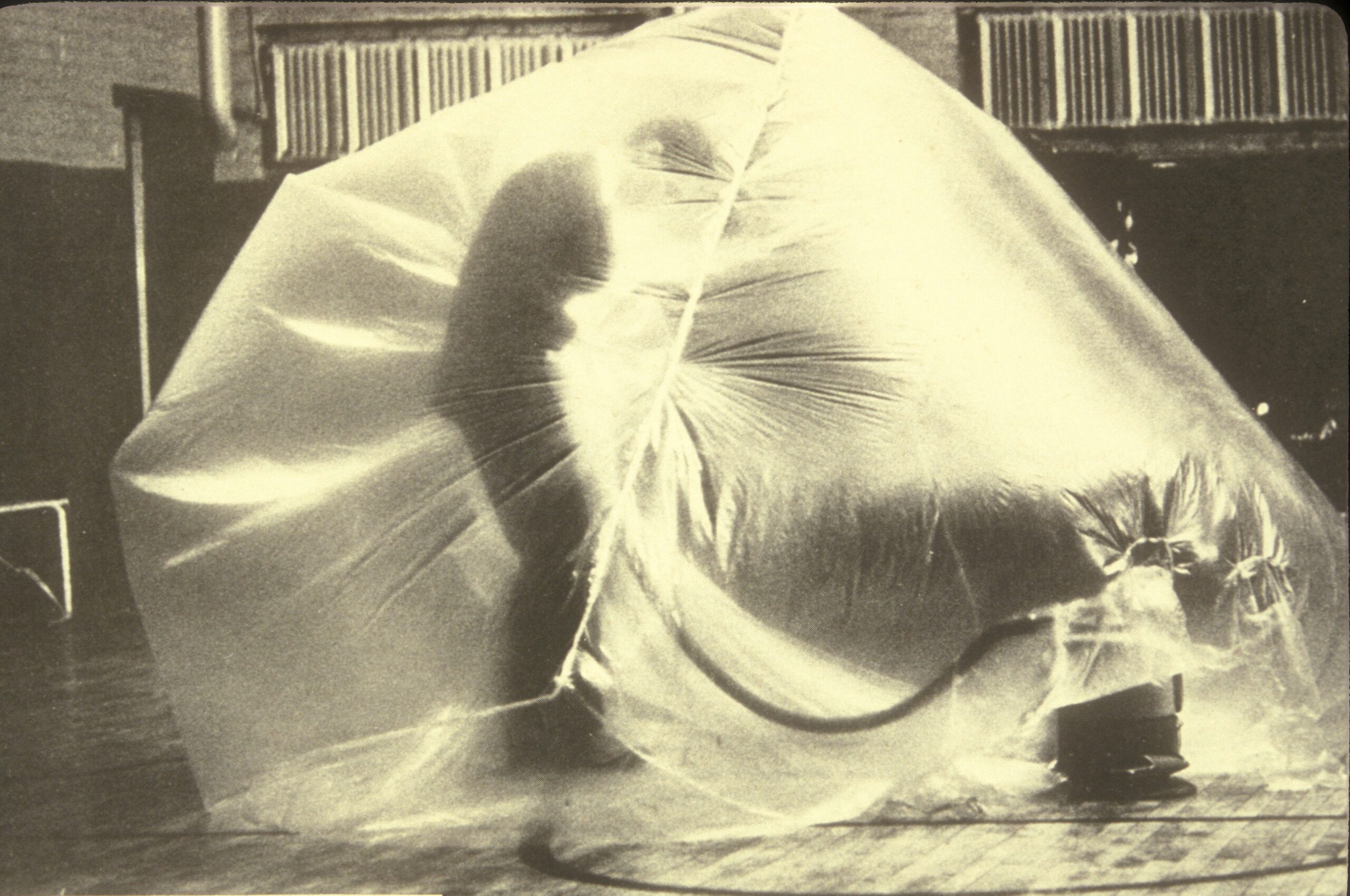
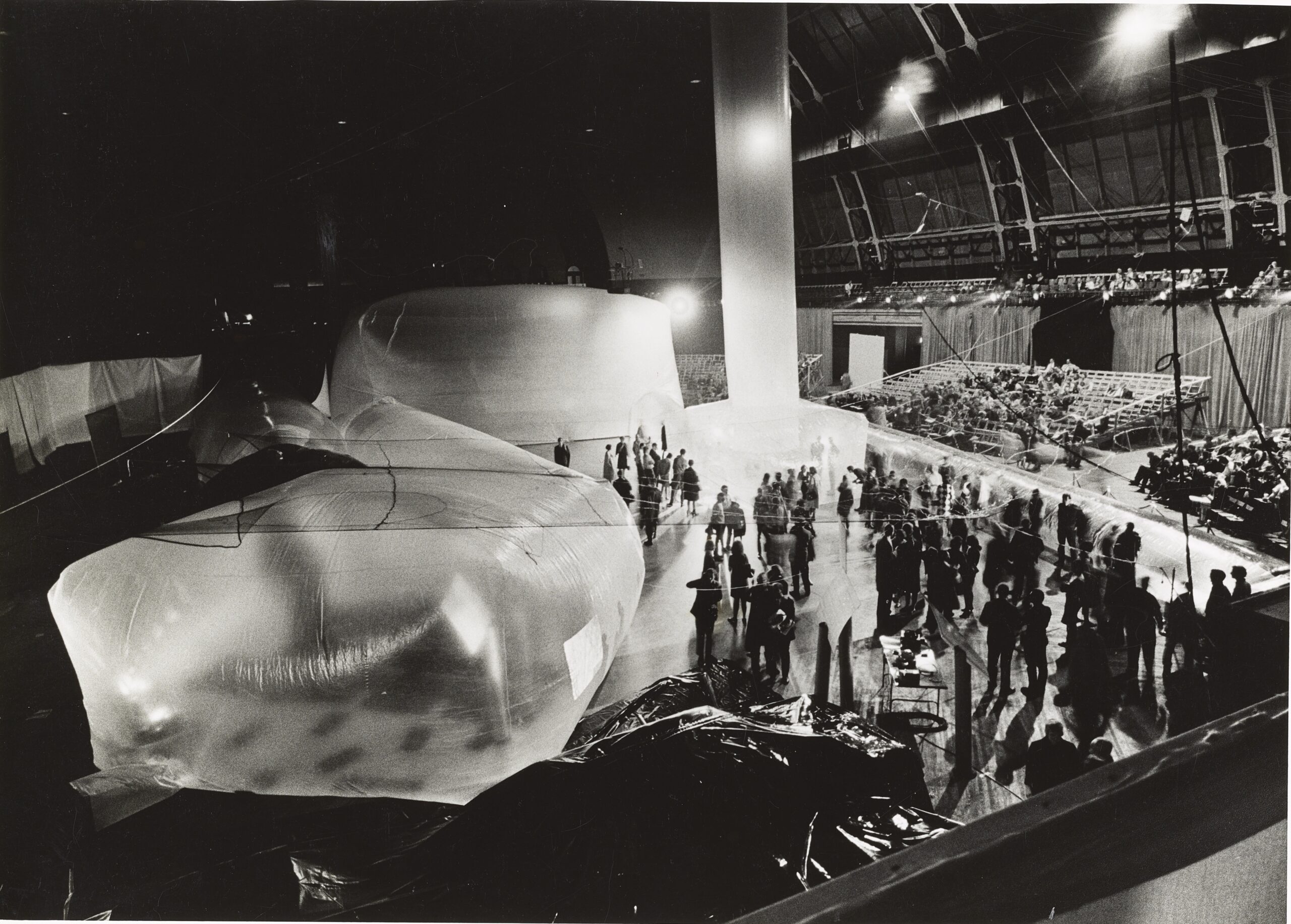
How can objects be transformative? In his surreal solo Bound (1982), Paxton wore a strange object around his neck that turned out to be a travel pillow. In some kind of endurance test, he walked slowly into a bright light, his eyes watering. For years he was fascinated by inflatable plastic sheets. In Music for Word Words (1963) at Judson Church, with the help of Rainer operating an industrial vacuum cleaner, he inflated a room-sized plastic bubble around himself, then deflated it and walked away. After several other experiments, his obsession reached its endpoint with Physical Things, the piece he made for “9 Evenings of Theatre and Engineering.” For that 1966 series in the massive 69th Regiment Armory, he created a huge inflatable tower that audience people walked through, realizing only later how toxic the plastic was.
Paxton in his Music for Word Word, 1963, Judson Church, ph Robert McElroy

Paxton’s Physical Things, 9 Evenings of Theatre & Engineering, 69th Regiment Armory, 1966, ph Peter Moore

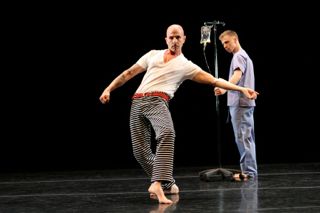
Another question was about censorship: What, really, is obscenity? For a performance at NYU in 1970, he proposed a version of Satisfyin Lover in which 42 red-headed people would be nude. The university administration nixed it on the grounds of obscenity, so he replaced it with Intravenous Lecture, in which a medical assistant injects him while he keeps talking. This piece was reprised by Stephen Petronio in 2012 with instructions from Paxton to “make it his own.”

Stephen Petronio in Paxton’s Intravenous Lecture 1970), 2012, ph Julie Lemberger

In 1971, Paxton worked with Vietnam Veterans Against the War, who had made a documentary with testimonies of the atrocities that American soldiers committed against Vietnamese civilians. In Collaboration with Winter Soldier, he had two performers watching this anti-war documentary while hanging upside down.

In 1972, he proposed Beautiful Lecture, which juxtaposed a porn film with a film of the Bolshoi’s Swan Lake (the famous Ulanova version), to the New School for Social Research. Pressured by the authorities to omit the porn film, he replaced it with a documentary about people starving in Biafra.


Paxton’s dancing—with his loose limbs, swerving spine, and charismatic aura—was magnificent to behold. In Terpsichore in Sneakers, Banes described him as projecting “a continuing sense of the body’s potential to invent and discover, to recover equilibrium after losing control, to regain vigor despite pain and disorder.”

Steve Paxton while in with Grand Union, Walker Art Center Auditorium, 1975, ph Boyd Hagen

At the end of the Sixties, Paxton was working with Rainer on her piece Continuous Project—Altered Daily, which changed with every performance. Rainer had given the dancers—Paxton, David Gordon, Douglas Dunn, Barbara Dilley and Becky Arnold—so much freedom that the choreography eventually blew open, obliterating previous plans. After a period of uncertainty, the group then morphed into the Grand Union, an improvisation collective with no leader. It was then augmented by Trisha Brown, Nancy Lewis and Lincoln Scott. Some of Paxton’s questions at that time were “how to make artistic decisions, how not to depend on anyone unless it is mutually agreed; what mutuality agreed means, and how to detect it.”

Paxton witj, from left: David Gordon, Yvonne Rainer, Becky Arnold, Carol Dilley, ph James Klosty

In the June 2004 issue of Dance Magazine, Paxton said, “Grand Union was a luxurious improvisational laboratory. All of us were very formally oriented, even though we were doing formless work.”  He called the group anarchistic, which meant to him that they could do its work without a leader. He had witnessed a “dictatorial” situation and a fixed hierarchy in dance companies. For him, Grand Union “bypasses the grand game of choreography and company [where] ego-play is the issue.”

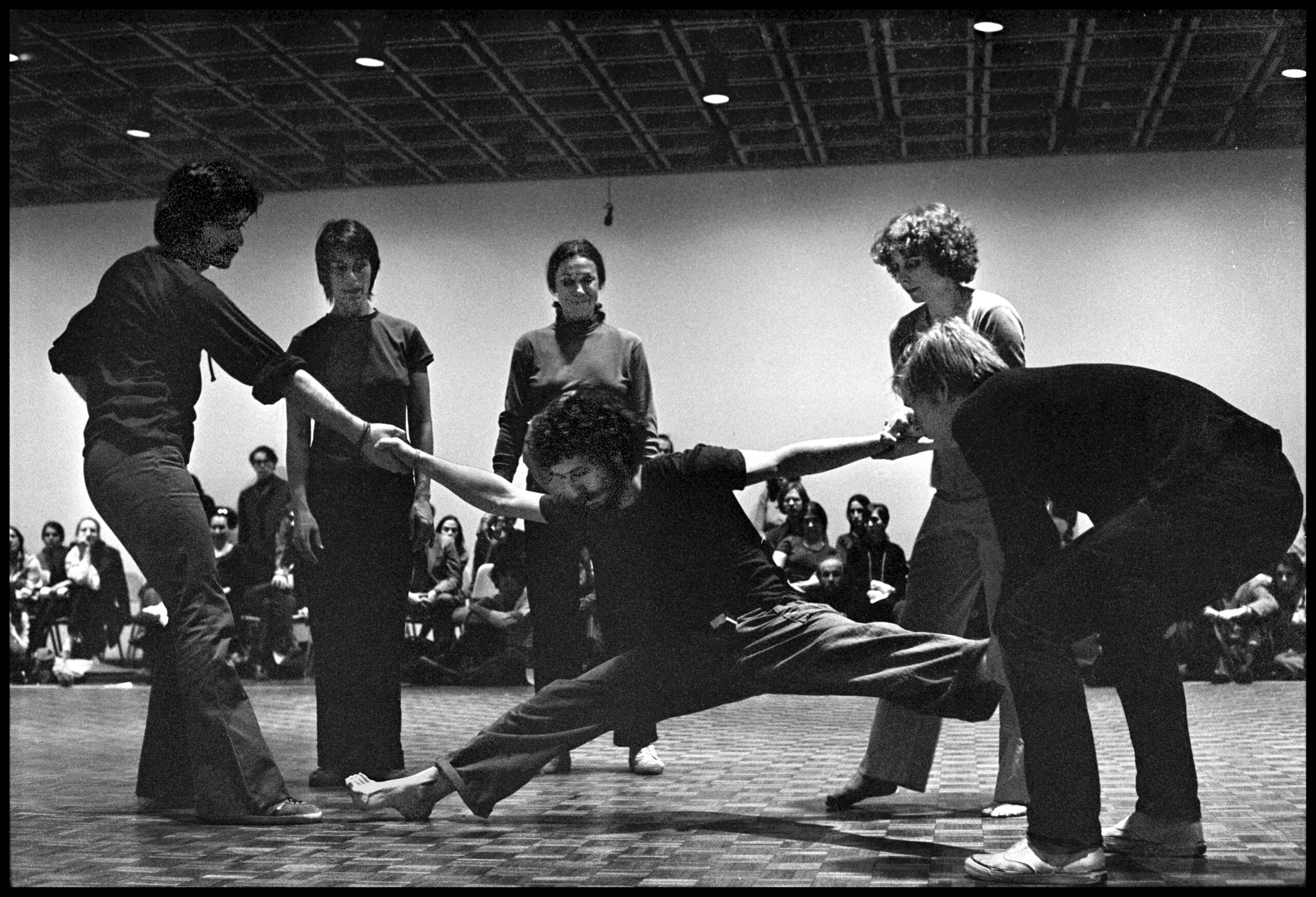
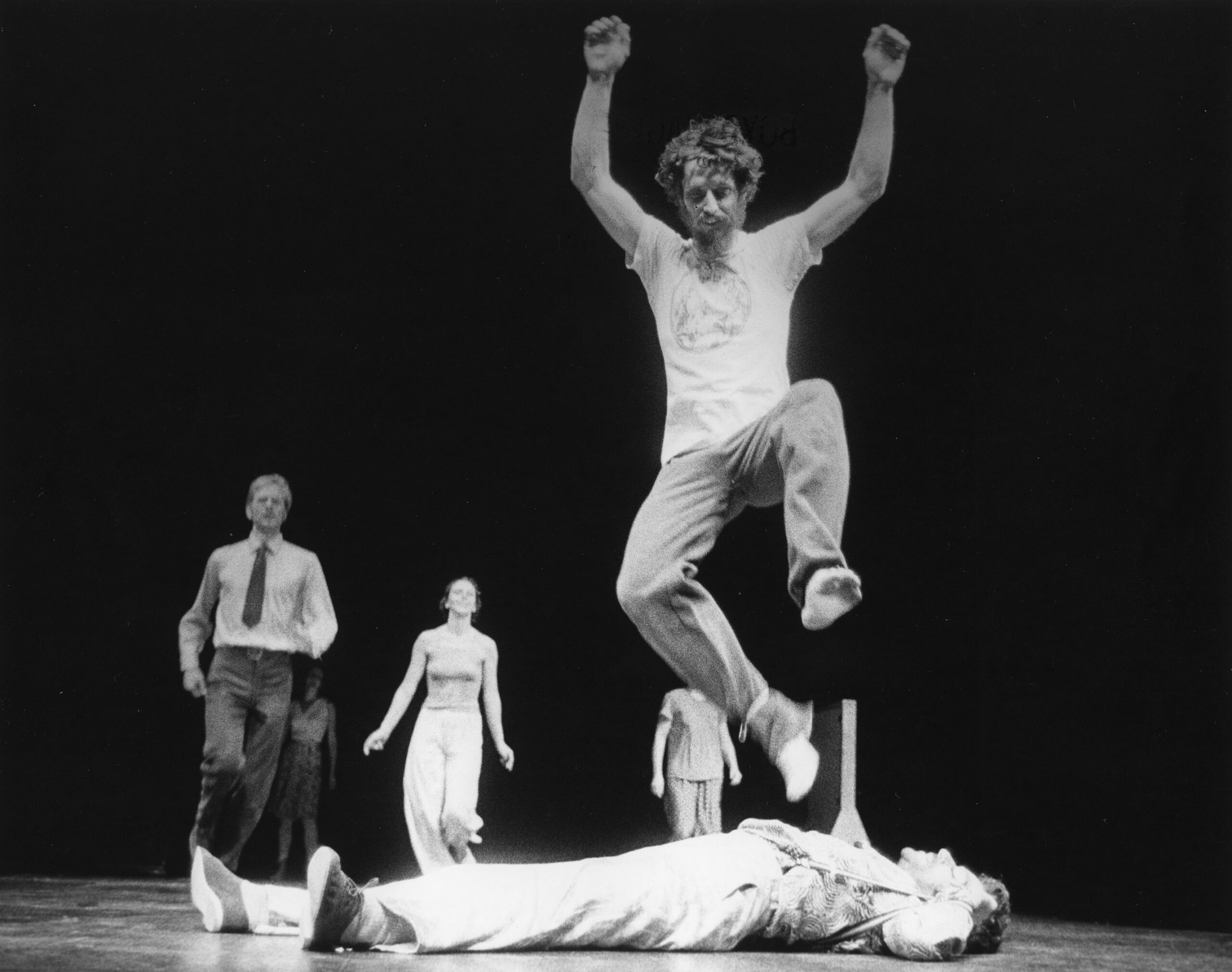
Grand Union residency at Walker Art Center, 1975. Steve jumping over David Gordon. At left: Douglas Dunn, Trisha Brown (almost hidden), Nancy Lewis and Barbara Dilley (head hidden), Tnx WAC Archives

Grand Union at Walker Art Center, 1975. From left: Barbara Dilley, David Gordon, Nancy Lewis, Douglas Dunn, Steve Paxton. Tnx to WAC Archives

When Grand Union was engaged for a residency at Oberlin College in 1972, Steve taught a daily class at dawn that included “the small dance.” Nancy Stark Smith, a student, took the class and loved it: “It was basically standing still and releasing tension and turning your attention to notice the small reflexive activity that the body makes to keep itself balanced and not fall over. So you’re standing and relaxing and noticing what your body’s doing. You’re not doing it but you’re noticing what it’s doing.” This concept of noticing interior movement became foundational for Contact Improvisation.

Barbara Dilley & Steve, Grand Union, Lo Guidice Gallery, 1972, ph Gordon Mumma

Trisha Brown supporting Steve, Grand Union, 1972, ph Gordon Mumma


He also taught an afternoon class in tumbling just for men. The question was: How can tumbling be taught in a non-aggressive way, with soft landings? The class produced a group piece called Magnesium that was, as Paxton said, a “prototype for Contact Improvisation.” After the performance, as he recounted, “Nancy told me that if it was ever performed again, she would like to be in it. I was startled. It had not occurred to me that such a rough-and-tumble dance would be of interest to a woman.”

Although Paxton is called the “inventor” of CI, he has pointed to the mutuality of the form. It’s “governed by the participants rather than by a leader, similar to the structure of Grand Union.”

Paxton & Nancy Stark Smith in a CI performance, ph Stephen Petegorsky. Behind them are Lisa Nelson, Daniel Lepkoff, and Christie Svane. Thorne’s Market, MA, 1980.

Contact Improvisation caught on for thousands of people who wanted to move—and move with other people—but who did not want to train to be concert dancers. Paxton and Smith co-founded Contact Quarterly, which presented an alternate vision of dance with its own strong aesthetic.

Lisa Nelson and Steve Paxton in their collaboration, PA RT, 1978, Ph Tom Brazil

He participated in Contact Improvisation, often with Nancy Stark Smith, for ten years. Then he started developing his solo works, including his improvisations to Bach’s Goldberg Variations from 1986 to early 90s. He then developed “Material for the spine,” which he described as “what the spine is doing in that tumbling sphere with another person—a kind of yogic form, a technique that focuses on the pelvis, the spine, the shoulder blades, the rotation of the head.” He has collaborated with Lisa Nelson, fellow improviser extraordinaire and his life partner, on two entrancingly improvised duets: PA RT (1978), and Night Stand (2004). Paxton has given workshops all over the U.S. and Europe, returning to some venues again and again, especially England, Netherlands, Austria, Germany, Italy, Spain, and Portugal.

Night Stand, ph Paula Court

When Paxton was honored by the Danspace Project in 2014, his Judson co-conspirator, Yvonne Rainer, gave a tribute. Here is an excerpt:

I won’t go into all the beautifully perverse and clarifying dances that Steve has created… over the years, like his performance of Flat from 1964, which I’ve heard drove members of a 2002 Parisian audience out of the theater as Steve took his own sweet time transforming himself into a clothes rack…and Proxy of 1961, which began with his promenading of Jennifer Tipton en passé on ball bearings in a washtub; and Steve’s glorious improvisations to Glenn Gould. Always we are riveted by his imposing presence and a solemnity that can morph unexpectedly into a wry comedic effect.

Paxton & Brown, Bennington College Judson Project, 1980, ph Tyler Resch

Trisha and Steve, ph Joanne Savio, Courtesy TBDC

In 1992, his burning question was What does an idea feel like? He brought this question to a panel at Movement Research at Judson Church. His Judson-era peers —Yvonne Rainer, Trisha Brown, Simone Forti, and Carolee Schneemann— seemed stumped by this question. No one answered him straight on, so he asked again: “Does an idea have a feeling for you? If you use a stove as a score, where’s the idea?”


The Beast ph Julieta Cervantes

His solo The Beast (2010), in which he seemed possessed, elicited intense reactions. When he performed it at Baryshnikov Art Center, dancer/writer Lisa Kraus wrote that he “presents his own body as a locus for inquiry… His investigation has become increasingly detailed, exquisite…he is pure facet, pure torque, pure stacked bones and stretched sinew.” Amy Taubin described it in ArtForum: “If a crustacean could trace its consciousness in its carapace, it might move as Paxton did in this darkly beautiful piece, an intimate examination of the living skeleton and an evocation of what remains in the grave.” One reviewer, however, claimed that the dance was “about” old age. In this interview at Dia:Beacon, Paxton rails against the word “about,” saying “it should be stricken from the vocabulary.”

While Paxton wasn’t a warm and cuddly teacher, he was thrillingly articulate. He never faked enthusiasm. He was trusted completely by his  colleagues from the Sixties—Trisha Brown, Yvonne Rainer, Simone Forti, and Cunningham dancer Carolyn Brown—in a way that I would call pure love.

Well after he had drifted away from CI, he extolled the efforts of Karen Nelson and others who brought CI to people with impairments. With democracy always in mind, he said, “that’s probably my favorite innovation in Contact Improvisation.”

Tea for Three at Danspace, 2017, From left: Rainer, Forti, Paxton, ph Ian Douglas

Reflecting on his role in the flow of dance history, Paxton said, while interviewed by Philip Bither at Walker Art Center, that he was both a “mutant” and an “evolver” (his terms), meaning he was both a maverick for change and a stabilizing force.

Paxton always opted for the organic, close-to-nature option. Toward the end of his life, he spent much time in his garden in Vermont. In a talk at the Judson Dance Theater exhibit at the Museum of Modern Art in 2018, when asked about his life at that time, he said, “Every atom in the landscape in front of me that I look at every day is changing…I feel like it’s a living soup and I’m…kind of dissolving into its space.” He has now completed his dissolution.


Sources

Books and journals:

• Terpsichore in Sneakers: Post-Modern Dance
By Sally Banes
Wesleyan University Press, 1977, 1987

• The Grand Union: Accidental Anarchists of Downtown Dance, 1970–1976
By Wendy Perron
Wesleyan University Press, 2020

Sharing the Dance: Contact Improvisation and American Culture
By Cynthia Novack
University of Wisconsin Press, 1990

• Taken by Surprise: A Dance Improvisation Reader
Editors: Ann Cooper Albright & David Gere
Contact Editions

• Caught Falling: The Confluence of Contact Improvisation, Nancy Stark Smith, and Other Moving Ideas
by David Koteen and Nancy Stark Smith
with a Backwords by Steve Paxton
Contact Editions, CE Books in Print

“Trance Script,” Contact Quarterly, Winter 1989 Vol. 14 No. 1, Judson Project Interview with Steve Paxton, Sept. 12, 1980.

• Avalanche, 11, 1975

Democracy’s Body 
by Sally Banes
Duke University Press, 1993

• Trisha Brown: Dance and Art in Dialogue, exh. catalog, 2002

Online resources

Contact Quarterly — for many videos and articles

Steve Paxton Talking Dance, Walker Art Center, 2014.  Paxton gives a full account of his professional life with video clips spliced in, and allows questions to lead him into deep discussion.

Steve Paxton and the Walker: A 50-Year History

Steve Paxton and Simone Forti in Conversation, REDCAT, 2016, A charming performance/encounter between two old friends who are also dance icons.

Paxton Interview with Dia:Beacon, 2014

“How Grand Union Found a Home Outside SoHo at the Walker”


Like this In Memoriam Uncategorized 4

Remembering Rudy Perez

Perez in Countdown, ph Steve Sbarge

I will never forget Rudy Perez performing Countdown in 1968. If the word “riveting” did not exist, it would have to be invented for that performance. Sitting in a chair, his feet rooted to the ground, his focus unwavering, he took a super slow-motion drag on a cigarette. He slowly stood up, and without breaking his tempo, streaked his cheeks with green paint. Were they tears? Were they war paint? The recorded music of the “Songs of the Auvergne” transported us to a faraway place. Rudy was perhaps remembering something beautiful that arrested his everyday action. Countdown was also an example of radical juxtaposition, a term I didn’t know then, which describes a dada-esque collision of opposites that forces the viewer to create their own cogency. (It was a term Yvonne Rainer borrowed from Susan Sontag.) His work also had a whiff of satisfying absurdism. Of course Rudy never used such terms to describe his choices.

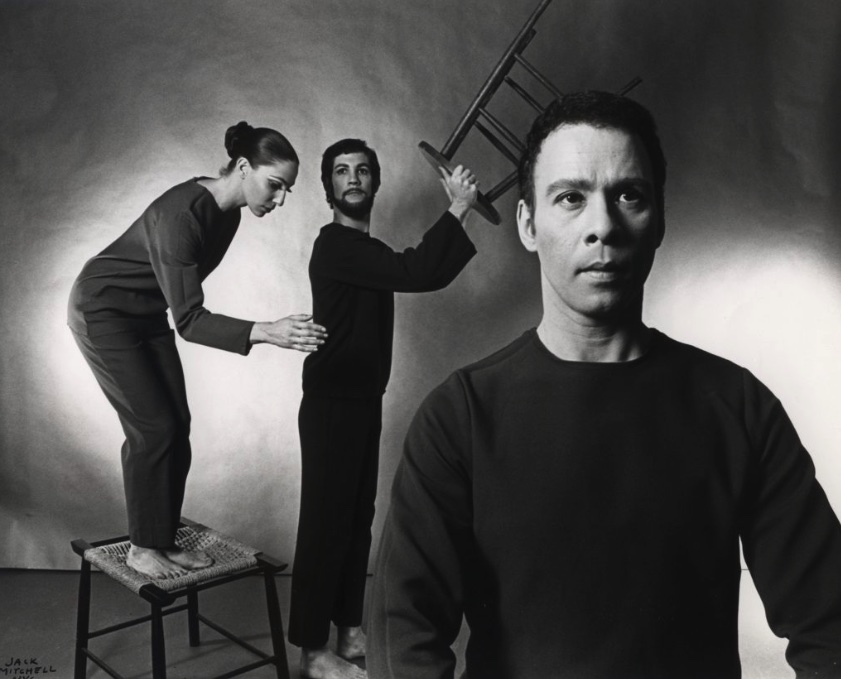
Barbara Roan, Anthony LaGiglia, and Perez, Ph Jack Mitchell

The place where I saw Countdown was the old Dance Theater Workshop, which was Jeff Duncan’s living space on West 20th Street. Later, in the fall of 1969, also at DTW, I was showing a solo of mine to Jeff Duncan for a program of what is now Fresh Tracks. Rudy had just finished rehearsing and decided to hang out and watch my solo. A few weeks later, I ran into Rudy in a local supermarket on the Upper West Side, and he invited me to join his tiny company. Having been knocked out by Countdown, I said Yes. I danced with him for a year, enjoying performing with the magnificent Barbara Roan, the delightful Anthony La Giglia, and being challenged by Rudy’s sturdy movement and uncompromising vision.

Me “picking flowers, to Mozart,’ in one of Rudy’s works, Ph Ted Wester

In 2019, the Stephen Petronio Company revived Rudy’s Coverage, a solo he made during the time I was dancing with him. When Siobhan Burke wrote an advance article for the New York Times, she asked me to describe what was unique about Rudy’s work. She quoted me describing his approach: “He had this instinct for what would work next to each other. We’d be doing something rigid and stiff, then suddenly we’d be bending down and picking flowers in a dreamlike slow motion…There was something very sure and magical about what he did onstage.”

Although Rudy was a strong and energetic dancer, he did not have what was considered a dancer’s body. He told me that he realized he’d have to make his own work if he wanted to dance. This, I think was a strength: He created his own aesthetics.

From left: Perez, Summit, Roan, Ph Herbert Migdoll for Dance Magazine

When Don McDonagh’s book The Rise and Fall and Rise of Modern Dance came out in 1970, I was excited because he highlighted dance artists from Judson and DTW—people I had danced with—as the ones who were raising modern dance up again in the Sixties. In his chapter on Rudy, he described the choreographer’s “vibrant stillness.” He also wrote that Rudy was “the most emotively charged dance maker of his generation, but his emotionalism is strictly controlled and measured out in carefully placed spurts of movement.” The elements of his choreography were “meticulous workmanship, unusual juxtapositions of visual and aural material, and a weighty intensity.”

Rudy was the first person I heard talk about Judson Dance Theater. He had attended some of Robert Dunn’s workshops and had participated in Judson concerts from day one. Judson became a huge topic of interest to me. Just hearing the name Judson helped me trace where Rudy got his exquisite simplicity from. When I started teaching at Bennington in 1978, I wanted to expose my students to the experimental spirit of Judson. I created a multi-year project called the Bennington College Judson Project, part of which is archived at the NY Public Library for the Performing Arts. (I also gave a “Dance Historian Is In” presentation on it. If you’re interested, the recording is viewable at the Library.)

Although Rudy is not often mentioned when Judson is discussed, he is one of the few of that collective who went on to have a multi-decade career in dance. (Others were the obvious names of Trisha Brown, Lucinda Childs, Yvonne Rainer, Steve Paxton, David Gordon.) I’m glad he found his niche in Los Angeles, but he drifted away from New York consciousness. Our loss was L.A.’s gain. Marcia B. Siegel called him “one of the quiet experimenters in whose hands I think the future of dance will rest.” At least two of his students there went on to create their own dance worlds: Victor Quijada of RubberbandDance and Chris Yon, now at Appalachian State University.

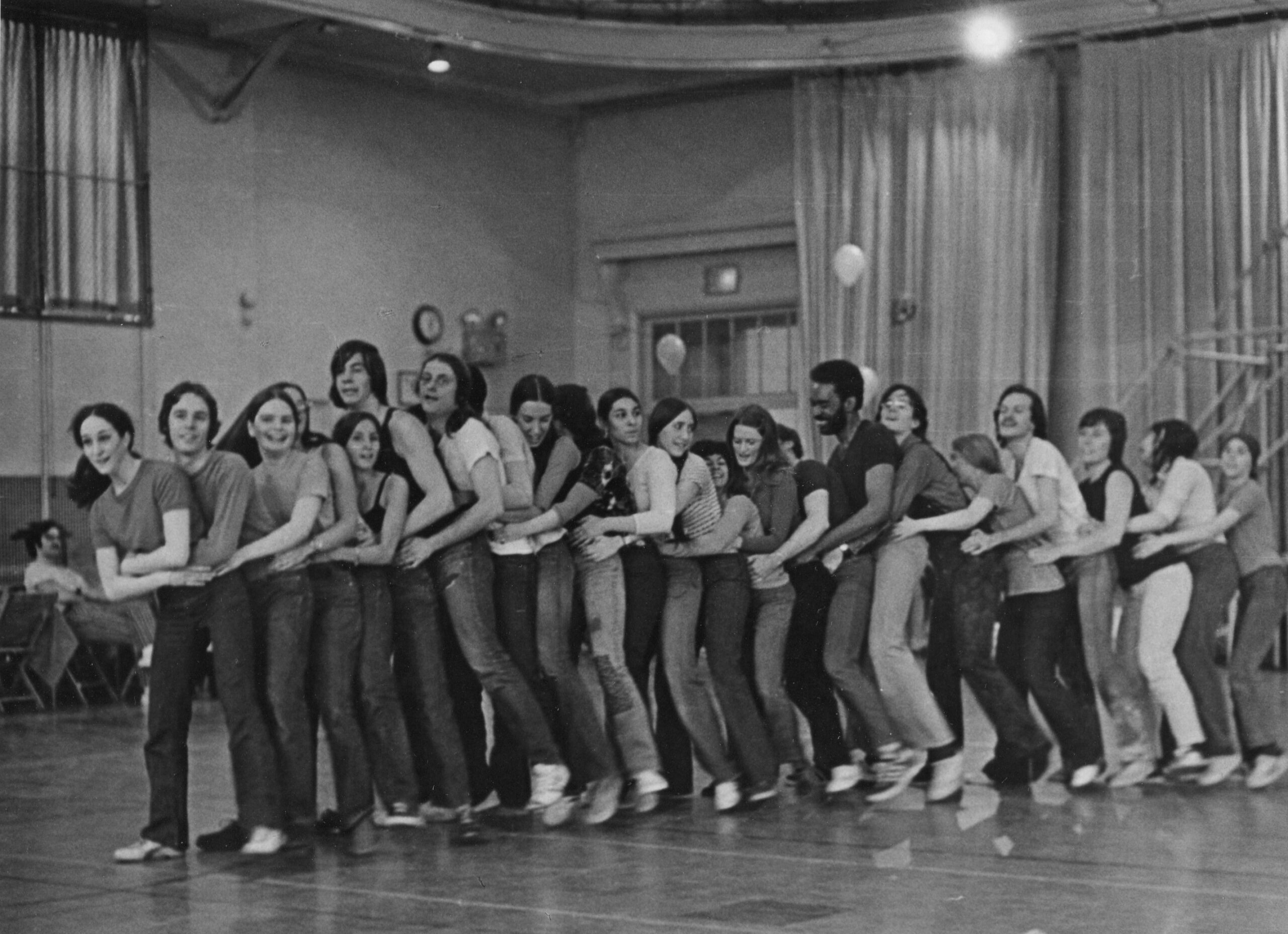
Conga line in one of Rudy’s pieces, c. 1971, led by Wendy Summit. Find Jane Comfort, ninth from the end. Ph unknown

In an article in the June 1971 issue of Dance Magazine, Rudy explained his process: “My work begins as a col­lection of images, but when it is finished it must be a whole, loose parts of exper­ience making up a whole. It’s like a jigsaw puzzle, trying to fit things together so that when it’s finished, it’s complete.”

Thank you, Rudy, for your completely remarkable work.

And thanks to Sarah Vox Swenson for setting up the memorial page of the website devoted to him.


1 person likes this Featured In Memoriam 1

Gus Solomons jr (1938–2023)

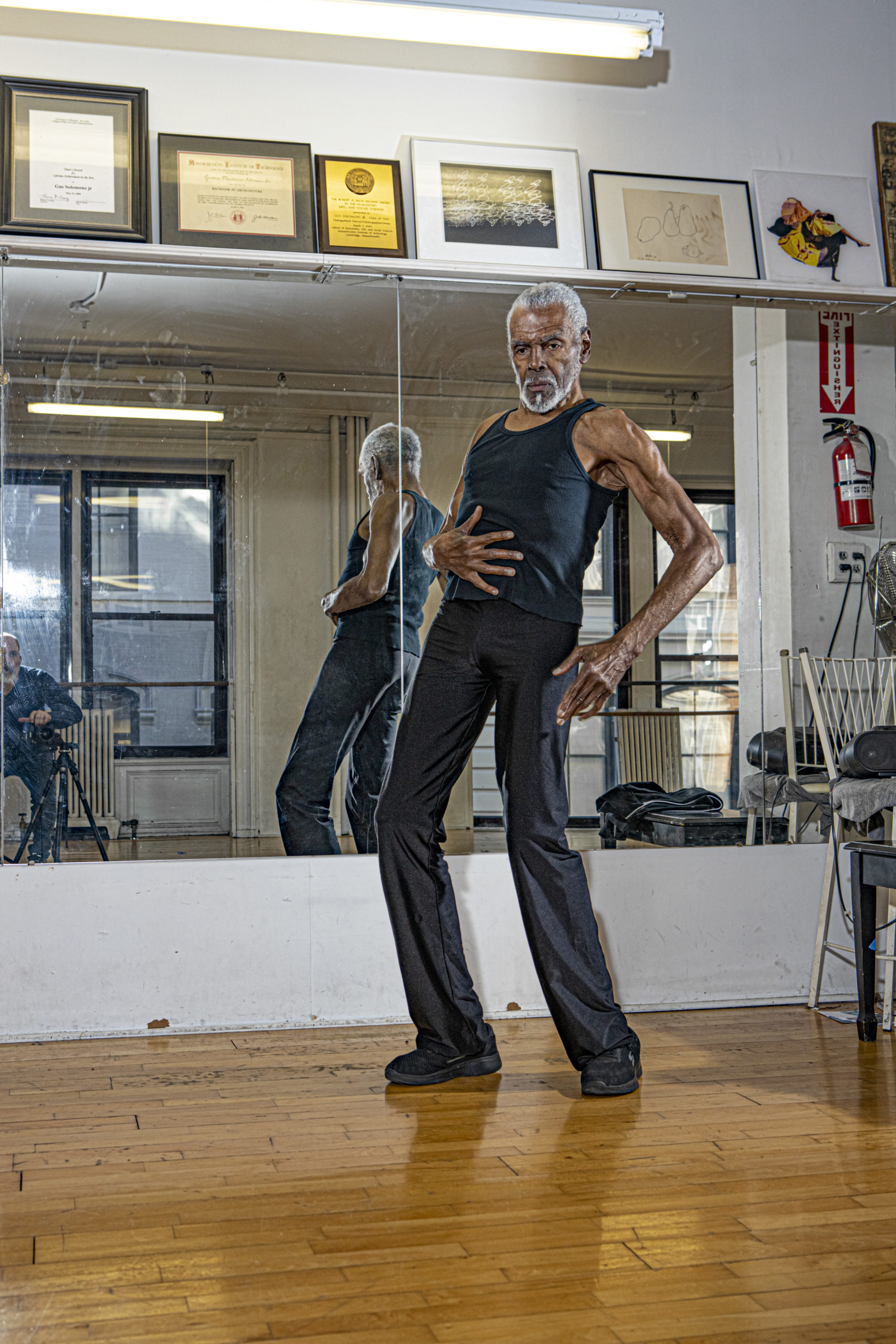
Gus in his studio, ph by Kyle Froman for Dance Teacher, 2017.

Striking performer. Adventurous choreographer. Unforgettable teacher. Straight-from-the hip-reviewer. Inspiring mentor. Gustave Martinez Solomons jr was all these things and more. With boldly energetic dancing, a Hollywood face, and a ready laugh, Gus seemed comfortable in any dance genre. His fluidity between the largely white postmodern community and various dance communities of color was a healing balm in these times of bifurcation. He was beloved by people in all these factions, so it’s no wonder that, since his passing on August 11, messages of love and gratitude have come pouring in on social media. He’s been called a legend, dreamboat, amazing artist, and earthly angel.

Born in Cambridge, MA, Gus briefly took tap, acrobatics and ballet lessons in a local studio. In high school he performed with the Boston Children’s Theater and other community groups. As an architecture student at Massachusetts Institute of Technology, he moonlighted by studying dance with Jan Veen, the German Expressionist émigré who founded the dance program at Boston Conservatory. When he told one of his professors at MIT that he wanted to be a dancer, the reply was, “Oh no, you’ll be a credit to your race if you become an architect!” (Source: The History Makers.)

Guest artists came to teach at Boston’s Dance Circle, and one of them was Donald McKayle, Remembering Gus from class, McKayle invited him to New York for a musical that was dead on arrival—but Gus’s professional life in dance was born. He quickly picked up gigs not only with McKayle, but also with Pearl Lang, Joyce Trisler, and Paul Sanasardo. And yes, Martha Graham.

Gus loved to jump and said he could “hang” in the air. McKayle witnessed that skill firsthand in his own work Legendary Landscapes (1963): “There were… phenomenal aerial moments with Gus Solomons jr suspended in space above the female ensemble.” (Source: McKayle’s memoir, Transcending Boundaries)

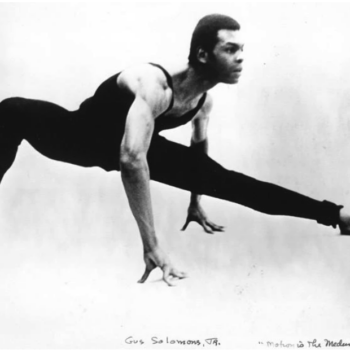
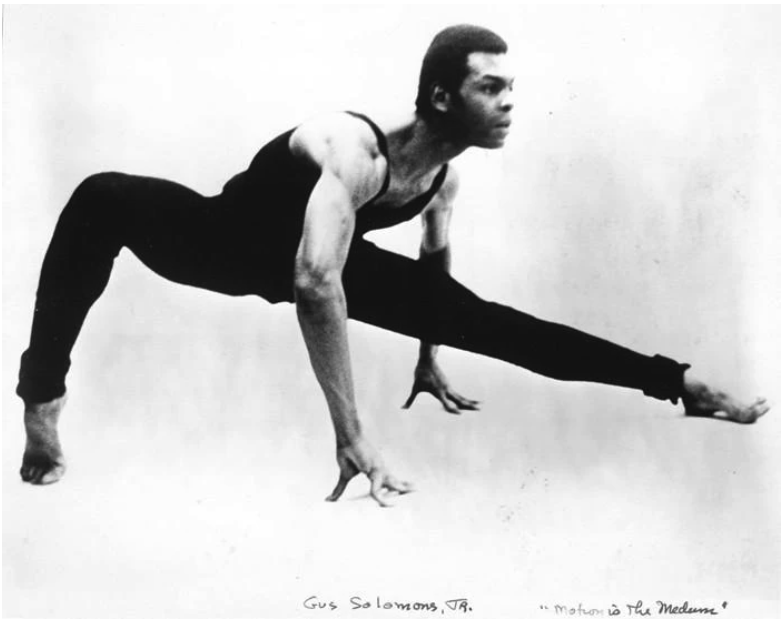
“Motion Is the Medium,” photographer unknown. @nypl

In the early 1960s Gus was part of a studio-sharing cooperative called Studio 9, with Elizabeth Keen, Phoebe Neville, Cliff Keuter, Elina Mooney, Kenneth King, and others. He attended some of the sessions in experimental dance-making that Robert Dunn led at the Cunningham Studio, and he enjoyed using chance method inspired by John Cage. But he was “too in love with technical dancing” to get involved in the pedestrian aesthetic of Judson Dance Theater, which emerged from Dunn’s workshops. Not to mention he was already getting paid gigs with more established companies.

Gus found his aesthetic home in the Merce Cunningham Dance Company, where he danced from 1965 to ’68. There he could just dance—leap, lunge, crawl, pivot, skitter, and extend his space-piercing legs. He originated roles in key Cunningham works: How to Pass Kick Fall and Run, RainForest, Place, Walkaround Time, and Scramble. After three years, a back injury forced him offstage temporarily. (For an excellent interview on his thoughts about Cunningham, see Mondays With Merce #14.)

In the late ’60s, Gus formed his own group, the Solomons Company/Dance, for which he choreographed more than 100 pieces. Taking an analytical approach, as per his architecture training, he made charts, designs, and diagrams and explored alternative spaces. Although many works had no music—or just the invited sounds of the audience coughing and rustling papers, as in Kinesia #5 (1967)—he sometimes collaborated with composers such as Mio Morales or Toby Twining. He embraced the new technology of video, creating an ingenious use of a dual screen for City/Motion/Space/Game in 1968 at WGBH-TV in Boston. His 1986 “interactive dance/sound/video system” titled CON/Text was performed at Just Above Midtown.

Randall Faxon, Doug Nielsen, Gus, and Santa Aloi. Solomons Company/Dance, 1973. Ph Joel Gordon.

Touring in the 1970s gave the Solomons Company/Dance full-time work. Many residencies, funded by the National Endowment for the Arts in conjunction with various artists-in-the-schools programs, required all company members to teach. The group became experts at adapting to all kinds of situations.

A watershed moment came in 1982, when Ishmael Houston-Jones brainstormed Parallels, a series for Black choreographers outside the Black mainstream of modern dance, at Danspace Project in downtown New York. Solomons, along with Ralph Lemon, Bebe Miller, Blondell Cummings, and Harry Sheppard, were invited to show their work. As Gus wrote for the 2012 reprise, he was glad to be included “instead of being criticized for not being ‘black enough’ as I often was back then.”

In 1996 Solomons founded Paradigm, a small group celebrating the artistry of older, seasoned dancers. The kickoff was A Thin Frost (1996), a trio Gus made for himself, Carmen de Lavallade, and Dudley Williams. This gem of a dance had moments of solemnity, wistfulness, and hilarity, where all three stars could revel in being themselves before finally reaching for a communal touch. Paradigm commissioned other choreographers, including Kate Weare, Robert Battle, Jonah Bokaer, and Wally Cardona. A glorious example of a guest work is Dwight Rhoden’s It All, for Solomons and de Lavallade. This was a moving, haunting duet to music by Björk, an excerpt of which, happily, is caught on video by Jacob’s Pillow.

Carmen de Lavallade and Gus in It All, by Dwight Rhoden for Paradigm, ph Marta Fodor via Ken Maldonado.

Solomons was a demanding but nurturing educator, teaching at UCLA, UC Santa Cruz, CalArts, Bard, and—for many years—NYU’s Tisch School of the Arts. His studio in Lower Manhattan was abuzz with his own classes as well as with rehearsals of dancers renting the space. In 2004, he received American Dance Festival’s Balasaraswati/Joy Ann Dewey Beinecke Endowed Chair for Distinguished Teaching. And the Bessie Awards honored him with Sustained Achievement in Choreography in 2013. The following year the Jerome Robbins Dance Division at the NY Public Library for the Performing Arts named him a Dance Research Fellow in its inaugural year.

Risa Jaroslow with Solomons, University Settlement, Lower East Side, 2000, ph Tom Brazil

Solomons has served as choreographic mentor at Dance New Amsterdam, The Ailey School, and NYU/Tisch and given informal advice to many others. He’s lent his performing self to younger choreographers, including Donald Byrd, Johannes Wieland, and John Heginbotham.

Always nimble with words, Solomons wrote reviews and features for Dance Magazine, as well as for the Village Voice, Ballet News, Attitude, andThe Chronicle of Higher Education. In recent years, he posted reviews and reflections on his own website, Solomons-Says.

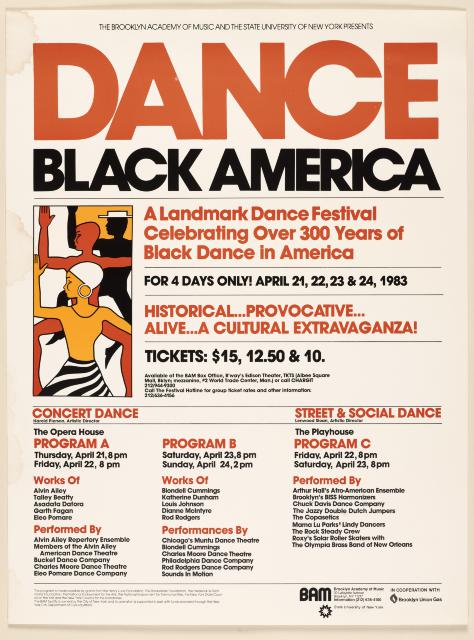
Poster, BAM Archives

He also used words to advocate for himself. In 1983, Gus was not invited to participate in Dance Black America, the historic gathering at Brooklyn Academy of Music. He felt slighted and wrote this letter to the planners:

I have spent twenty years making dances that stem from my honest experience and my perceptions of dance as an expression of energy-as-motion, not as a vehicle for the expression of racial anger or social oppression, which, fortunately do not happen to be part of my personal background. It saddens me to realize, if indeed it is the case, that my work is apparently being ignored by my Black colleagues because it refuses ethno-cultural categorizing. (Source: The Black Tradition in American Dance by Richard A. Long)

Because Gus’s contribution was so huge, I’ve asked a few dance artists who worked closely with him for their memories:

Gus and Doug Nielsen, Solomons Company/Dance, 1970s

Douglas Nielsen, member of Solomons Company/Dance, 1973–75, and friend for life

Gus was like a coffee pot that never stopped percolating. He was a source of infinite possibilities. Articulate to the core. He was a director with a purpose. Always prepared, and always in step with the times. His choreography was clear and nonnegotiable: ‘This is what it is. Now do it.’ He often showed it, physically, but he also had prepared a movement score on graph paper for reference.
Gus was a role model. I am 6’4”, and so was he. He taught me how to move fast in space. Not to music, but with an inner non-narrative motivation. We did a duet called Prance Dance (1974), with extremely fast footwork in unison. It was like a race against the clock. I still remember every bit of it. The challenge was to stay focused, be precise, and be in the moment. Gus never gave us notes after a performance. We knew what might’ve gone wrong, and we knew how to correct it.
Gus lived his professional life as a man free of labels. He never defined himself by race, gender, or sexual orientation. When I asked him about that, he simply said he was “oblivious.” Truly an original.

Gus with Margaret Jenkins, 1964.

Margaret Jenkins, artistic director, Margaret Jenkins Dance Company

Gus and I started working on simply this fondness in 1964. I had met him when he came to teach a workshop at UCLA. He said, “Come east and let’s work.” I did. His long legs and my long torso became the “subject” of the work—how to find the balance between the two. He pushed me to lean into risk. He taught me how to trust I would be caught. He was fierce in his demand. He was kind with his physical support. There was joy, aways joy, close by.


Larry Keigwin, Artistic director, Keigwin + Company; producer of the short film #sharethemattress—Gus Solomons jr.

Not only was Gus a mentor and friend, but he was also quick to dance for our camera when I asked him to participate in our video project Share The Mattress. It was a delightful and intimate afternoon. Gus gladly invited us into his bedroom and with cheer and vigor improvised for our camera. He didn’t need much direction….his physical instincts and dramatic intentions were spot on. Sensitive and self deprecating (in a good way) he kept us laughing with clever conversation and witty quips. It was pure joy.

Donald Byrd, Artistic director, Spectrum Dance Theater; member of Solomons Company/Dance, 1976–1978

What struck me about Gus was how thin he was, how long his limbs were, and that he was Black in what was often a very “white” context. I felt an affinity. The performance I saw, around 1973 at MIT, was enthralling. While Ailey’s work, which I was also enraptured by, struck me as heart and passion, Gus and his Cunningham-like vocabulary and odd organizing principles seemed to be a very different way of being Black. Its physicality was based on a subtle and ongoing interaction between body and mind, and an unapologetic assertion of the possibility that Blackness could be odd, astringent, and care little for respectability. I saw myself in him. And to some degree I still do.

Michael Blake and Gus in Idyll by Kate Weare for Paradigm, ph Christopher Duggan.

Michael Blake, Faculty member, University of Missouri, Kansas City; former member of Paradigm

Puzzles. To work with Gus was a puzzle from the day you committed until the day you completed the task. He would give you a map in words or on paper and say, “Make steps!” I loved that! I loved hearing his voice say that, too! That map was confusing, complex, challenging, and in the end, beautiful to look at and perform. Gus challenged my brain as well as my body and my nervous system.

Courtney Escoyne, senior editor at Dance Magazine; former NYU Tisch student

Gus fundamentally altered the way I look at and talk about dance. Responding to our peers’ movement studies week to week always started in the same way: Gus projecting his warm, resonant voice to ask us, “Now, what did you see?” It was an invitation to not leap immediately to judgments of good or not good, whether what we’d seen was to our taste or not, and instead to analyze what had actually unfolded and what we had taken from it. The word ‘like’ was banned from the room. If we wanted to express appreciation, we had to specify if we were intrigued, moved, made curious. He encouraged us to do the same thing when we attended performances, and reliably listened to, questioned, and supported our conclusions about what did and didn’t work. When he offered his own observations, it was invariably with wit, wisdom, and kindness—and more often than not opened up new angles we hadn’t considered.
A decade later, every time I sit at a keyboard to write about a performance or draw breath to give feedback to a peer, it’s still his voice that I hear first, asking not whether I had liked it, but what I had seen.

In his studio, ph by Jayme Thornton for Dance Magazine, 2022.

¶¶Quotes from Gus’s lips or pen¶¶

¶ On Cunningham technique: “Since the dancing was not ‘about’ anything but the movement itself, absolute clarity was quintessential to its full expression, and you couldn’t mask a wobble with a dramatic flourish.” Dance Magazine, November 2007, “Technique: Move Your feet! Merce Cunningham Technique.”

“In my early preteens… I was practicing a move I had seen Donald O’Connor do…and I flipped backwards off the couch and broke a window in our living room. I wasn’t hurt, but I was punished…because I was dancing!” (Source: Sharon Kinney’s documentary on the first “From the Horse’s Mouth” in 1998, now in posted on Facebook.)

¶ “Studying with Merce Cunningham, learning to dance from stillness, was giving me technical control rather than sheer muscle power, on which I’d been dancing until then.” (Source: Reinventing Dance in the 1960s: Everything Was Possible, ed. Sally Banes)

¶ “When I was in the world of Martha Graham, I was clinging to the world of Merce Cunningham.” (Source: “Choreography in Focus,” 2016)

¶ “I try to write reviews that are both engaging to the readers and instructive to the creators, while respecting the integrity of their efforts—however effective or not they turn out to be.” (Source: “Meet the Press” panel, Dance/NYC, 2012, quoted by me in “A Debate on Snark,” collected in Through the Eyes of a Dancer: Wendy Perron, Selected Writings)

Paradigm, with Gus, Valda Setterfield, Dudley Williams, ph Tom Caravaglia.

¶ “Paradigm…has reconfirmed my original naive conviction that dance can be a life-long vocation. Age need not be a limitation; it is a resource of life experience and dance craft that enriches performance beyond technical virtuosity.” (Source: AlumWeb Open Door Archive)

¶ “I’m dancing on momentum now. You can do more on momentum than on muscles.” (Source: “Moving Joyfully and Carefully into Old Age,” New York Times, April 2, 2000)

Solomons, ph Tom Caravaglia

¶ How to watch a Cunningham work: “The idea is to let the movement enter your consciousness without hierarchy and respond to it in that way. And then your experience, your culture, and your needs at the moment will create a hierarchy for you.” (Source: Mondays With Merce, #14, interviewed by Nancy Dalva)

¶ “As I got less depressed…I started involving my dancers more—my dancers’ input into the work—which became a much more fulfilling way to make work.” (Source: Mondays With Merce, #14)

¶ “Architecture and dancing are exactly the same. You design using all the same elements — time, space and structure — except that in dance, time is not fixed.” (Source: Cambridge Black History Project)

¶ About A Thin Frost, his first choreography for Paradigm: “It would change every [night]. Every time we’d come offstage, Carmen would say, ‘Well, who were we tonight? That never happened before!’” (Source: “From the Horse’s Mouth” Celebration of Gus Solomons, Interview with me, 2016, long version)

¶ Advice for making dances: “When I watch a dance I don’t want to be able to check out and do my emails. Keep me interested. Keep giving me new information. Take me on a journey. When I finish watching your piece, I want to be in a completely different place than when I started.” (Source: “From the Horse’s Mouth” Celebration of Gus Solomons, Interview with me, 2016, long version)

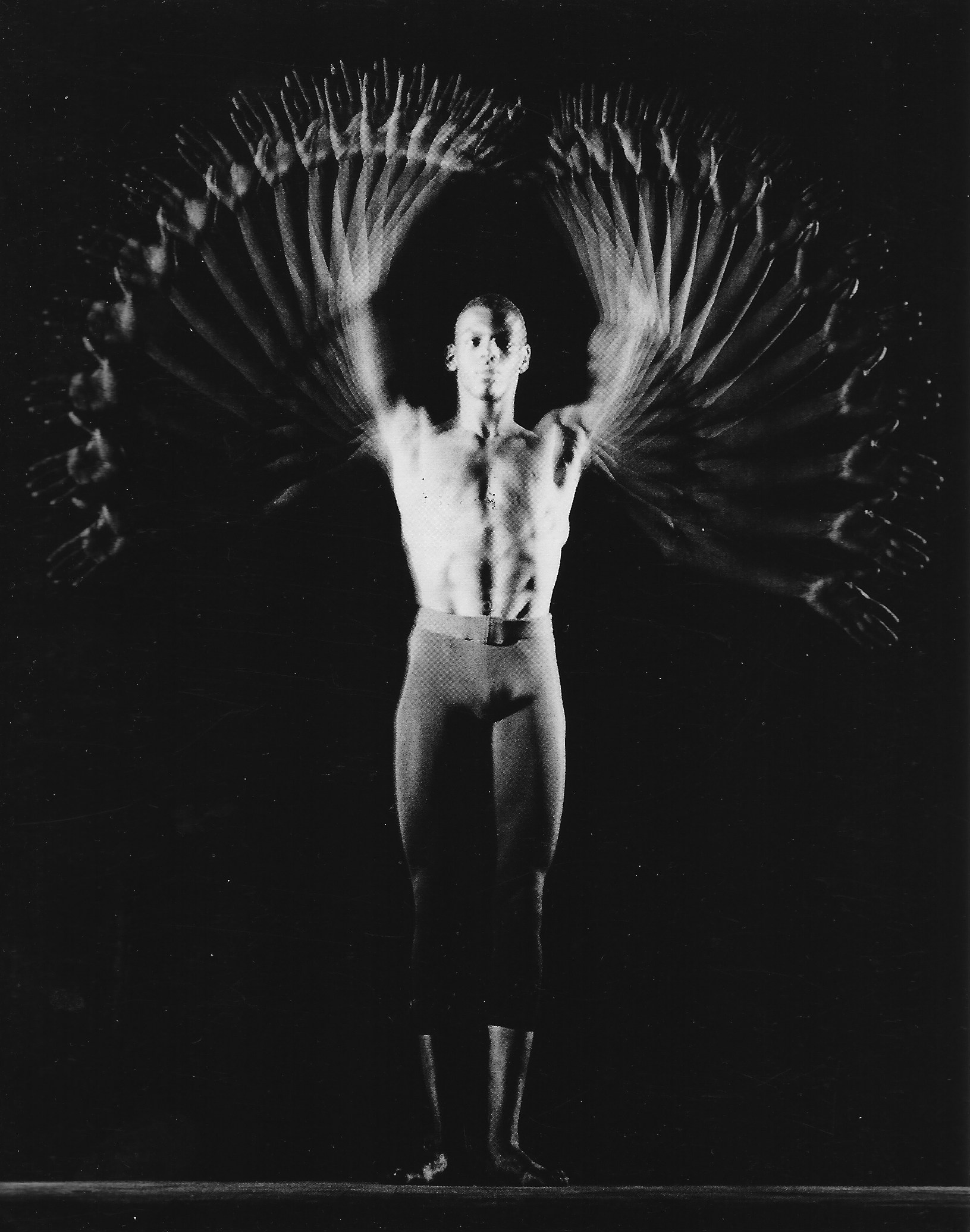
Photographed by MIT electrical engineering professor Harold Edgerton with stroboscopic camera, 1960.

The Gus Solomons Papers are held at the Jerome Robbins Dance Division of The New York Public Library for the Performing Arts.

Last(ing) memory: I visited Gus at Mt. Sinai Morningside Hospital on July 25. He looked vibrant to me, so I did not think this would be the last time I’d see him. When I was leaving, Gus (usually so unsentimental) took my hand and kissed it.


Like this Featured In Memoriam 3

Sally Banes (1950–2020)

Courtesy Wesleyan University Press

The brilliant dance critic and historian Sally Banes, who pioneered a new way to write about dance as a social phenomenon, died on June 14, 2020, in Philadelphia. Her husband, Noel Carroll, said the cause was ovarian cancer.

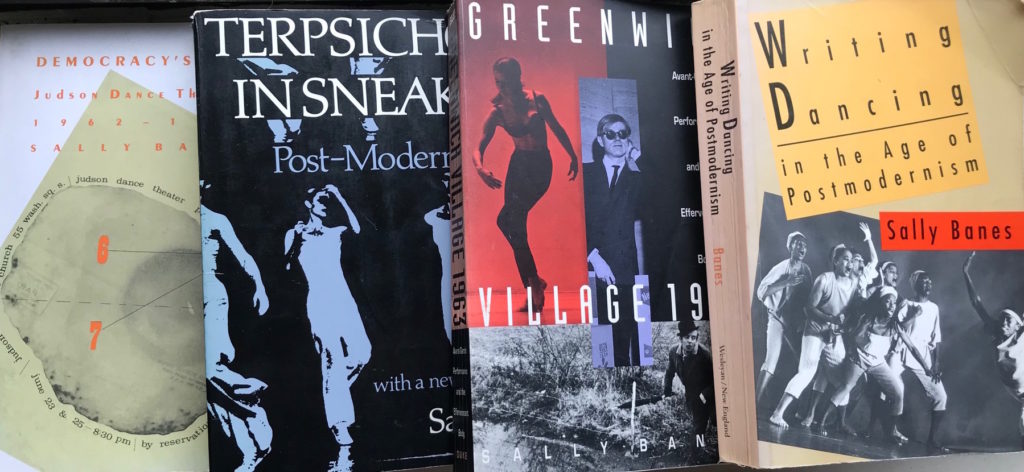
Banes visited New York in October 1973 with a standard assignment: to write a book on modern dance for Chicago Review Press. Because of her curiosity about choreography, instinct for the experimental, and scintillating prose, she produced, in 1980, one of the most essential dance books of the twentieth century: Terpsichore in Sneakers: Post-modern Dance.

Shifting her attention from SoHo to the Bronx, Banes was the first dance critic to write about the exciting new urban form known as break dancing. Her article “To the Beat Y’All: Breaking is Hard to Do,” in the Village Voice in April 1981, introduced break dancing to readers before there was even a name for hip-hop culture. Fascinated by what she saw, she returned to this genre again and again.

Although these were her two favorite subjects—the (largely white) avant-garde and (largely black) urban dance—she investigated many other passions over time. In seven additional books on dance and a myriad of essays, she explored subjects ranging from the influence of black dance on Balanchine, to the drunk dances of Fred Astaire, to the Russianness of Firebird, to the knotty problem of appropriation. She held a string of college teaching-and-research positions and earned several lifetime achievement awards. She’s been a leader in the burgeoning field of dance studies, challenging her peers to rise to her level of intellectual rigor paired with vibrant prose.

Banes grew up in Silver Spring, MD, taking ballet lessons in nearby Washington, DC. She attended the University of Chicago, where she participated as a script writer and performer in a group called The Collective. She graduated in 1972 with an interdisciplinary degree in criticism, art, and theater. The following year she started writing criticism for the Chicago Reader and became its dance editor while also writing book reviews for the Chicago Daily News. During the same period, she founded the Community Discount Players, which she called “a motley collection of performers, dancers, and wizards.” She created performances that were part dance, part theater, part every-day happening. In 1974 she participated in the creation of Meredith Monk’s Chacon at an Oberlin residency. That same year, she was a co-founder of MoMing Dance and Arts Center, which was a collective as well as a presenter. She performed there with New York choreographer Kenneth King. According to dancer Carter Frank, “Without her guiding light and her enthusiasm, MoMing would not have made such a mark in Chicago. It was where I got to see people whom I had only read about in the Village Voice and it was like getting a drink of cool water in the desert.” It was at MoMing, after a 1975 performance of the improvisational group Grand Union, that she met her future husband, philosopher and critic Noel Carroll.

Collaboration with Ellen Mazer: “A Day in the Life of the Mind, Part 2,” 1975, The University of Chicago, ph Frank Gruber

Banes and Carroll moved to New York in 1976. She took class at the schools of Graham and Cunningham and the downtown Construction Company, and workshops with Simone Forti. She performed in Forti’s large improvisatory group work, Planet (1976) at P.S. 1 in Queens. (Forti was a lion, Pooh Kaye a bear, and Banes an elephant.)

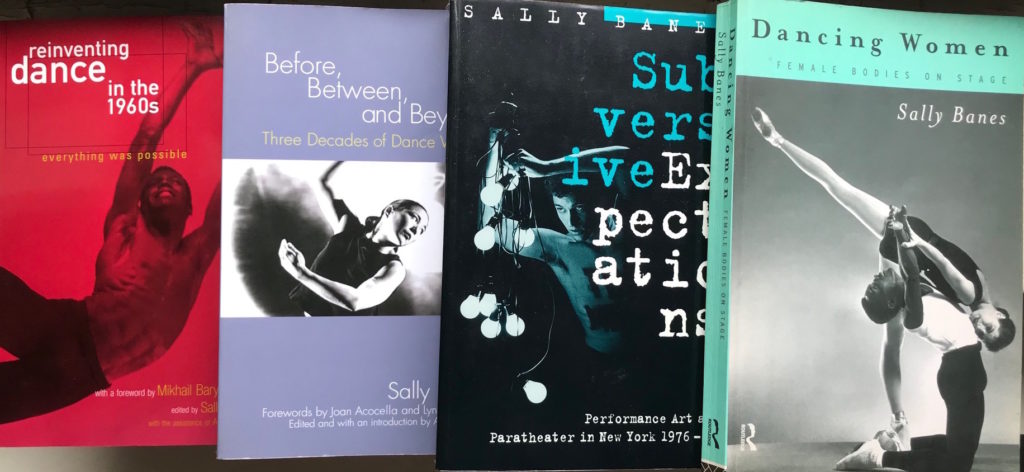
The “Concepts in Performance” page of the SoHo Weekly News was the first to review the new boundary-crossing performances that defied the categories of dance, theater, poetry, or visual art—before the term performance art was coined. Banes wrote for this page from 1976 to 1980, becoming editor the last two years. She was given her own column called “Performance” in the Village Voice from 1980 to ’85, where she reviewed major artists like Meredith Monk, Robert Wilson, and Laurie Anderson. She also reviewed singular performers before they became big names like Whoopi Goldberg (“careening from bathos to pathos”), Steve Buscemi (“like a human rubber band”), Eric Bogosian (“a raw, cognitive screech”), and Karen Finley (“this messy scabrous conduct exhilarated us”). These reviews are reprinted in Subversive Expectations: Performance Art and Paratheater in New York 1976–1985 (1998).

Banes adopted, in her own words, a stance of “knowing innocence” and a “sense of wonder.” She wasn’t wowed by mere virtuosity but was attracted to the questions posed by the mind/body of an enquiring artist. Whether she was writing in Dance Magazine or Dance Chronicle, she situated every artist in a social context. Her prose was informal, witty, and spontaneous, and she could paint a picture in words that was as startling as the performers themselves.

Sally wore her socialist feminism on her sleeve; she never tried to be “objective.” Reading her words, you got a strong sense of her presence at the performance. She was in line with the Duchampian idea that each work of art was not complete until the audience experienced it.

For Judson choreographers like David Gordon, Trisha Brown, and Steve Paxton who appeared in Terpsichore, and for break dancers like the Rock Steady crew, she was a staunch advocate. She took her advocacy further when, in 1978, she decided that Yvonne Rainer’s solo Trio A from 1966 had to be preserved. Although most critics were indifferent or worse—Clive Barnes labeled it a “total disaster” in The New York Times—Sally regarded this not-quite-five-minute sequence an exemplar of post-modern dance. Rainer agreed to re-perform it for the camera, even though by then she was a filmmaker who hadn’t danced in years. Originally a trio section of The Mind Is a Muscle, Trio A embodied all of Rainer’s studied defiance: odd, unmusical phrasing; looking away from the audience; eschewing repetitions that would make for a legible structure. Trio A has become a symbol of, or gateway to, postmodern dance—which probably wouldn’t have happened if Sally had not filmed it.

In 1980 Banes earned a PhD from the Department of Graduate Drama at NYU, later named the Department of Performance Studies. In 1983, Banes turned her dissertation on Judson Dance Theater into a book, Democracy’s Body: Judson Dance Theater 1962–1964, reprinted by Duke University Press in 1993. She framed the unruly Judson collective as democracy itself. This book has been the touchstone—or target—for younger scholars seeking to make their mark in contemporary dance.

In 1983, photo: WP

Making the shift from journalism to academia, she edited the scholarly Dance Research Journal from 1982 to 1988. There was a period of cross-fade when she was writing less journalism and more academic essays. Whether journalistic or academic, Banes’s writing possessed both intellectual heft and sensuous description.

Still invested in the sixties, she took the densest year of Judson, 1963, and expanded her research into the political, social and artistic activity during that time. Greenwich Village 1963: Avant-Garde Performance and the Effervescent Body, published in 1993, describes the intersecting constellations of Andy Warhol, jazz musicians, underground film, avant-garde playwrights, beat poets, and Bread and Puppet Theater.

In Writing Dancing in the Age of Post-Modernism, her 1994 collection, Banes conflates “the avant-garde, the popular, the commercial, and the vernacular.” Her interests range from post-Judson choreographers Bill T. Jones and Molissa Fenley, to emerging Latino choreographers, to, of course, break dancing. In Dancing Women: Female Bodies on Stage (1998), she brings a feminist angle to women’s roles in the canon of dance from Romantic ballet to recent modern dance.

Sally was a radiant person, bursting with life. Her enthusiasms were contagious and her knowledge was vast. She championed artists from Yvonne Rainer to Urban Bush Women, Merce Cunningham to Tim Miller. She delved into historical pockets that aren’t in “the canon,” like Ballet Suédois of the 1920s and the leftist Workers Dance League in the 1930s. On the advice of dance historian Selma Jeanne Cohen, she started studying Russian and quickly developed an interest in Soviet experimental choreographers of the 1920s.

Banes’ college teaching career began in 1980 at Florida State University. From 1981 to 86 she taught at SUNY Purchase, followed by two years at Wesleyan University, then three at Cornell. In 1991 she became associate professor of dance and theater at University of Wisconsin Madison, and chair of the dance program from 1992 to ’96, when she was named the Marian Hannah Winter Professor of Theater History and Dance Studies.

Lori Brungard, a faculty member in Hunter College’s dance department, studied with Banes at SUNY Purchase in the mid-1980s. “With her big coke-bottle glasses and her lisp and her energy in what she was talking about,” Brungard recalled, “I wouldn’t expect to be engaged by this person but I was. She was like wooo! but still focused. She had this phosphorescence, a glow. Light emanated from her and she induced a light in me.” Brungard felt enriched by what Banes was teaching: “One bridge she made was the connection to the African diaspora. She was excited about Robert Farris Thompson’s ideas and she inspired me to read African Art in Motion after her course was over.”

Banes suffered an incapacitating stroke in 2002. Her last collection, Before, Between, and Beyond: Three Decades of Dance Writing was compiled and edited by her then-assistant Andrea Harris. It has two forewords that sum up Banes’s prodigious output, one by historian Lynn Garafola, and the other by New Yorker critic Joan Acocella.

Garafola: “By the 1990s the hip, young critic of the mid-1970s had become a hip, mature academic. Yet . . . she continues to write in plain English. Her sentences move across the page with energy, and for all her interest in ideas, she still wants the reader . . . to see the movement and experience it imaginatively…More than any other critic or scholar of dance, she belongs to her time, writing with the voice of the Zeitgeist.”

Acocella: “Underneath it all…is an anarchic spirit, walking on the wild side. And joined to it is exactly what one needs with it: scholarship, moderation, wisdom.”

There aren’t many traces of Banes in person on the internet, but Walker Art Center posted this wonderful conversation between her and Yvonne Rainer in 2001. The occasion was Baryshnikov’s PastForward project, which gathered several of the Terpsichore artists together for a tour.

For her naming and framing of new forms, and for the breadth and depth of her writing about dance as part of a complex world, Banes garnered lifetime achievement awards from the Congress on Research in Dance, the Society of Dance History Scholars, and the New York Dance and Performance Awards (the Bessies). When Terpsichore was translated into French by Denise Luccioni, it won the prize for the best dance book of 2003 in France.

Brungard says, “When I read her now, I hear her voice coming through the page, I hear her excitement behind the words. I have that same sense of inspiration I had when she was my teacher. I’m glad her personal voice comes through in her writing because it’s a way that people can have her as a teacher now.”

There is another way her teaching lives on: choreographer Li Chiao-Ping, a protegée of Sally’s at University of Wisconsin, has just been awarded a named professorship and has chosen to be named the Sally Banes Professor of Dance.

Here are a few of the 51 comments from dance scholar Mark Franko’s Facebook page after he announced that Banes was in hospice care:

Millicent Hodson: “Sally was the star journalist of her time in Soho NYC & a generous colleague.”

Dena Davida: “She will be leaving us with an epic body of insightful and radiant texts about our dance world.”

Jennifer Fisher: “Such a beautiful writer, and her work retains relevance over time.”

Donald Byrd: “Sorry to hear this news. I admire her.”

Ginnine Cocuzza: “Bright flame.”

¶¶¶

Disclosure: Sally and I were friends and colleagues. She conferred with me when writing Terpsichore; I invited her to write for SoHo Weekly News when I was editor of its “Concepts in Performance” page. After I handed the editorship of “Concepts” off to her in 1978, she edited my reviews. She wrote about my choreography a couple times, and I invited her to be part of my Bennington College Judson Project while she was writing her dissertation on Judson Dance Theater. I was in her performance piece-in-progress, Sophie Heightens the Contradictions in 1983, in which I played Sophie, a young Communist ballet dancer at the time of the Paris commune. And Sally appeared in a video for my performance Standard Deviation in 1984. I contributed to Reinventing Dance in the 1960s: Everything Was Possible (2003), the collection of personal reminiscences she edited.

¶¶¶


1 person likes this Featured In Memoriam 12

Arthur Mitchell (1934–2018)

I wrote this obit for The Guardian, U.S. edition of September 21, 2018.

Arthur Mitchell, ph Martha Swope © Billy Rose Collection, Library for the Performing Arts

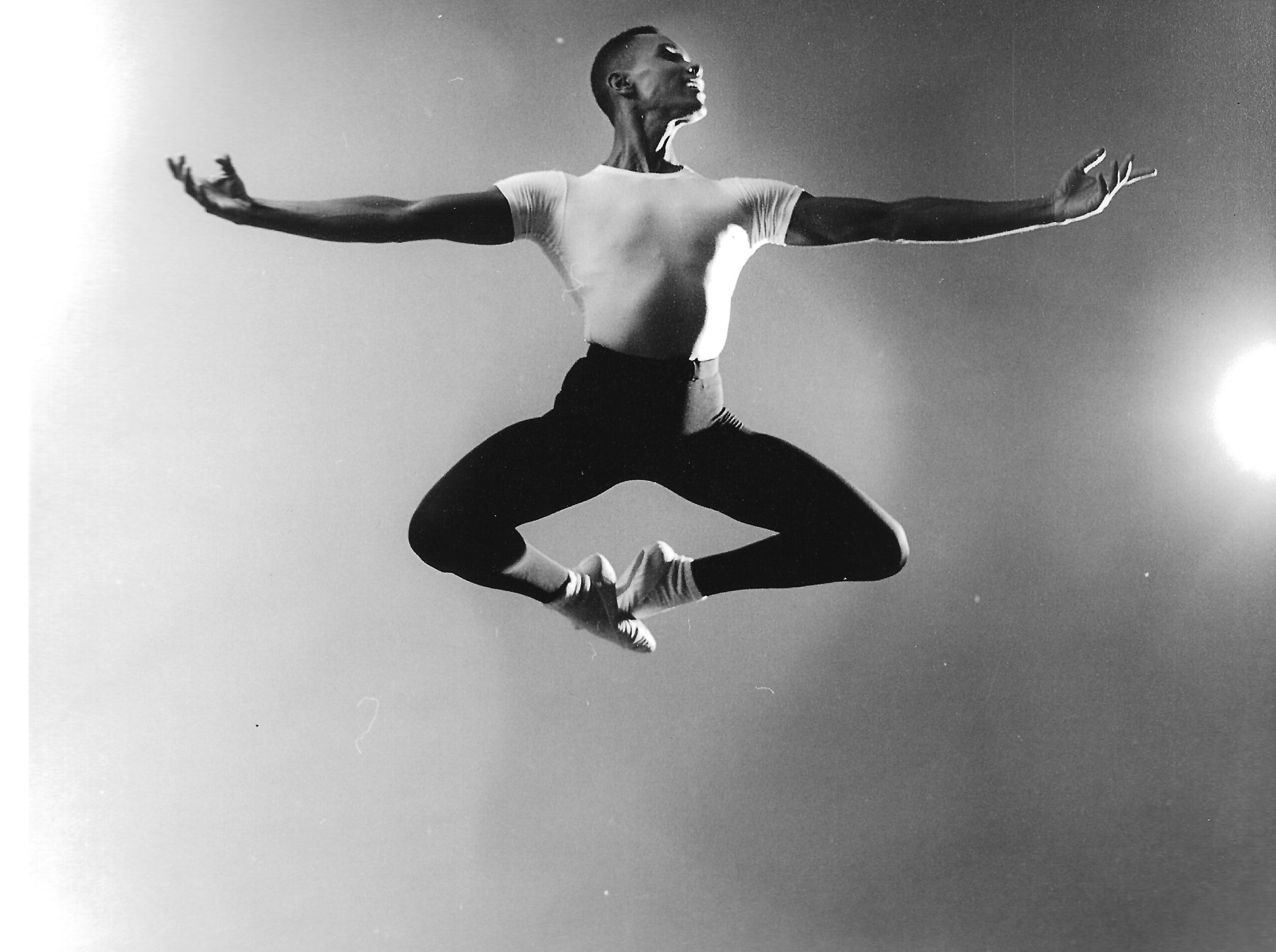
A star of New York City Ballet and the co-founder of Dance Theatre of Harlem, Arthur Mitchell was also the first African American principal dancer in any major ballet company. Mitchell, who has died, aged 84, had classical lines, buoyant energy, and a palpable joy in movement.

In NYCB, where he danced from 1955 to 1968, he gained renown for two roles he created: the startlingly modernist Agon pas de deux, choreographed for him and Diana Adams by George Balanchine, and the mischievously bounding Puck in Balanchine’s A Midsummer Night’s Dream. According to his fellow NYCB dancer Jacques d’Amboise, “every time we toured Europe, he was a sensation … There would be hundreds of fans at the stage door.”

Mitchell and Balanchine in rehersal, ph Martha Swope

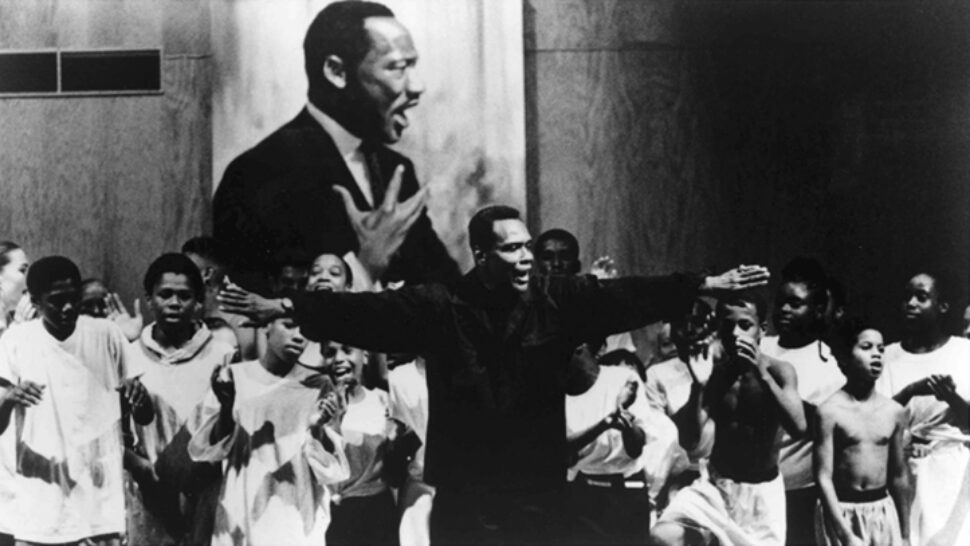
After Martin Luther King Jr. was assassinated in 1968, Mitchell had his own dream, which was to form a top-notch ballet company that would shatter the myth that black bodies were not “right” for ballet. In a garage lent by the Harlem School of the Arts and with the support of his mentor Karel Shook (artistic director of Dutch National Ballet), he started a school. They left the doors open to attract young people from the street. To entice the boys there, Mitchell compared ballet to basketball, hired drummers instead of pianists to accompany the class, and allowed them to wear jeans. Within four months, Dance Theatre of Harlem school had 800 students, and the professional company debuted in 1971 at the Guggenheim Museum. It thrived for more than three decades, becoming one of the most sought-after dance companies in the world.


With students i front of mural of MLK, ph Sharon Perry

Mitchell was born in Harlem. His father, Arthur Mitchell Sr., was a janitor, and his mother, Willie Mae (nee Hearns), raised their five children. From the age of 12, Arthur helped support his family by shining shoes and delivering newspapers. He started singing at the local Police Athletic League, a youth programme run by US police departments, and tap dancing in neighbourhood studios. A guidance counsellor spotted him dancing at a junior high school party and suggested he audition for the High School of Performing Arts (now the Fiorello LaGuardia High School).

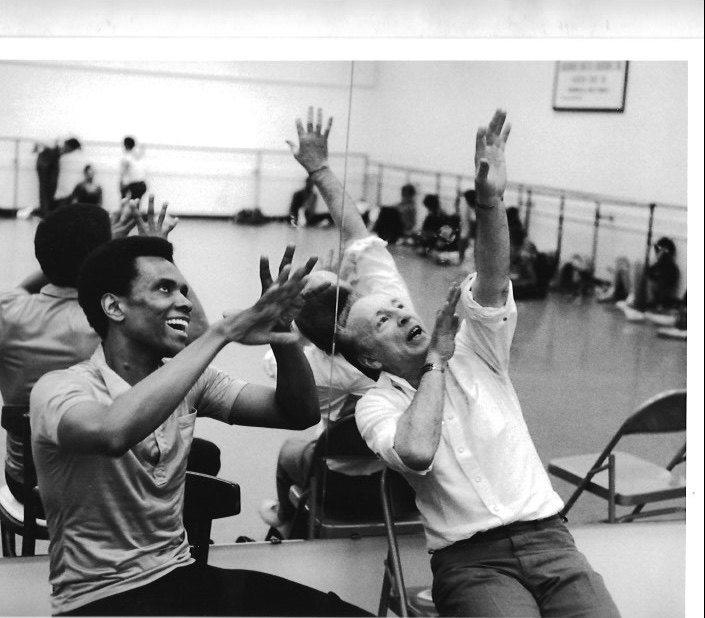
After graduating from LaGuardia in 1952, he won a scholarship to the School of American Ballet, the training ground for Balanchine’s New York City Ballet. He danced with John Butler Dance Theater and with the modern choreographers Sophie MaslowAnna Sokolow and Donald McKayle before joining NYCB. While still in the corps, he stepped in for d’Amboise in Balanchine’s Western Symphony. As Puck, he brightened the entire stage with his devious bounding. For Agon, he had no problem with Stravinsky’s atonal music. “Because I can tap dance, I can always find the pulse,” he said.

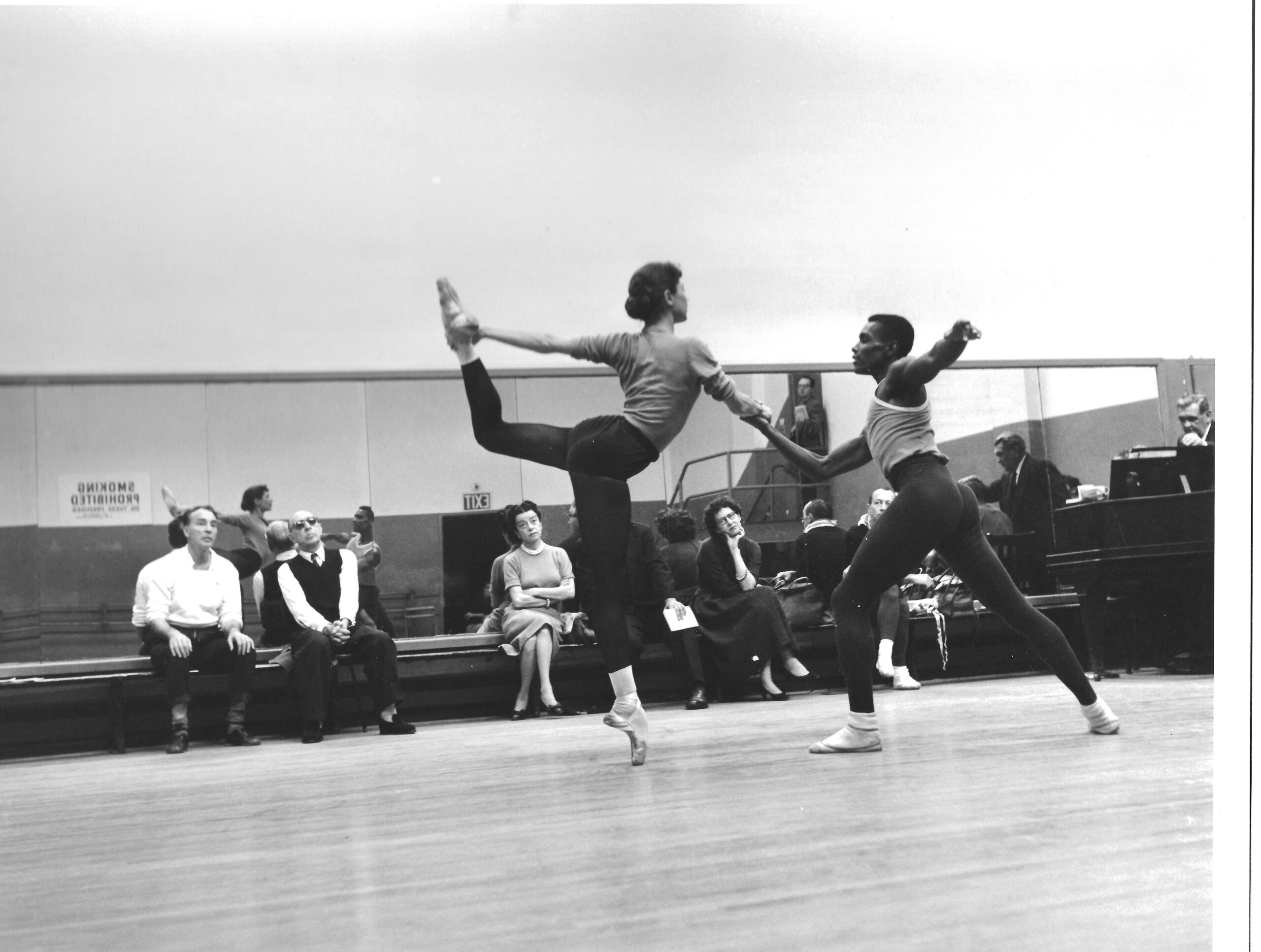
Diana Adams and Mitchell rehearsing Agon, , with Balanchine and Stravinsky looking on, ph Swope @Billy Rose Collection

Mitchell praised Balanchine for having an African American man dance with white ballerinas in the time of civil rights. He was very aware of the potential controversy of the central pas de deux in Agon. The man manipulates the woman in ways that bring their bodies into unusual points of contact. “He used our skin tones as part of the choreography,” Mitchell said. “Like where I have my arm, or how I would take her foot.” However angular the choreography, Mitchell, who was promoted to soloist in 1958 and principal in 1962, always presented his ballerina graciously.

Allegra Kent and Mitchell in Balanchine’s Agon. PC Fritz Peyer

The ballerina Allegra Kent, who partnered Mitchell in Agon during an NYCB tour of the Soviet Union in 1962, recalled how “the audience went wild” during their performance. She said: “Arthur was a superb partner. His musicality and stagecraft enhanced the choreography and made his partner look great.”

As co-founder and artistic director of DTH, Mitchell did not perform on stage, but his infectious energy made his mission come alive for those around him. One of his innovations was to replace pink tights and pointe shoes with those dyed to match each dancer’s skin colour, aligning the aesthetic with the Black Is Beautiful movement.

Balanchine supported the enterprise by giving his ballets gratis, including Agon, Concerto Barocco, Prodigal Son and Bugaku. However it was Geoffrey Holder’s Dougla (1974) that brought the house down. With its festive costumes, extreme technique and Trinidadian blend of African and Hindu traditions, Dougla concluded each programme with a gloriously giddy celebration. When the company debuted at Sadler’s Wells, London, in 1974, Mary Clarke wrote in the Guardian: “The company is irresistible. Young, fresh, still excited about the pleasures of the physical movement, they move with ease from the most demanding choreography of George Balanchine to the classical capers of Le Corsaire.”

Dougla by Geoffrey Holder, with Da’von Doane aloft, Ph Rachel Neville

In addition to Holder, Mitchell commissioned ballets by John Butler, John Taras and Talley Beatty, and choreographed a few of his own. He also mounted an evening of works by Bronislava Nijinska.

Sir Frederic Franklin, of Ballet Russe de Monte Carlo fame, staged Swan Lake and Valerie Bettis’s A Streetcar Named Desire for DTH. But it was his Creole Giselle that established the group’s ability to weave magic into a full-length romantic ballet. Mitchell set the ballet in the Louisiana bayou, and Franklin, who later became artistic adviser of DTH, staged it with traditional steps, but changed the harvest from grapes to sugar cane. When it premiered at the London Coliseum in 1984, Creole Giselle received the Olivier award for the most outstanding dance production of the year. It was broadcast on US public television in 1987.

Giselle with Virginia Johnson and Eddie Shellman, 1984, ph Leslie Spatt

In 1992 DTH was invited to perform in South Africa. Mitchell was reluctant, but Nelson Mandela called him and persuaded him that the young people needed inspiration. The company made the trip and performed for newly integrated audiences. Mitchell’s experiences teaching children in the townships inspired him to start the Dancing Through Barriers outreach programme at DTH.

Plagued by financial difficulties in 2004, DTH took a break. Mitchell named Virginia Johnson artistic director in 2009 but the company did not resume full operation until 2012. It celebrates its 50th anniversary this season.

Mitchell’s awards include a National Medal of Arts, a Kennedy Center Honor, and a MacArthur “genius award”. Earlier this year, Arthur Mitchell: Harlem’s Ballet Trailblazer, a show celebrating his life and work, was held at the Wallach Art Gallery, Columbia University. (See my “What Wendy’s Watching” video preview of that exhibit here.)

He is survived by a niece.


Like this In Memoriam Uncategorized Leave a comment